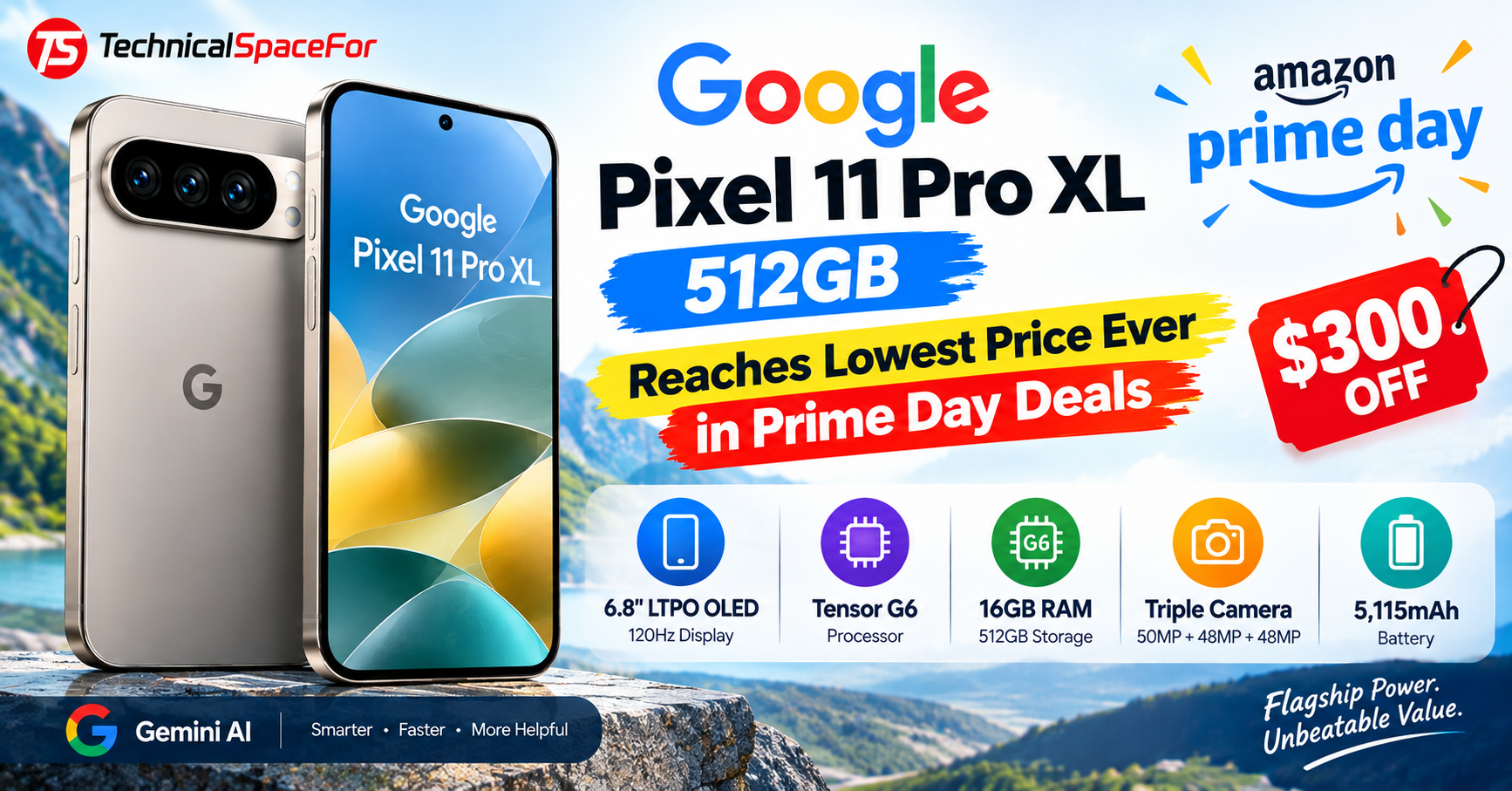
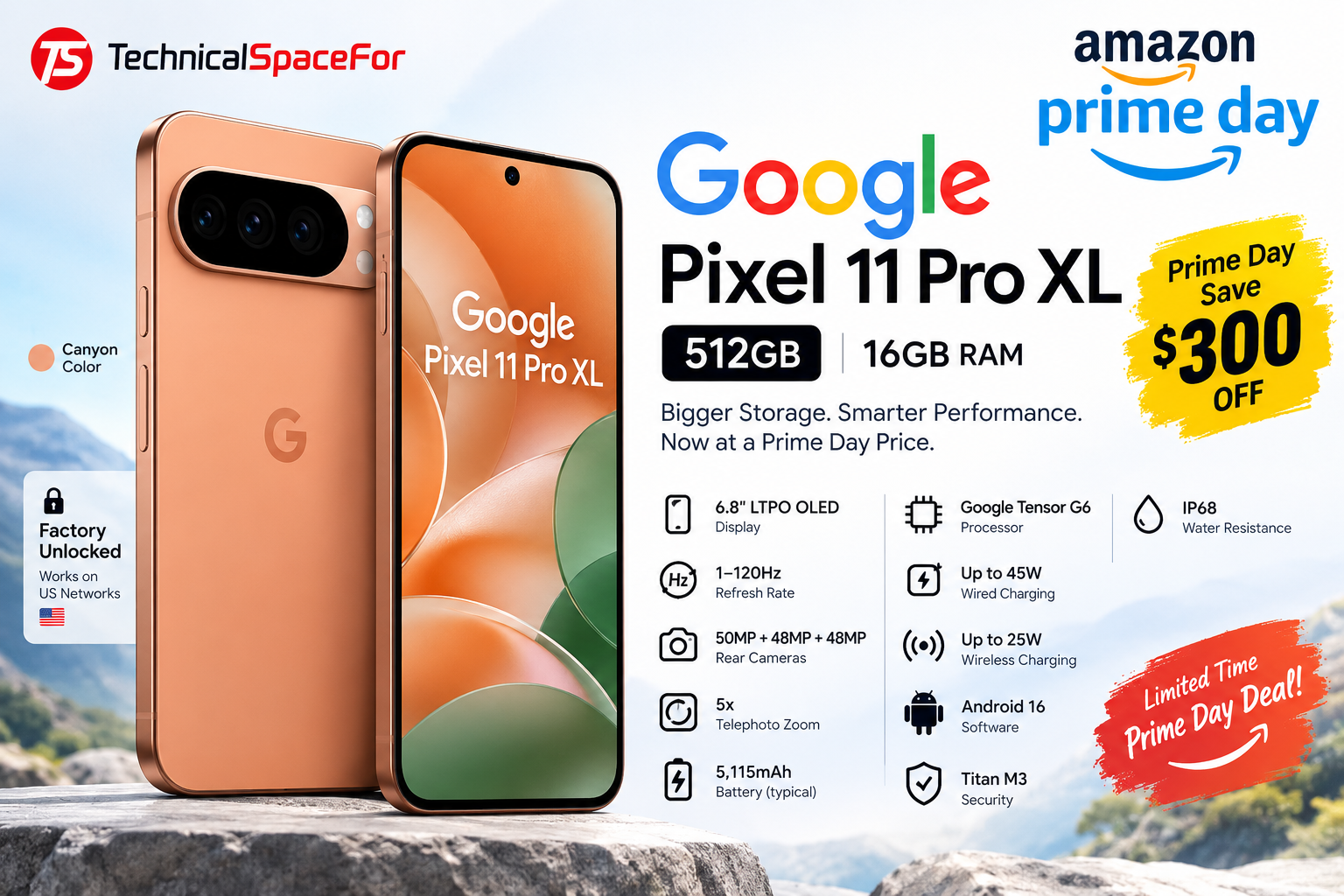
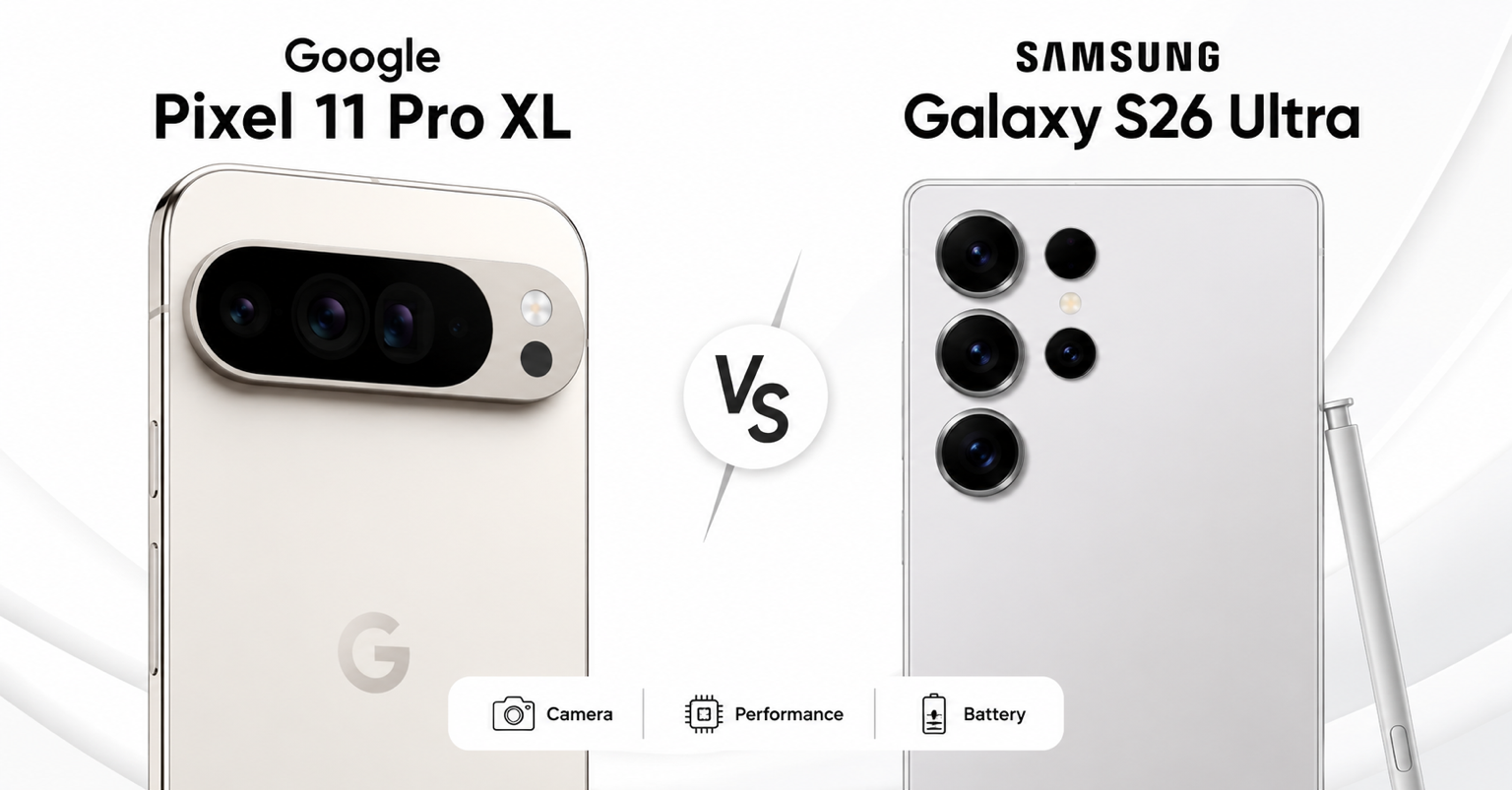
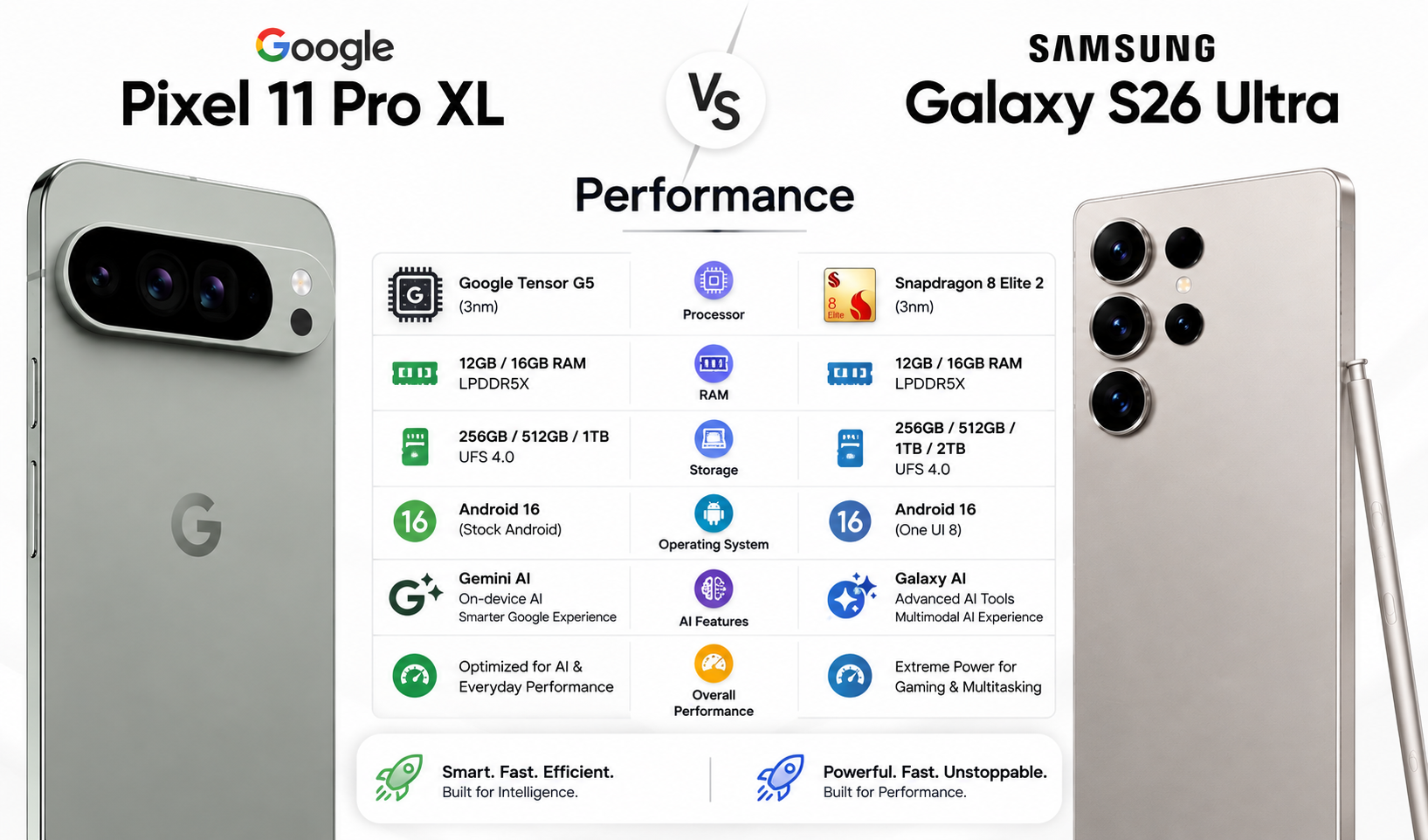
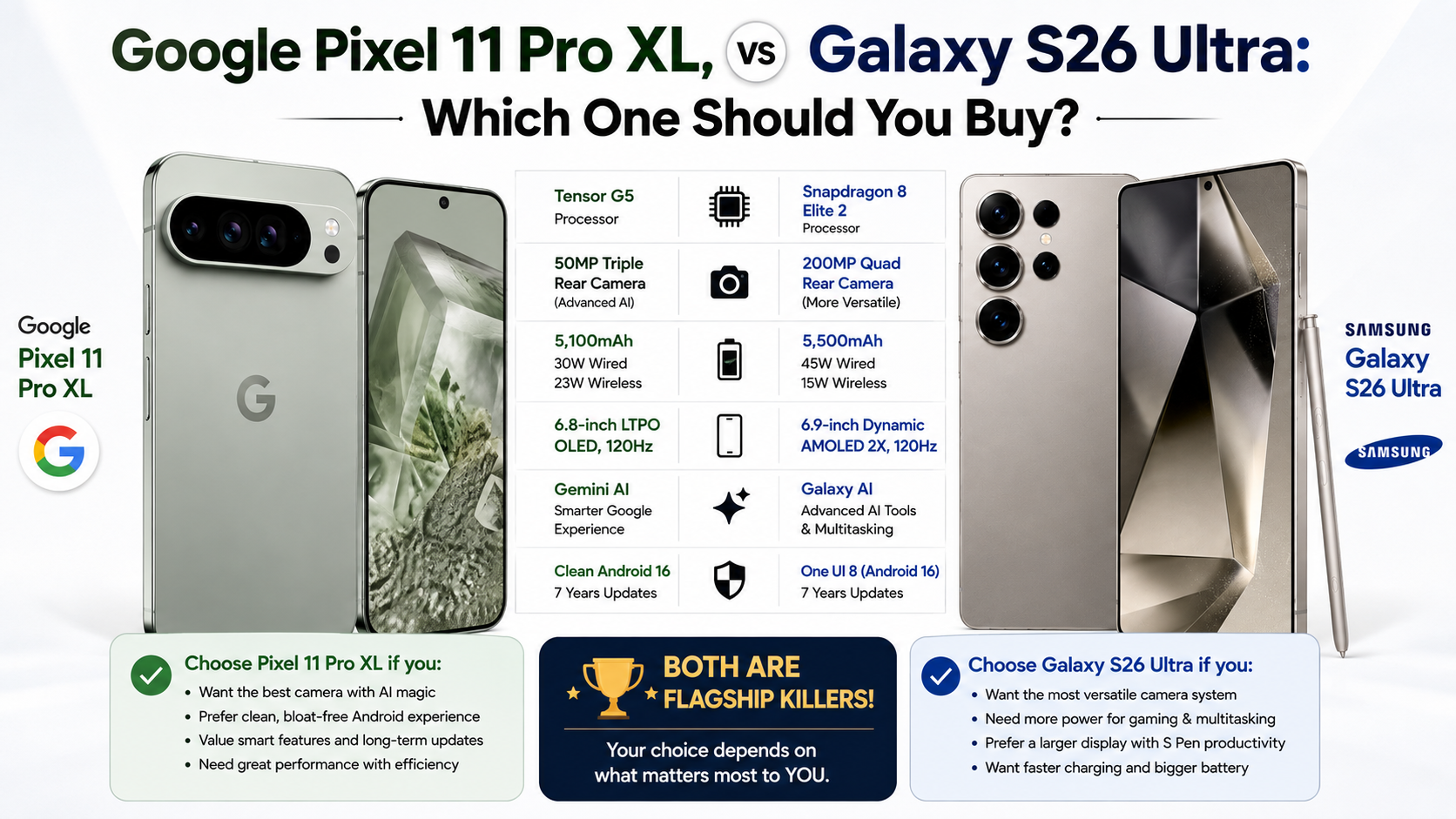
Among the most impressive deals during Prime Day for smartphones is theGoogle Pixel 11 Pro XL 512GB, whereby the unlocked Canyon model enjoys a reduction of $300. This deal will make the device more attractive for people looking to buy a high-end Android smartphone with massive storage capacity the Pixel 11 Pro XL has an OLED display of 6.8 inches with an adaptive refresh rate that offers a smooth scrolling experience. The smartphone also has 16 GB of RAM for heavy multitasking the Tensor G6 chipset from google drives the phone and the three-camera setup targets photography enthusiasts and videographers. The other great feature is the huge 5,115mAh class battery that will give this device all-day power endurance along with its 512GB of internal storage space, ensuring that this smartphone is loaded with enough room for photos, videos, applications and files. As a result, the Pixel 11 Pro XL 512GB is an especially compelling option at a cost of $300 off due to the Prime Day offer, for consumers who seek the flagship Google experience.
Google Pixel 11 Pro XL 512GB Amazon Prime Day Sale
Google Pixel 11 Pro XL 512GB with $300 Prime Day savings.
Model of the Discount is Google Pixel 11 Pro XL with 512GB storage and Canyon color and Factory Unlocked model working on US networks.
Feature
Details
Phone
Google Pixel 11 Pro XL
Storage
512GB
RAM
16GB
Processor
Google Tensor G6
Display
6.8-inch LTPO OLED
Refresh Rate
1–120Hz
Rear Cameras
50MP + 48MP + 48MP
Telephoto
5x optical zoom
Battery
5,115mAh typical
Wired Charging
Up to 45W
Wireless Charging
Up to 25W
Software
Android 16
Security
Titan M3
Water Resistance
IP68
Prime Day Saving
$300 off
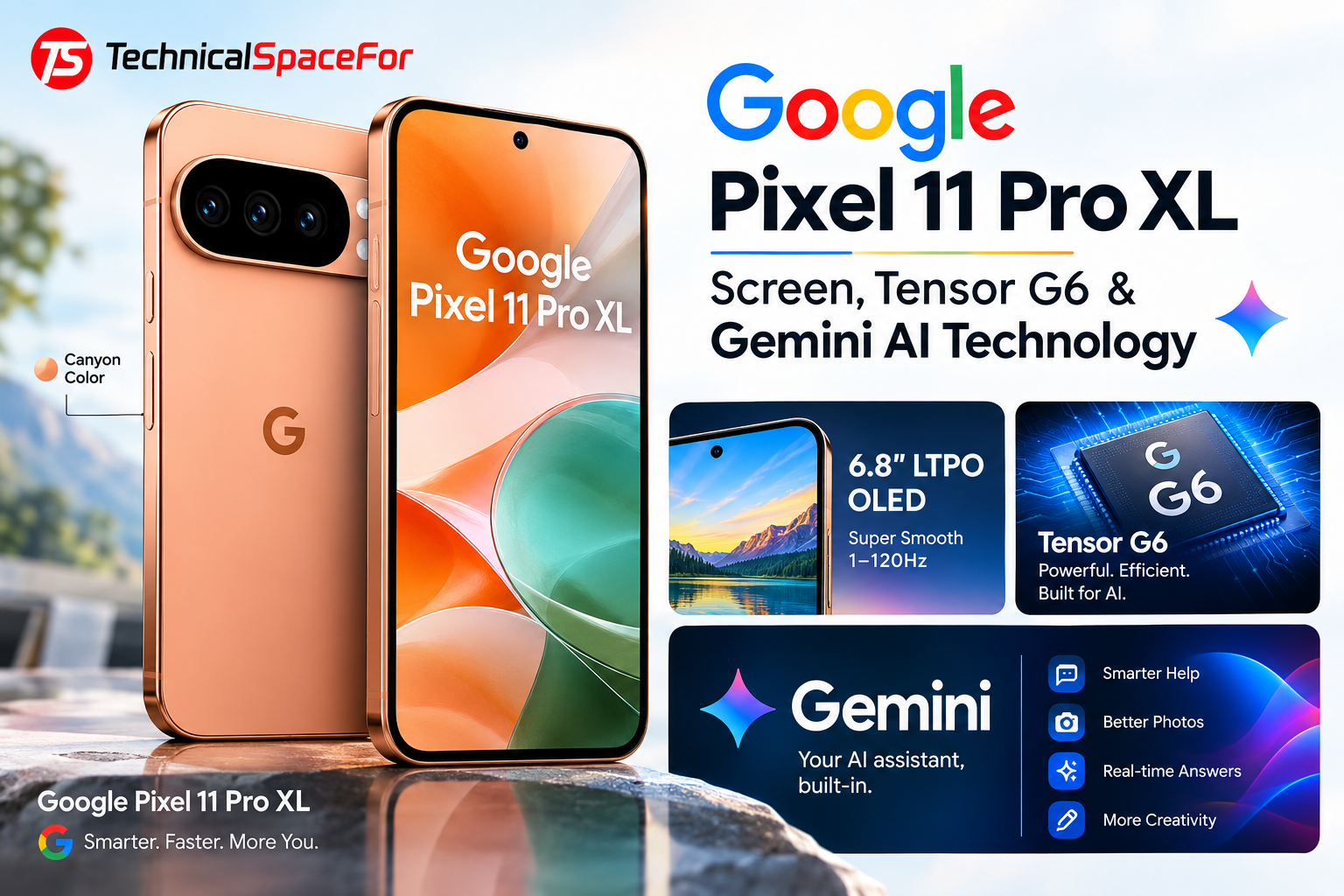
Google Pixel 11 Pro XL Screen, Tensor G6 & Gemini AI Technology
Explore the Pixel 11 Pro XL display, Tensor G6 performance and Gemini AI technology.
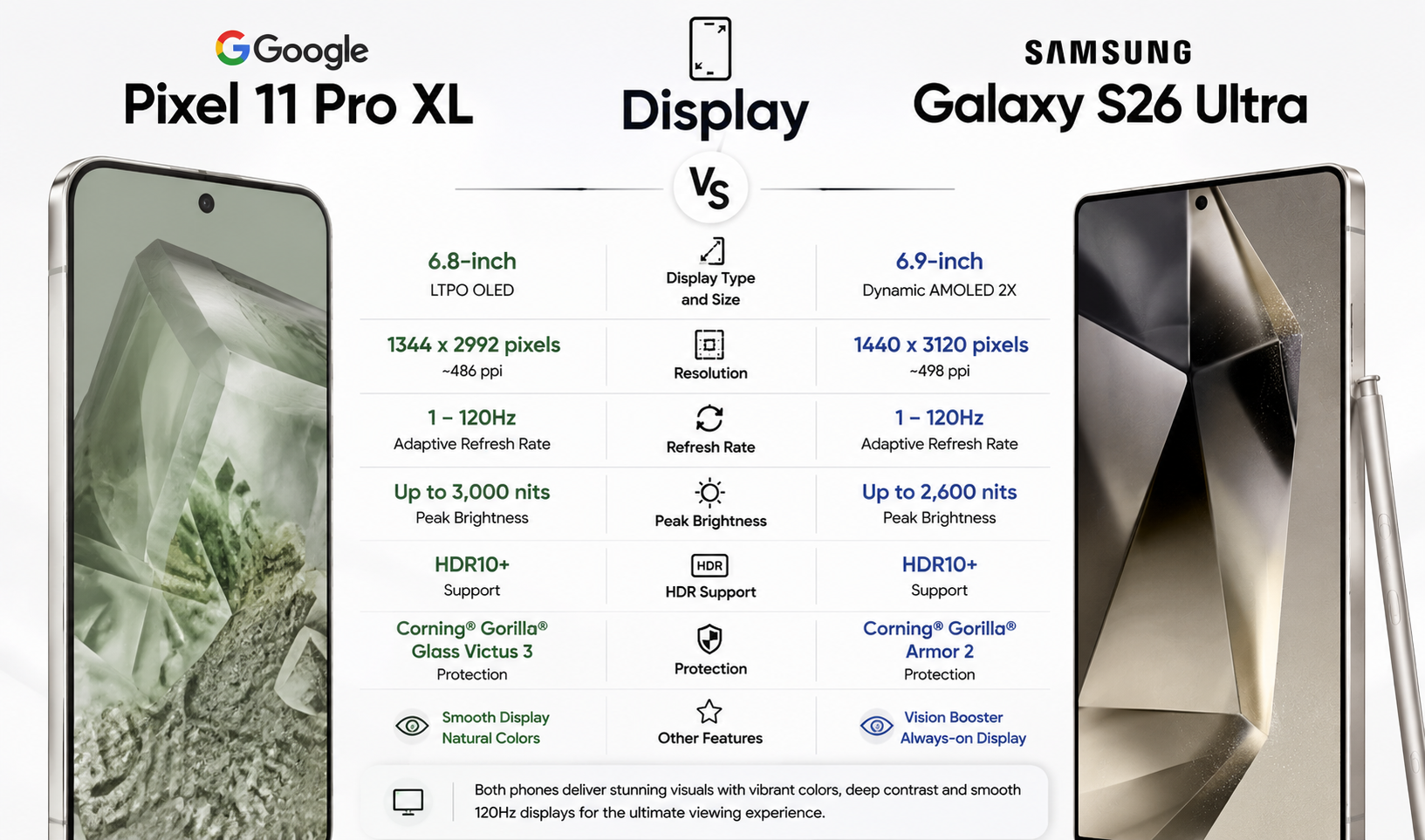
Google Pixel 11 Pro XL is a flagship phone that is equipped with an impressive 6.8-inch Super actua LTPO OLED screen, Tensor G6 processor and a keen emphasis on the AI features of the company’s most recent innovations. High resolution of 1344 × 2992 pixels allows the display to show sharp images, while the adaptive 1Hz–120Hz refresh rate optimizes performance and power usage. the screen is able to attain its maximum brightness of 3,600 nits and therefore makes the screen suitable for outdoor and HDR viewing, and the screen is protected from any form of damage through Gorilla Glass victus 2.
The Googles Tensor G6 relies on AI-powered performance to deliver computational photography, voice processing, security, and other intelligent phone capabilities, which the Pixel 11 Pro XL also enjoys, along with Gemini Intelligence that can assist you in various tasks such as organizing data, performing mundane tasks, and giving you context-specific help. Gemmni functions may differ from one country to another for those users who are used to running intensive programs, capturing high-quality videos, gaming, and using AI technologies for long durations, the company has provided the vapor chamber cooling system to help manage the temperatures. The high refresh rate OLED screen, Tensor G6 processors, and Gemini AI make the Pixel 11 Pro XL a good option for the users who are looking for a top-tier Android phone with a good display, camera, and intelligence.
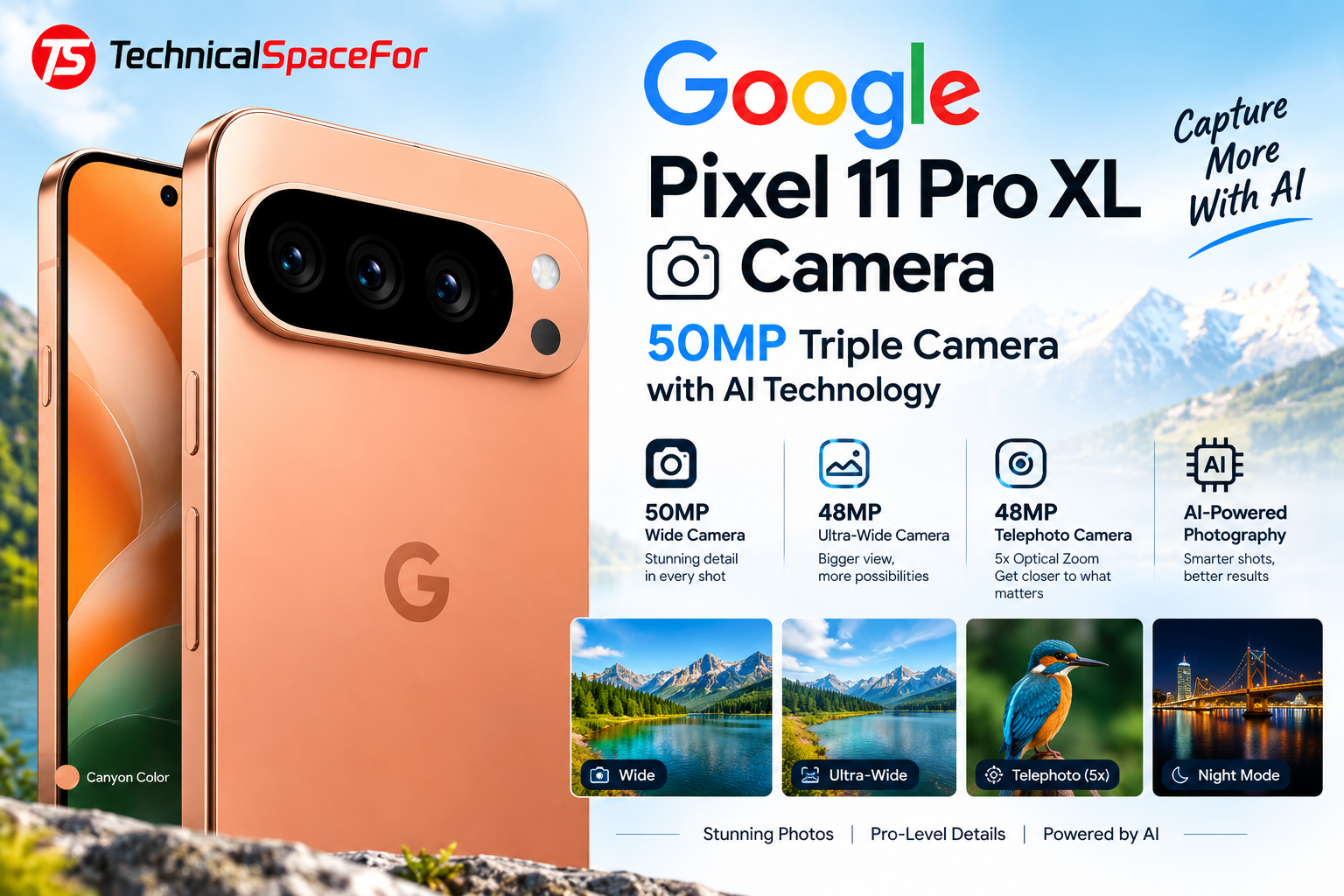
Google Pixel 11 Pro XL Camera: 50MP Triple Camera with AI Technology
Google Pixel 11 Pro XL features a 50MP triple camera system with AI-powered photography.
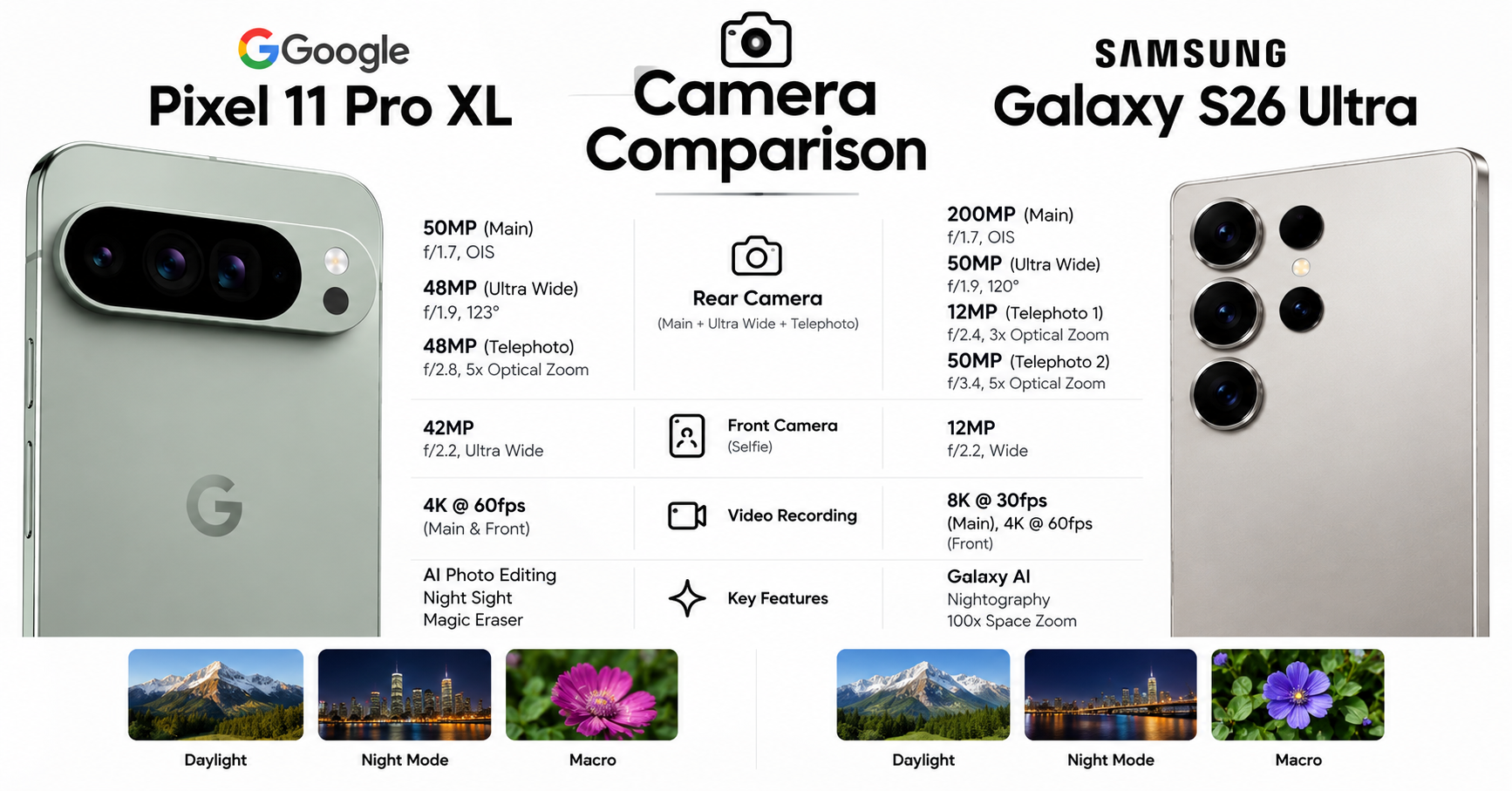
Google Pixel 11 Pro XL is a smartphone that has three types of cameras which are highly functional and can be used in photography and recording videos the three types include the following 50 MP main camera, 48 MP ultrawide camera with autofocus and 48 MP periscope telephoto camera with 5x optical zoom. in addition the main camera has a 1/1.3 inch sensor f/1.68 aperture and optical image stabilization, while the ultrawide camera has 123 degree field of view the new telephoto camera is created in a way that it can capture more light than the old one while features like Macro Focus, Optical Stabilization, and even 8K video recording enhance its ability to take photos and videos.
Computational photography and AI processing functions such as Night Sight, Magic Capture, Video Boost and Pro Stable Video have also been used extensively by Google to improve the quality of the image, low light photography and stabilize videos. the 42MP front-facing camera on the Pixel 11 Pro XL can focus and offers 103 degrees wide field of view for selfies and video calls, which is ideal for group selfies and portraits. the camera technology uses high-res sensors, optical zoom, and AI-based image processing by Google to create the best camera experience ever on any phone.
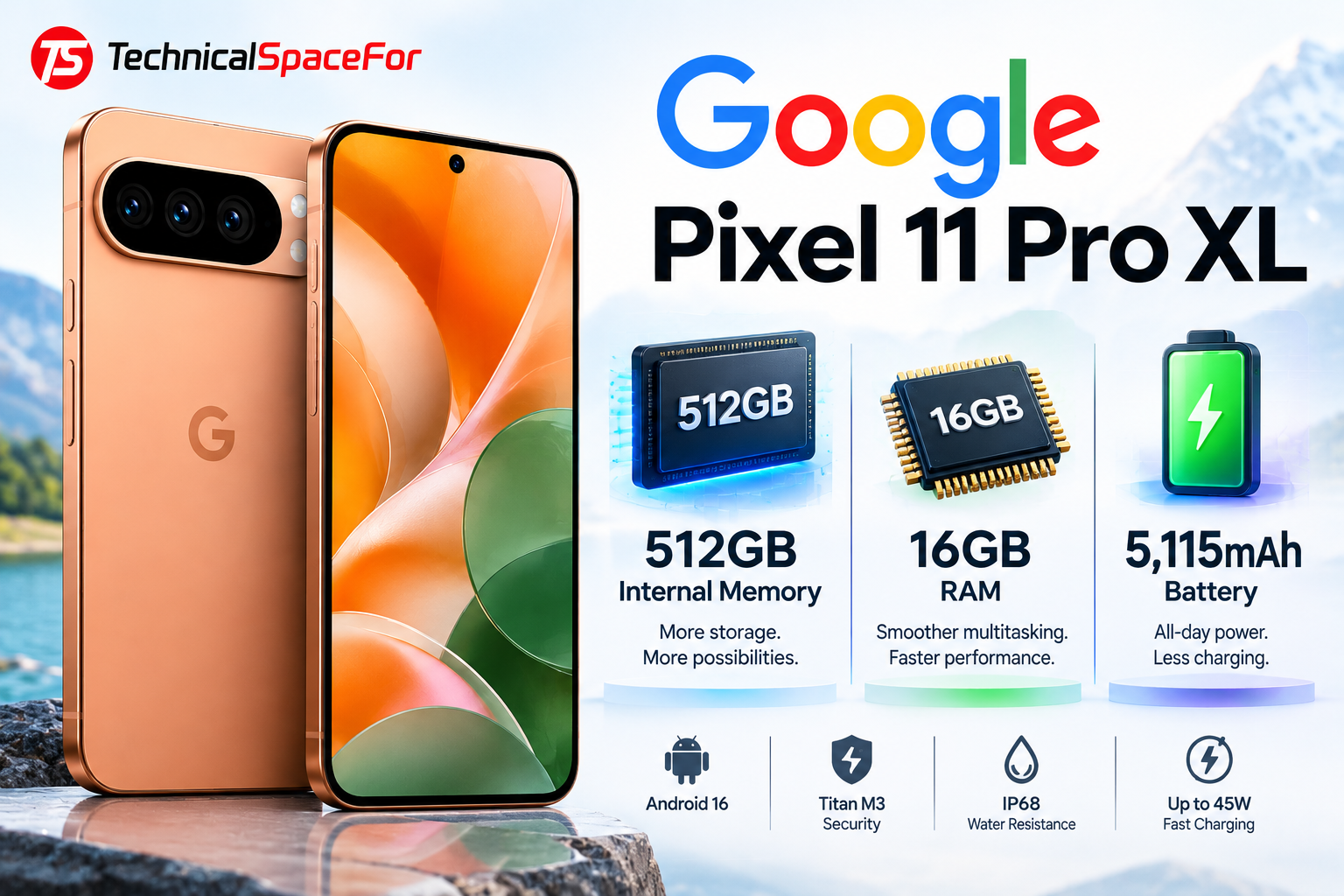
Google Pixel 11 Pro XL: 512GB Internal Memory, 16GB RAM and 5,115mAh Battery
Google Pixel 11 Pro XL combines 512GB storage, 16GB RAM and a 5,115mAh battery
For users requiring ample storage capacity, the Google Pixel 11 Pro XL 512GB model presents good memory options as it provides a total of 512GB of internal storage and 16GB of RAM, making it a great choice for users performing complex activities including multitasking, gaming, 4K/8K video recording, and Google’s AI capabilities; as there is no option for a microSD card slot it would make sense to opt for the 512GB version for users planning to store much content on the smartphone
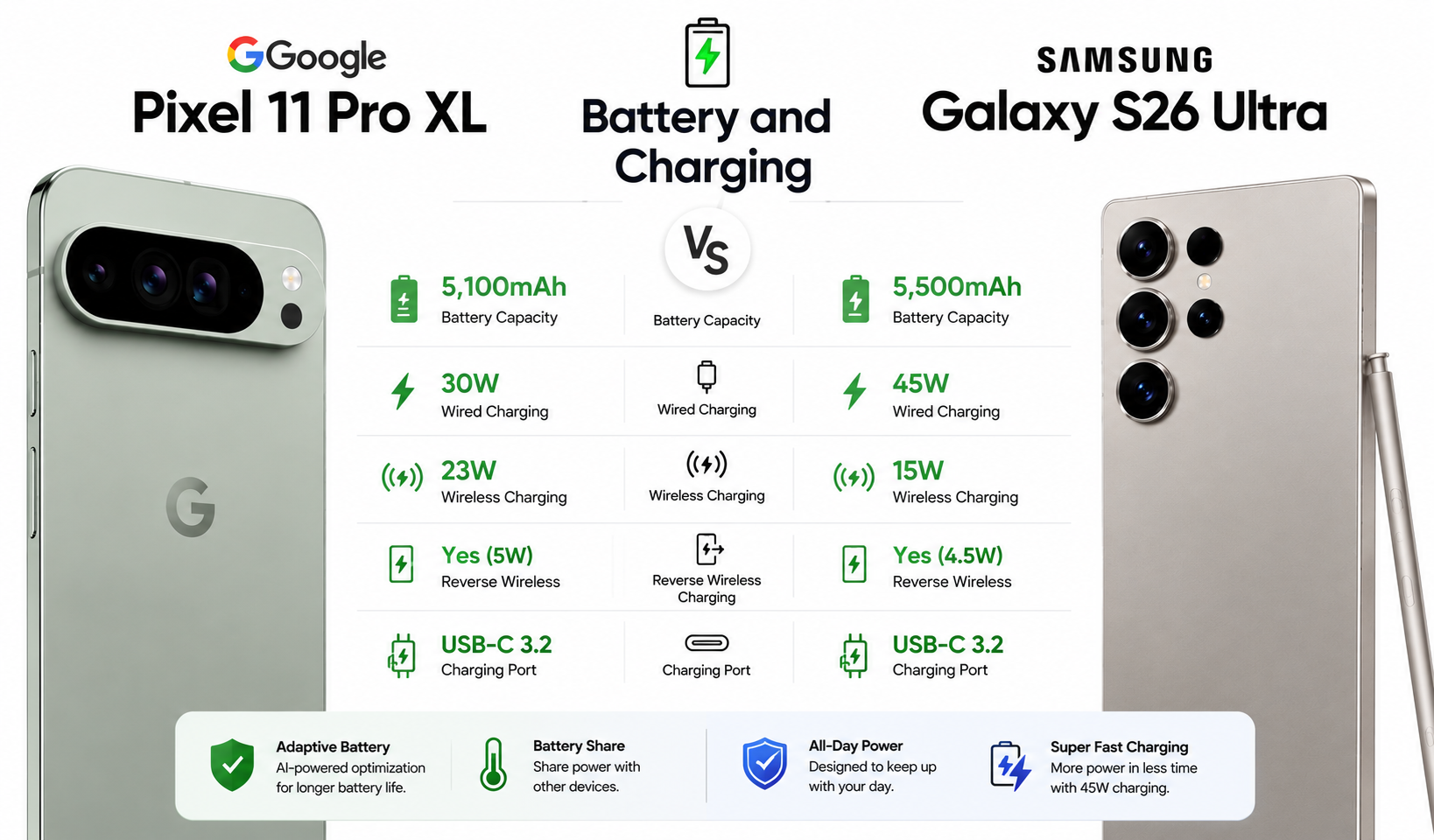
The phone features a 5,115mAh typical battery with a minimum battery capacity of 5,000mAh as reported by Google according to Google, the battery lasts for more than 30 hours in their tests while the extreme battery saver prolongs battery use through limited background processes and features. as far as the charging is concerned, the Pixel 11 Pro XL supports 45W or more USB-C PPS charging and according to Google, it can provide a 75% charge in about 30 minutes. It is also compatible with Qi2.2 wireless charging which works up to 25W.
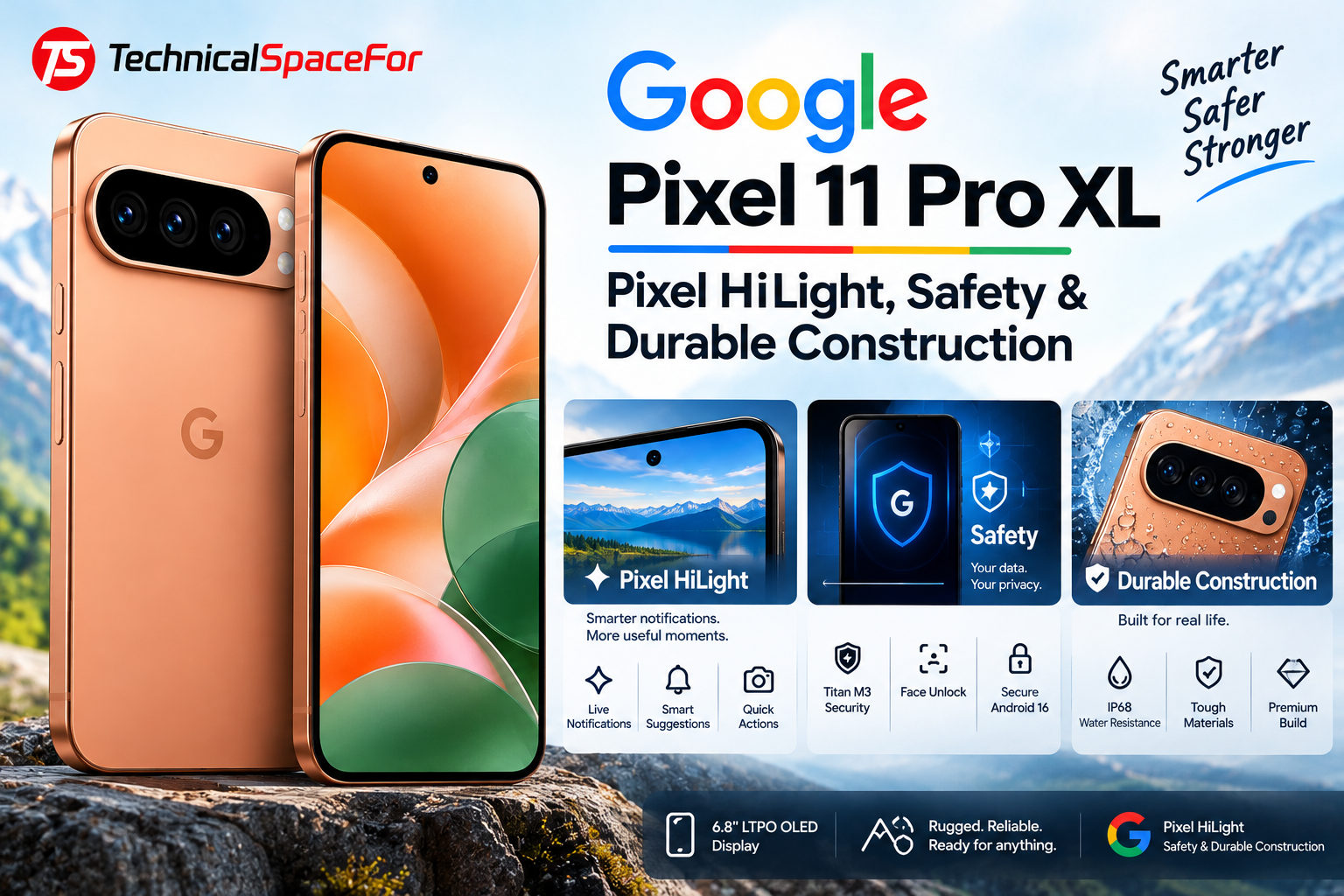
Google Pixel 11 Pro XL: Pixel HiLight, Safety & Durable Construction
Google Pixel 11 Pro XL combines Pixel HiLight, advanced safety features and durable construction
With the Pixel 11 Pro XL, Google has incorporated Pixel HiLight, a feature that will glow softly when the phone is lying with its screen facing downwards and can help users identify certain types of calls and Gemini interactions without picking up the phone. For security purposes, the phone features a combination of the Tensor G6 processor and Google’s Titan M3 coprocessor for security and trusted execution environment. the phone has secure boot, malware protection, phishing defense, fingerprint authentication, and face recognition.
the device is designed to be durable for regular use, featuring an IP68 rating for its dust and water-resistance capabilities, as well as Gorilla Glass Victus 2 protecting the display screen, thus making Pixel 11 Pro XL a balanced flagship smartphone for users who prefer intelligent features and robustness.
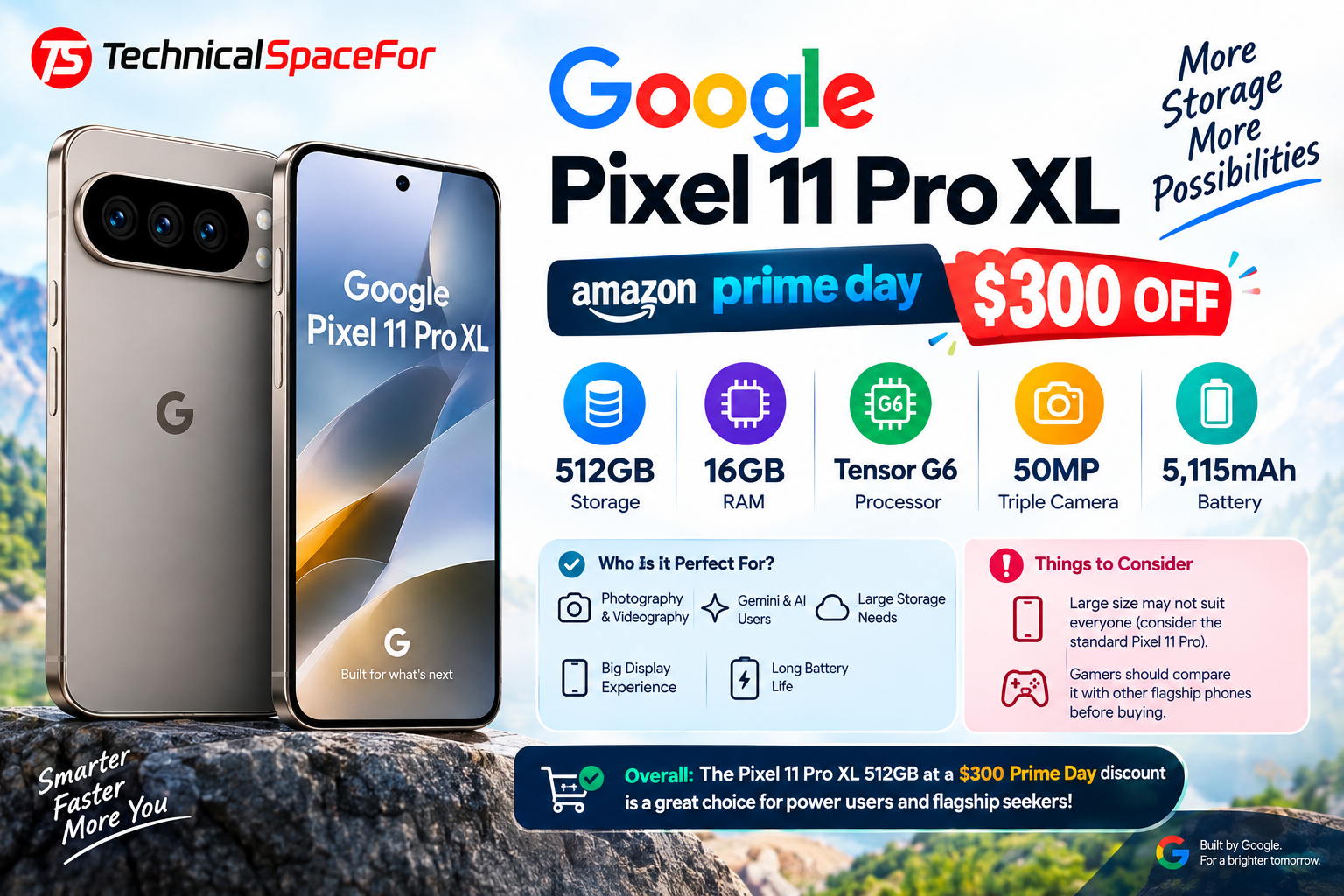
Is the Google Pixel 11 Pro XL 512 GB Prime Day Offer Good?
Google Pixel 11 Pro XL 512GB gets a $300 Prime Day discount.
This offer from the Google Pixel 11 Pro XL 512GB during Prime Day is one to be considered by buyers looking for a high-end Android flagship phone with high storage space, 16GB of RAM, Google’s newest Tensor platform, high-end camera, and high battery. The discount of $300 makes this high-storage variant more appealing to people looking for flagship phones at affordable prices. Pixel 11 Pro XL is very much suited to people who have interests in taking pictures on mobile phones, videography, gemini and AI users and even those people who need large storage capacity to store pictures, high definition video clips and applications. The reason behind is that the display and battery capacity of this phone is large. Nevertheless, its big body size might not be for everyone; customers who like their devices small and portable may opt for the standard Pixel 11 Pro instead, while gamers need to test it against other flagships phones before making up their mind about this device.
Generally, considering its features like 512 GB of storage, 16 GB of RAM, sophisticated cameras, a high-capacity battery, and AI-driven Google software, the reduced Pixel 11 Pro XL is a perfect candidate to purchase on Prime Day.
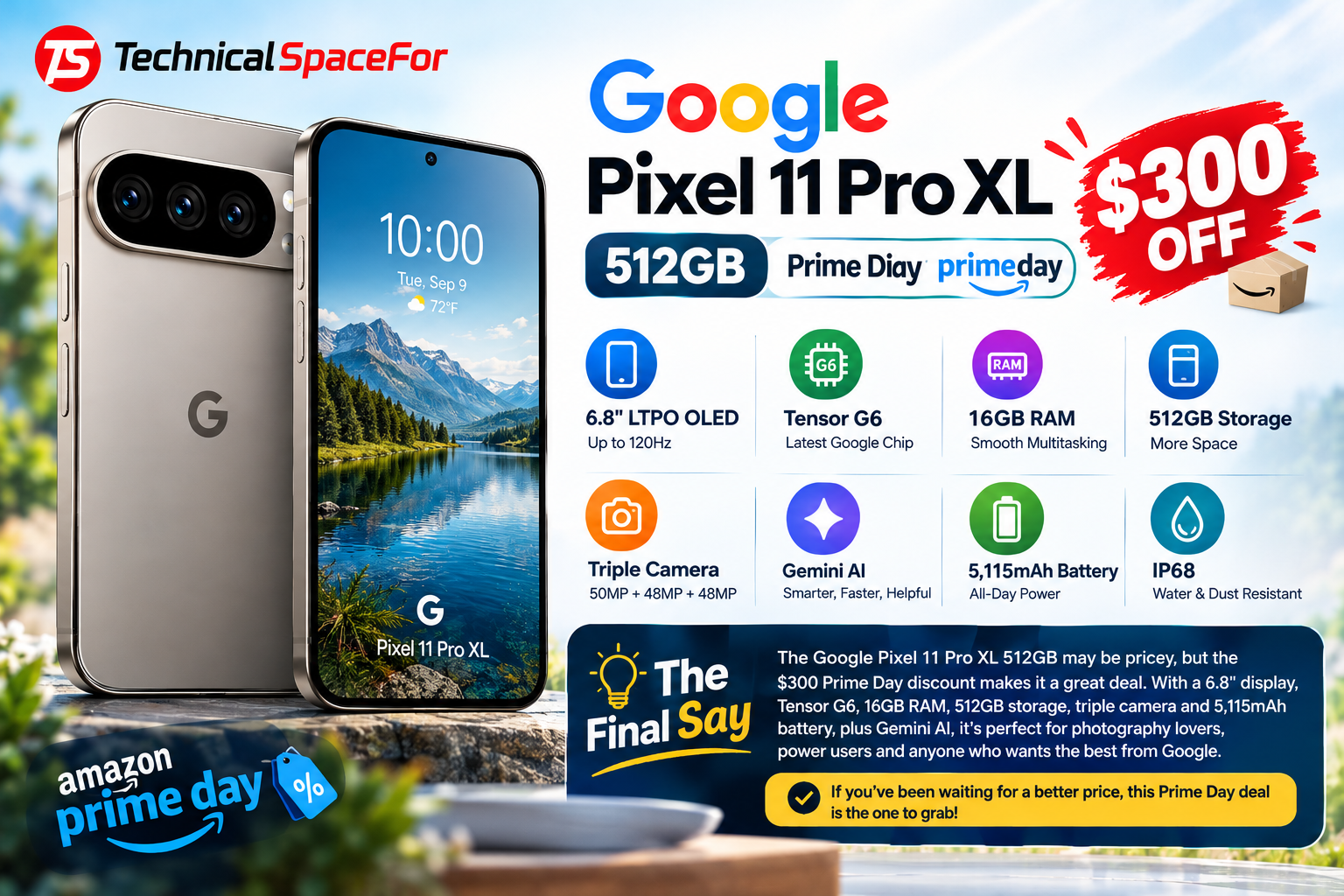
Google Pixel 11 Pro XL 512GB Prime Day Offer: The Final Say
Google Pixel 11 Pro XL 512GB gets a $300 Prime Day discount with flagship features.
The Google Pixel 11 Pro XL512GB is an expensive device to begin with, but the $300 price cut that occurs on Prime Day will definitely increase its attractiveness. the combination of the newest Google technology and lots of space for users will definitely satisfy those who are interested. this phone has a 6.8-inch LTPO OLED display, a tensor G6 processor, 16GB of RAM, 512 GB of memory, and an all-around triple camera as well as a 5115mAh battery Functions like the Google Gemini AI, as well as the pixel technology, make it powerful, especially for people who love taking photos on a mobile device.
To conclude, if you have been patiently waiting for an affordable price deal on the 512 GB Pixel 11 Pro XL, this Prime Day deal is something that should not escape your consideration in light of the technology, storage capacity, and Google OS that it has.
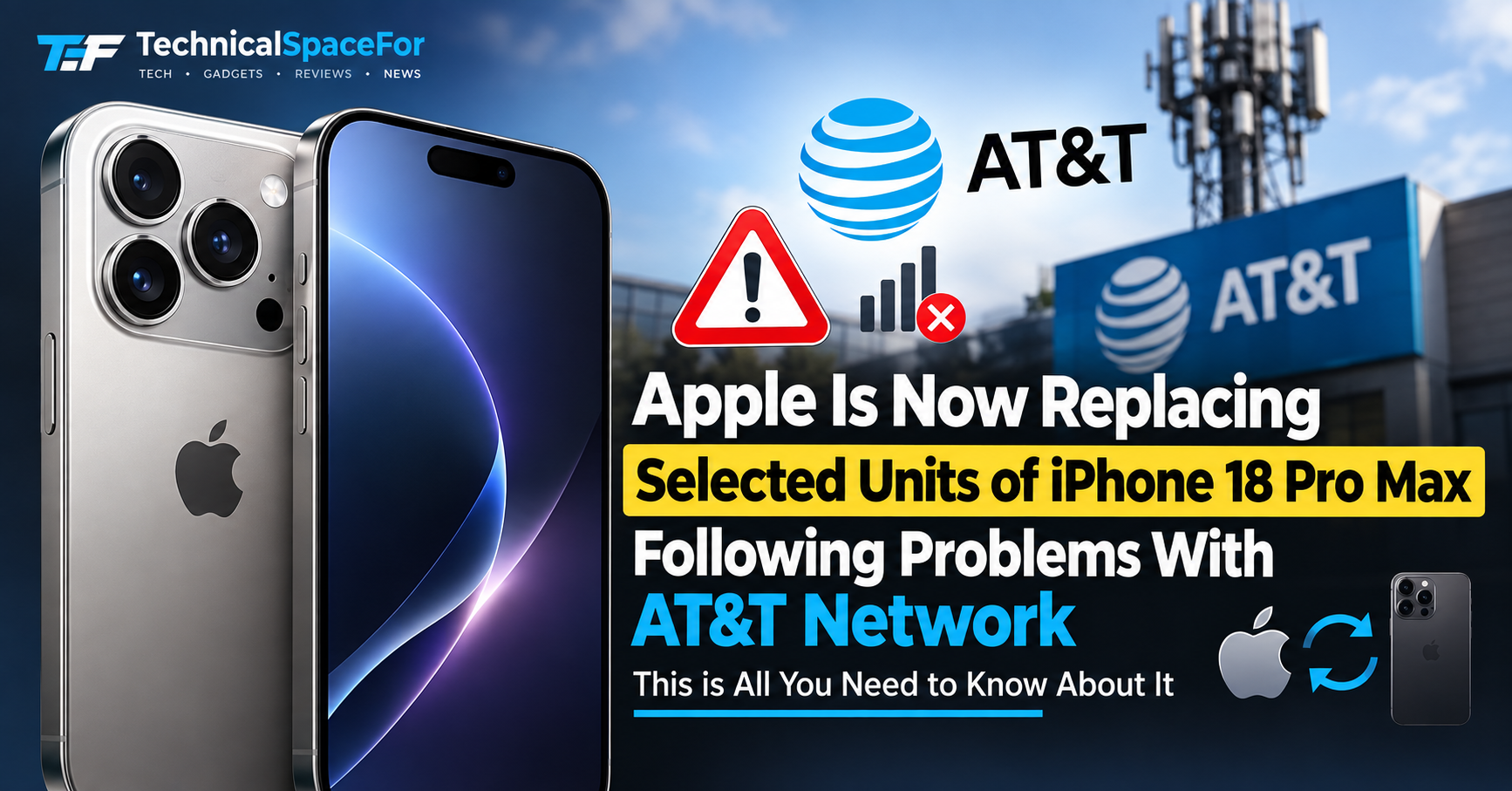
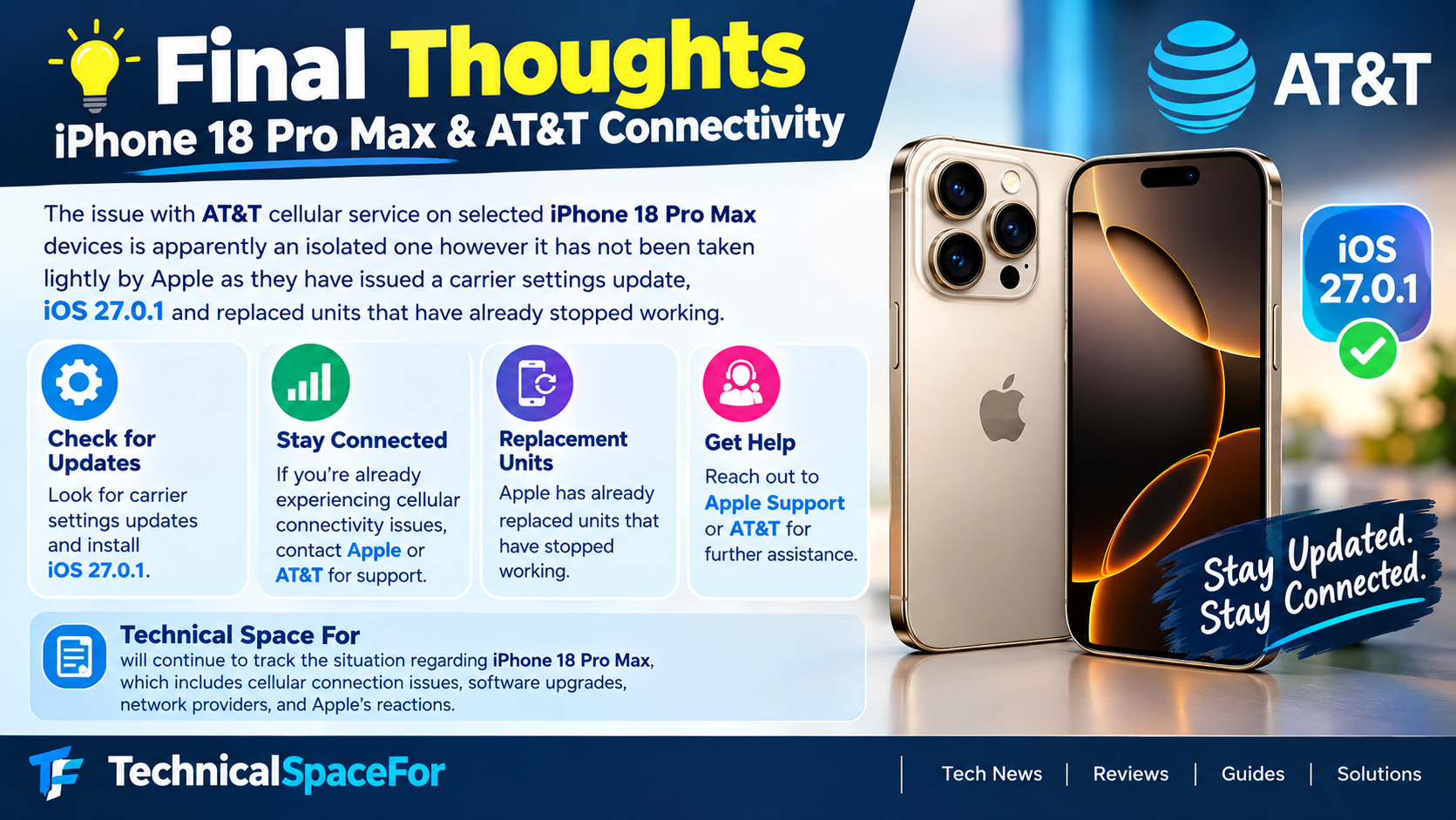
Apple’s has issued recalls of a batch of iPhones 18 Pro Max due to issues that led to loss of cellular signals among some of its customers on the AT&T network the affected iPhones have issues with network connection hence inability to make phone calls and send text messages the release of carrier settings update and iOS 27.0.1 will be done by Apple to avoid any other devices getting affected by the issue but for those who have experienced the loss of cellular services on their iPhone 18 Pro Max the device may be replaced according to Aples, there is a problem affecting some users of iPhone 18 Pro Max on the network of AT&T as per the company, this problem may lead to loss of signal for the particular device, resulting in inability to call others AT&T has also recognized this issue to some users and is working on it in collaboration with Apple so far, while on the other hand, Apple has yet to disclose how many units of the iPhone 18 Pro Max are affected by this issue, or what is the need for replacement when the cellular service is lost.
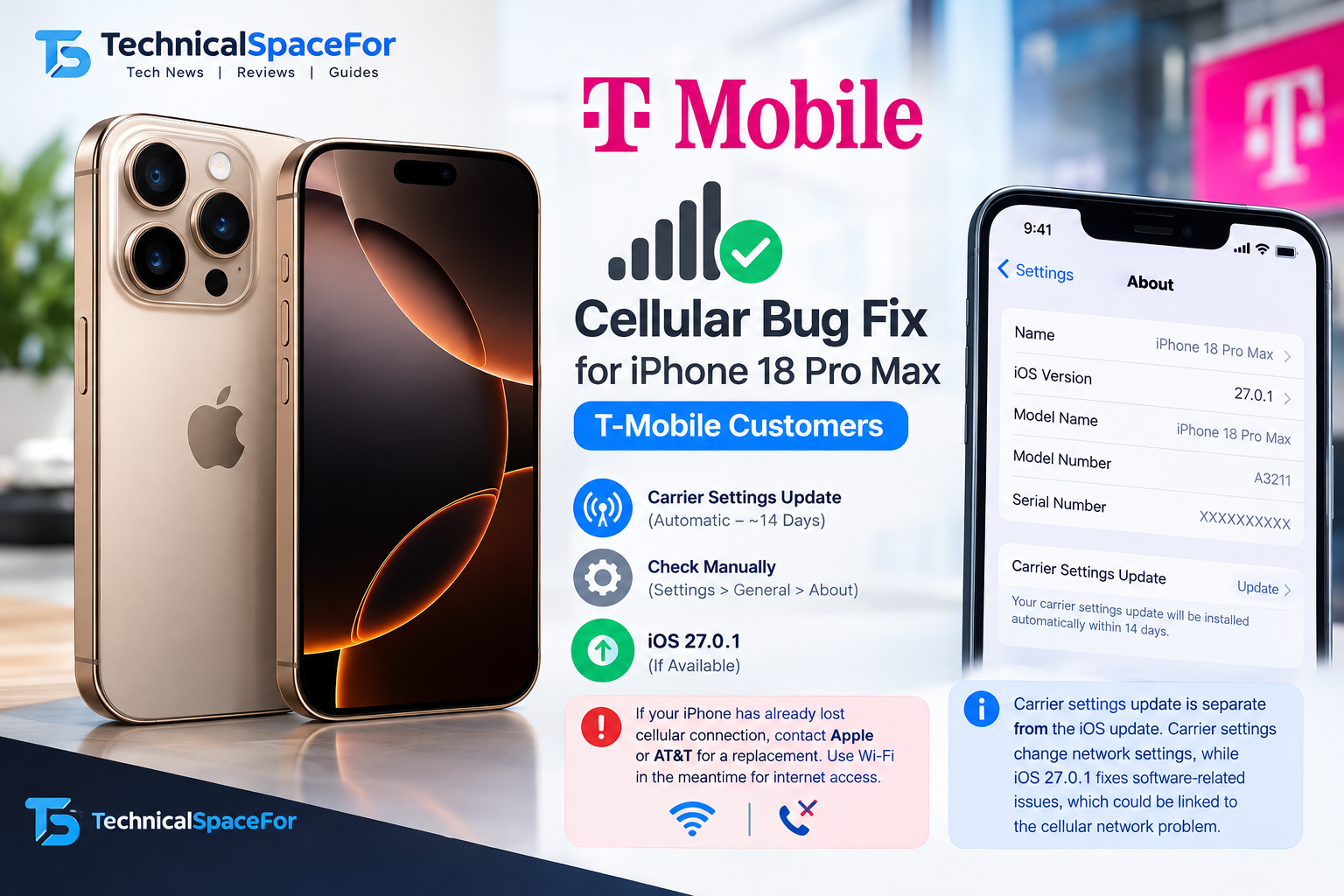
Apple Launches Cellular Bug Fix for iPhone 18 Pro Max for T-Mobile Customers
Apple releases a carrier settings update to address cellular issues on iPhone 18 Pro Max.
Apples has released an update for carrier settings that would help fix the cellular connectivity issues in iPhones 18 Pro Max affected by the update. The update will take about 14 days to reach your phone automatically but you can also check manually through Settings > General > About. Apple also suggests updating to iOS 27.0.1 if possible In case a defective iPhone has already lost cellular connection altogether, users need to seek help from Apple or AT&T for replacement and, in the meantime, use Wi-Fi as the only option for Internet access; while calling, SMS, and data may not work carrier settings update is separate from iOS update: whereas carrier settings change network settings, iOS 27.0.1 takes care of software-based problems, which could be linked with the cellular network issue
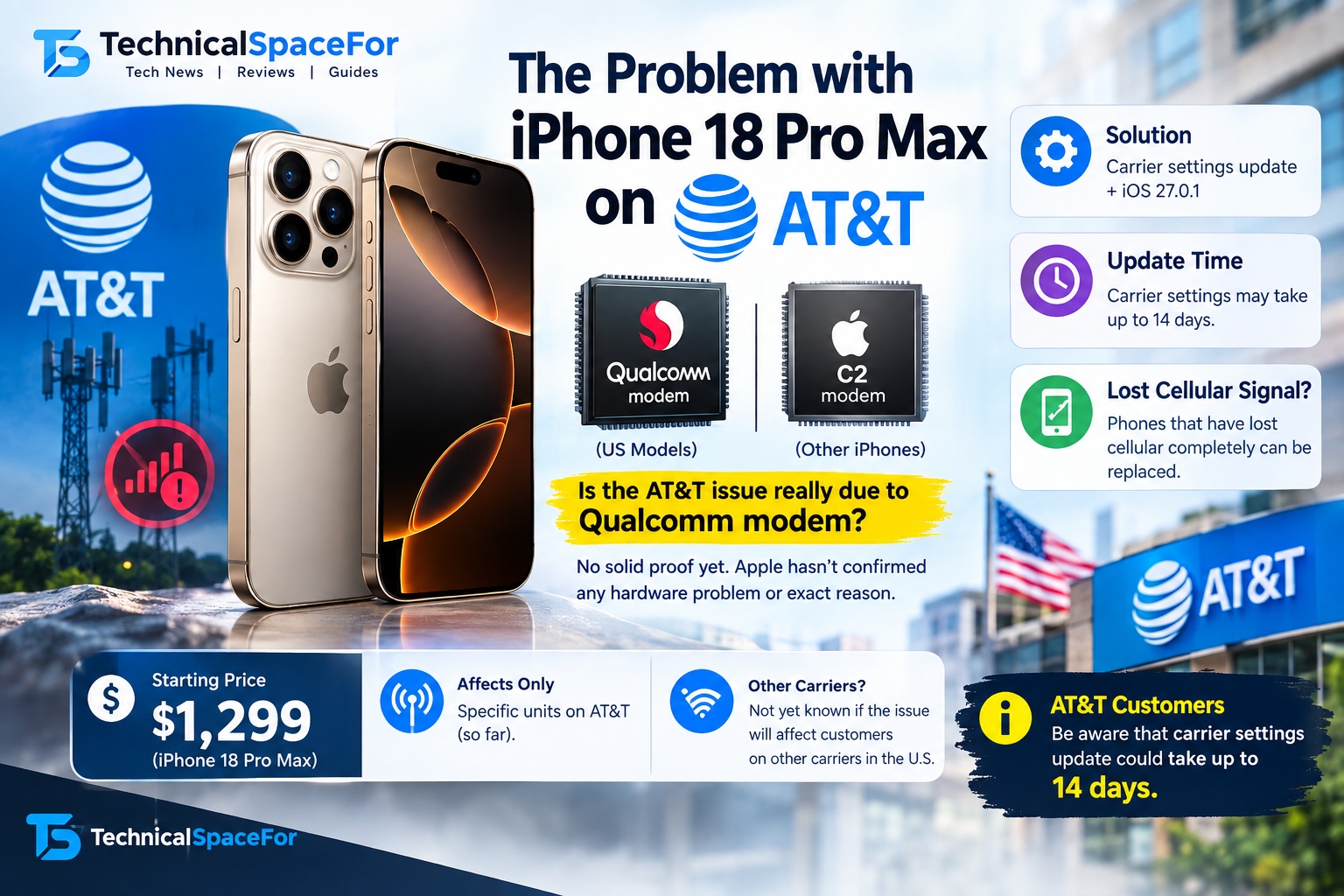
The Problem with iPhone 18 Pro Max on AT&T: Qualcomm Modem, Cellular Solution, and Owner Information
iPhone 18 Pro Max faces a reported AT&T cellular issue, with carrier and iOS updates offered as solutions.
It has been reported that the iPhone 18 Pro Max uses a Qualcomm modem in America whereas some other iPhones use Apple’s C2 modem, but still, there is no solid proof that the AT&T issue is due to Qualcomm modem. it seems that this problem only affects specific units of the iPhone 18 Pro Max on AT&T and there has been no confirmation from apple yet about any hardware problems or reasons behind the problem apple is dealing with the problem via an update in carrier settings and iOS 27.0.1 although phones which have lost their cellular signal completely can be replaced
The starting price for iPhone 18 Pro Max is $1,299 and it is not yet known whether the problem will affect customers with other carriers in the United States. AT&T customers should be aware that the update of carrier settings could take up to 14 days.
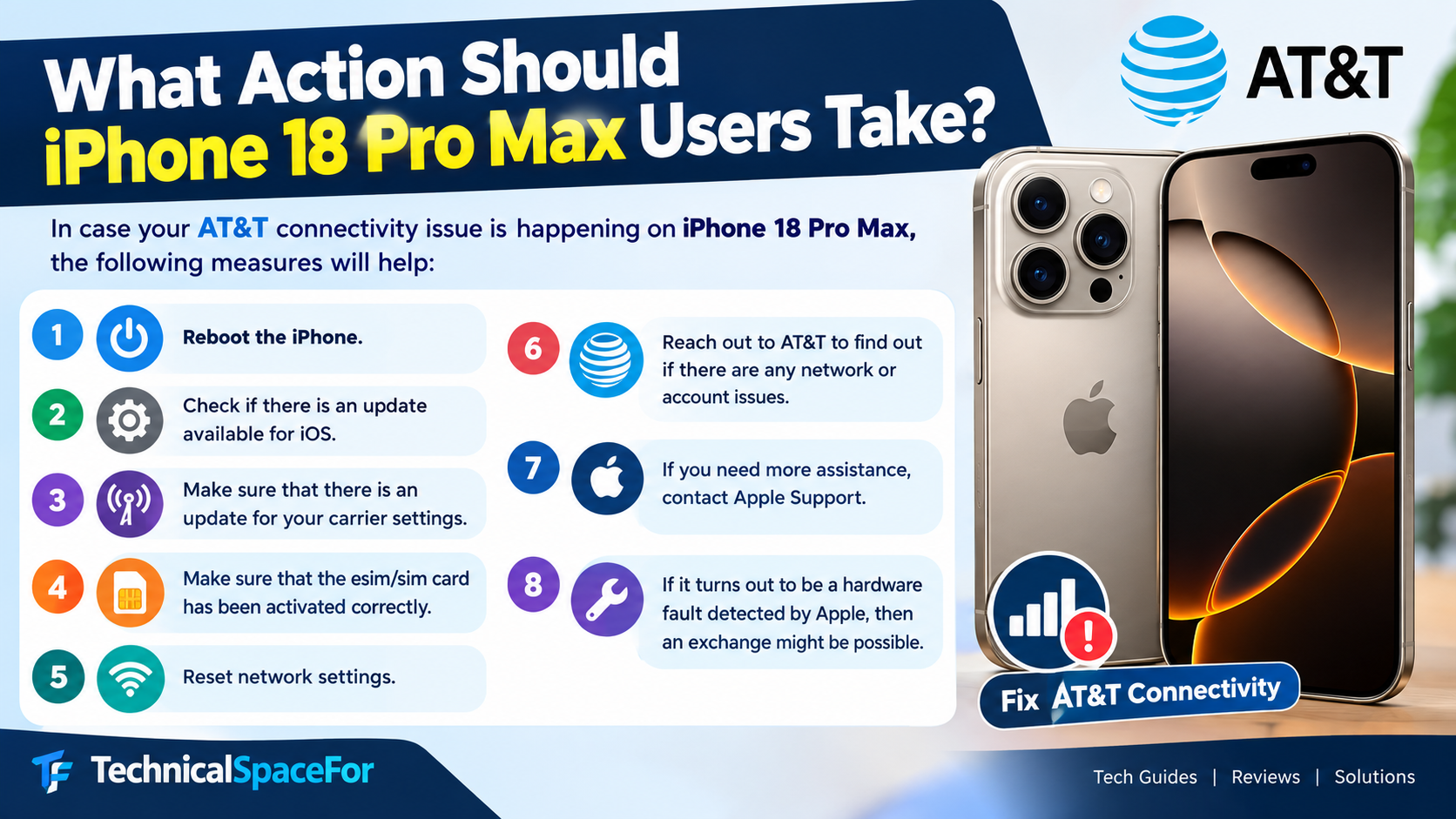
What Action Should iPhone 18 Pro Max Users Take?
How to fix AT&T connectivity issues on iPhone 18 Pro Max
In case your AT&T connectivity issue is happening on iPhone 18 Pro Max, the following measures will help:
Reboot the iPhone.
Check if there is an update available for iOS.
Make sure that there is an update for your carrier settings.
Make sure the esim/sim card has been activated correctly.
Reset network settings.
Reach out to AT&T to find out if there are any network or account issues.
If you need more assistance, contact Apple Support.
If it turns out to be a hardware fault detected by Apple, then an exchange might be possible.
Final thoughts
Apple’s response to AT&T connectivity issues on selected iPhone 18 Pro Max devices.
The issue with AT&T cellular service on selected iPhone 18 Pro Maxdevices is apparently an isolated one however it has not been taken lightly by Apple as they have issued a carrier settings update, iOS 27.0.1 and replaced units that have already stopped working. For iPhone 18 Pro Max users at AT&T, it is suggested to check carrier settings for updates and update to iOS 27.0.1. Users who are already experiencing problems with cellular connectivity should get in touch with Apple or AT&T for help. Technical SpaceFor will continue to track the situation regarding iPhone 18 Pro Max, which includes cellular connection issues, software upgrades, network providers, and Apple’s reactions.
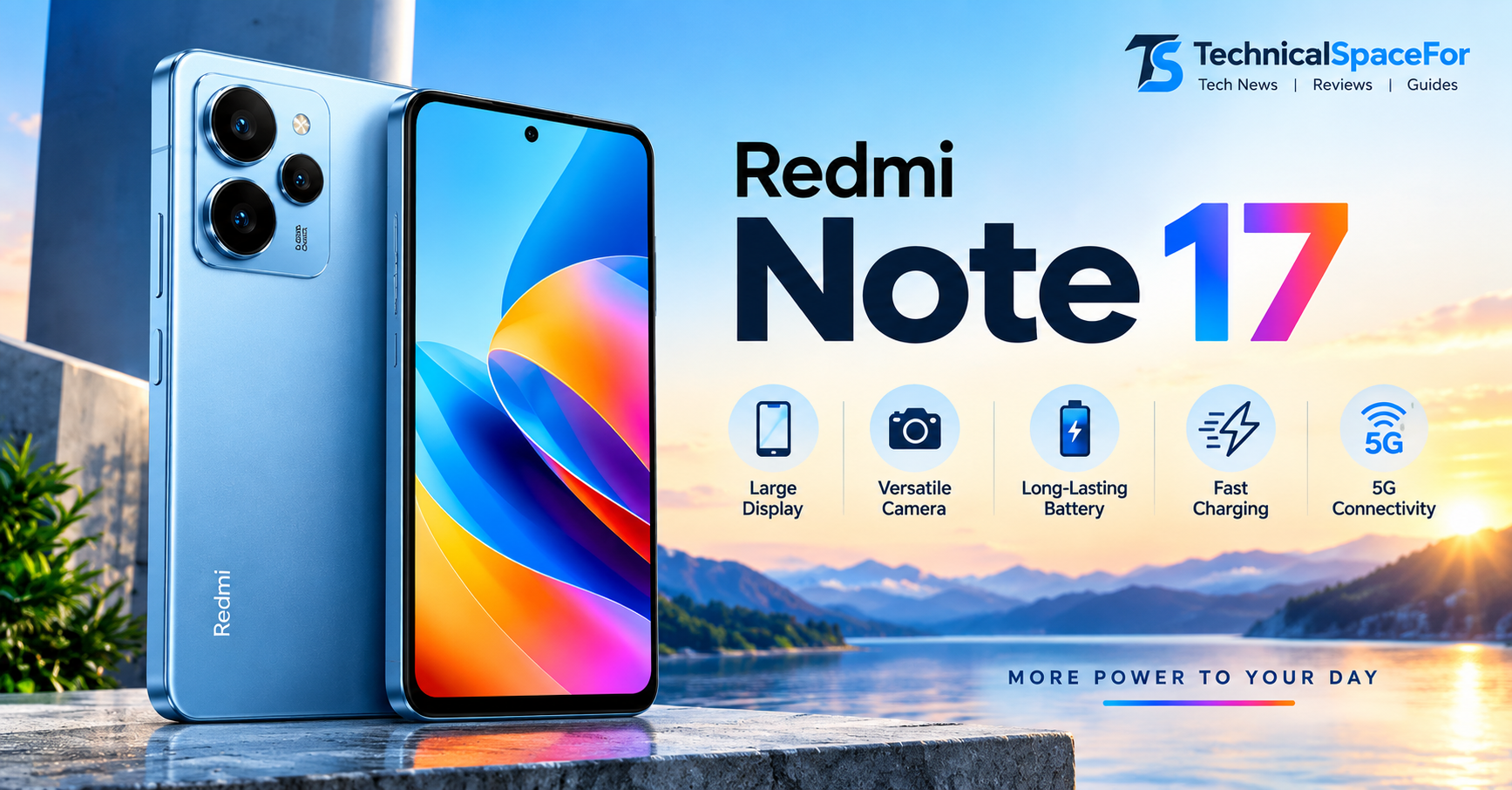
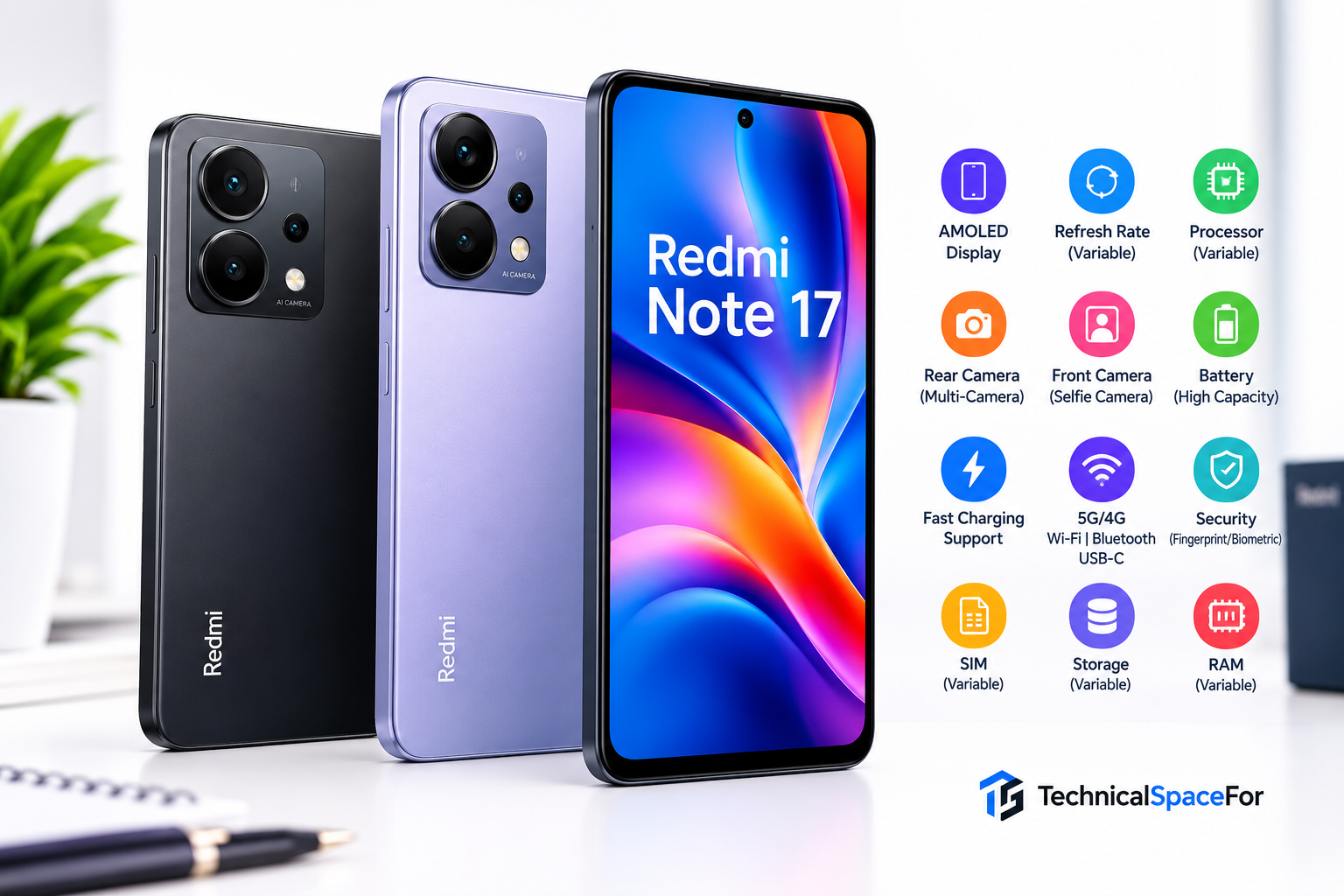
The Redmi Note 17 is a smartphone from the popular line of Redmi Note smartphones made by Xiaomi, which provides value and modernity in an affordable price range for such customers, who require a combination of many things because the Redmi Note range is a global brand that competes in many international markets the Redmi Note 17 is a smartphone aimed at such people who are looking for a complete Android smartphone in a competitive price range. This Redmi Note 17 review discusses the design, screen, performance, cameras, battery, software, connectivity, expected price range, and other specifications.
Redmi Note 17 Key Features
Redmi Note 17 with display, camera, battery, and connectivity highlights.
Specification
Redmi Note 17
Brand
Xiaomi
Series
Redmi Note
Operating System
Android-based Xiaomi software
Display
AMOLED-class display
Refresh Rate
Market/configuration dependent
Processor
Market/configuration dependent
Rear Camera
Multi-camera system
Front Camera
Selfie camera
Battery
High-capacity smartphone battery
Charging
Fast charging support
Connectivity
5G\4G Wi-Fi Bluetooth USB-C
Security
Fingerprint/biometric security
SIM
Market dependent
Storage
Market dependent
RAM
Market dependent
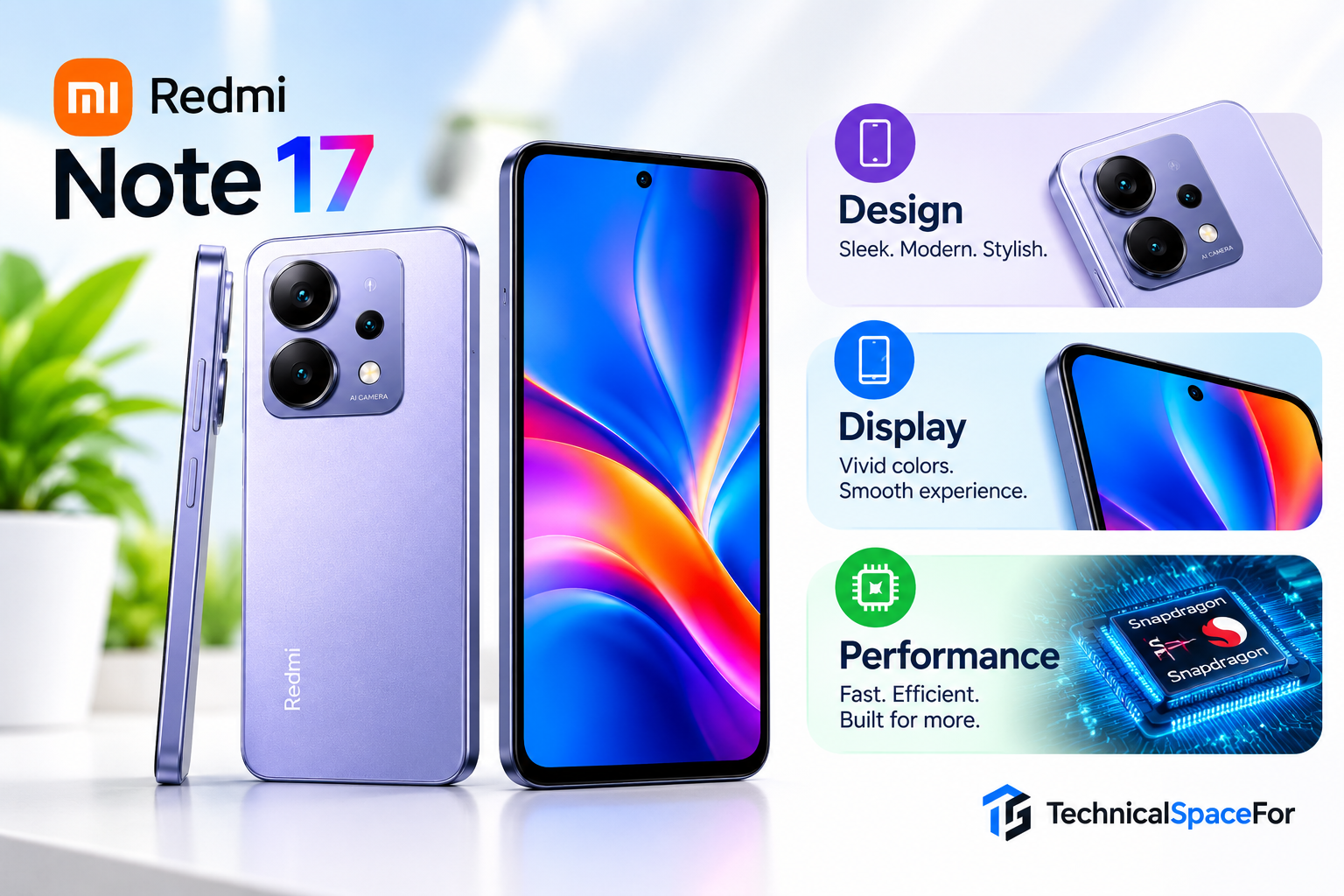
Redmi Note 17: Design, Display and Performance
Redmi Note 17 showcasing its stylish design, vivid display and performance.
Redmi Note 17 phone is constructed to be a modern smartphone for everyday use The phone has a sleek appearance and a large screen, and its performance features are excellent the screen is ideal for watching videos, browsing the Internet, social networking, photo shooting, and gaming An AMOLED-type screen would provide clear colors and good contrast as far as performance is concerned, the phone would be able to execute normal software, multitasking, streaming videos, video conferencing, and gaming Different types of RAM and storage, processor speed, colors, and other customization options can be available in different models of the Redmi Note 17
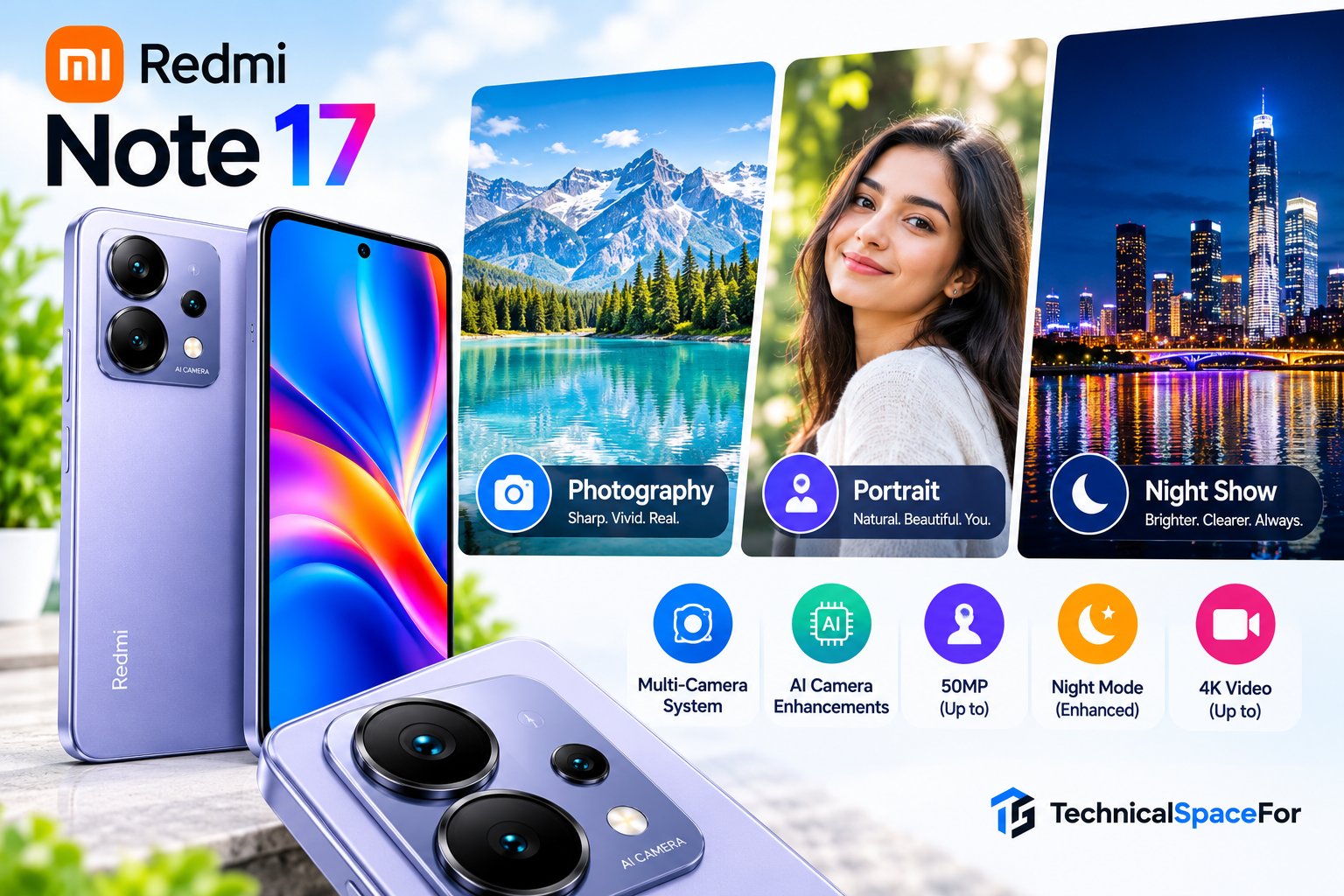
Redmi Note 17 Camera: Photography, Portrait, and Night Show
Redmi Note 17 camera showcasing photography, portrait and night photography capabilities
Camera system of the Redmi Note 17is intended for regular photography involving the following elements: outdoor photography, portraits, travel photography, food photography, selfies, and taking pictures that can be posted in social media. The processing features of the images can help improve the clarity of the details, the colors and the image quality in general, while portrait photography involves the creation of the pictures where the subject stands out against the background. Night photography is intended to create more brightly lit and detailed images in poor lighting conditions, though it should be noted that the results may differ in accordance with particular models and the software used.
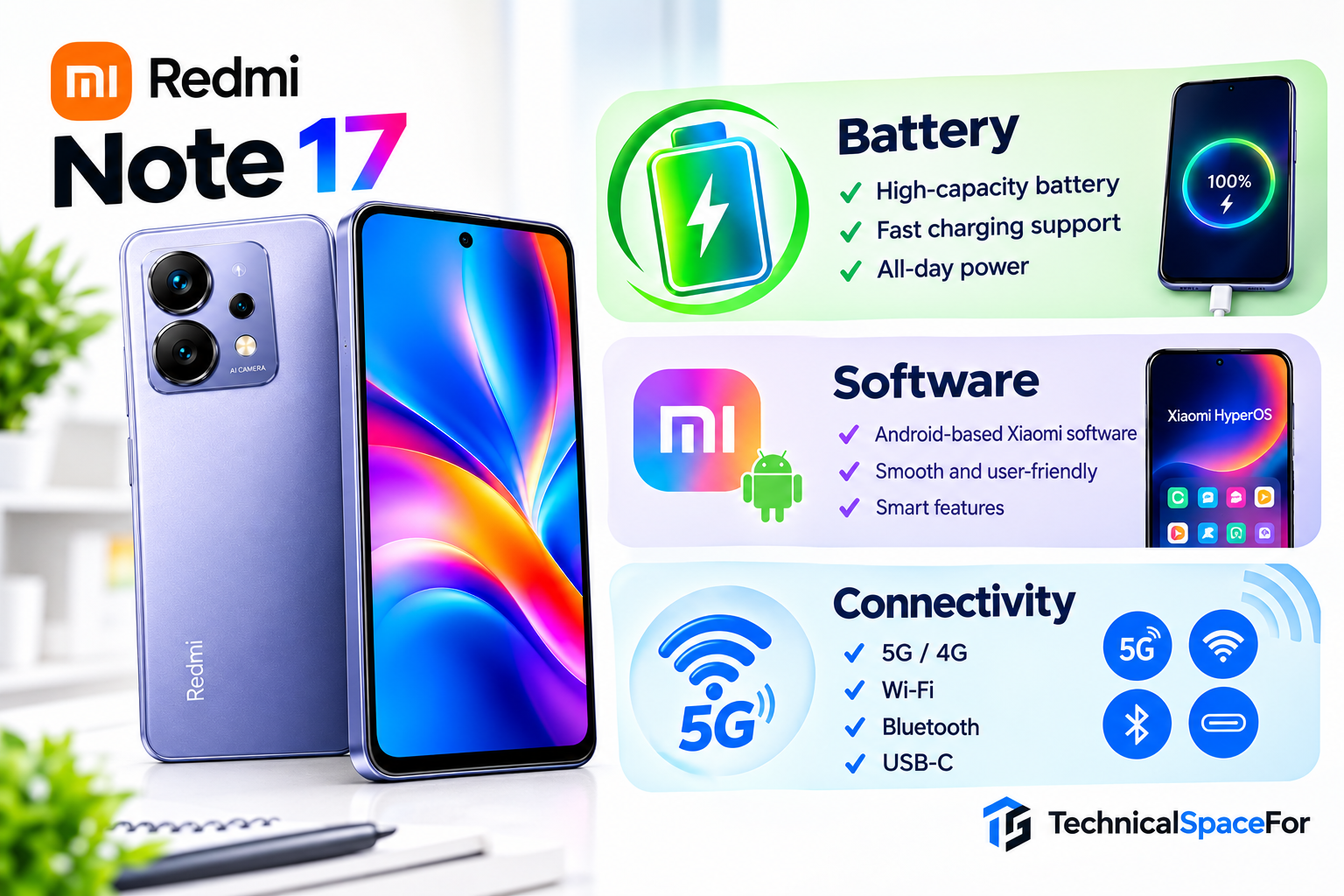
Redmi Note 17 Battery, Software and Connectivity
Redmi Note 17 showcasing battery life, software and connectivity features.
Redmi Note 17 offers good battery performance for the everyday usage for actions like video streaming, social networking, surfing the internet, photo taking, playing games, making calls, and navigating while fast charging helps save some charging time. The software experience offered by the device uses Xiaomi’s Android operating system and includes features such as customization, security, app management, etc. The device can come with options such as 5G/4G, Wi-Fi, Bluetooth, GPS, USB Type-C, and Dual SIM among others based on the variant purchased.
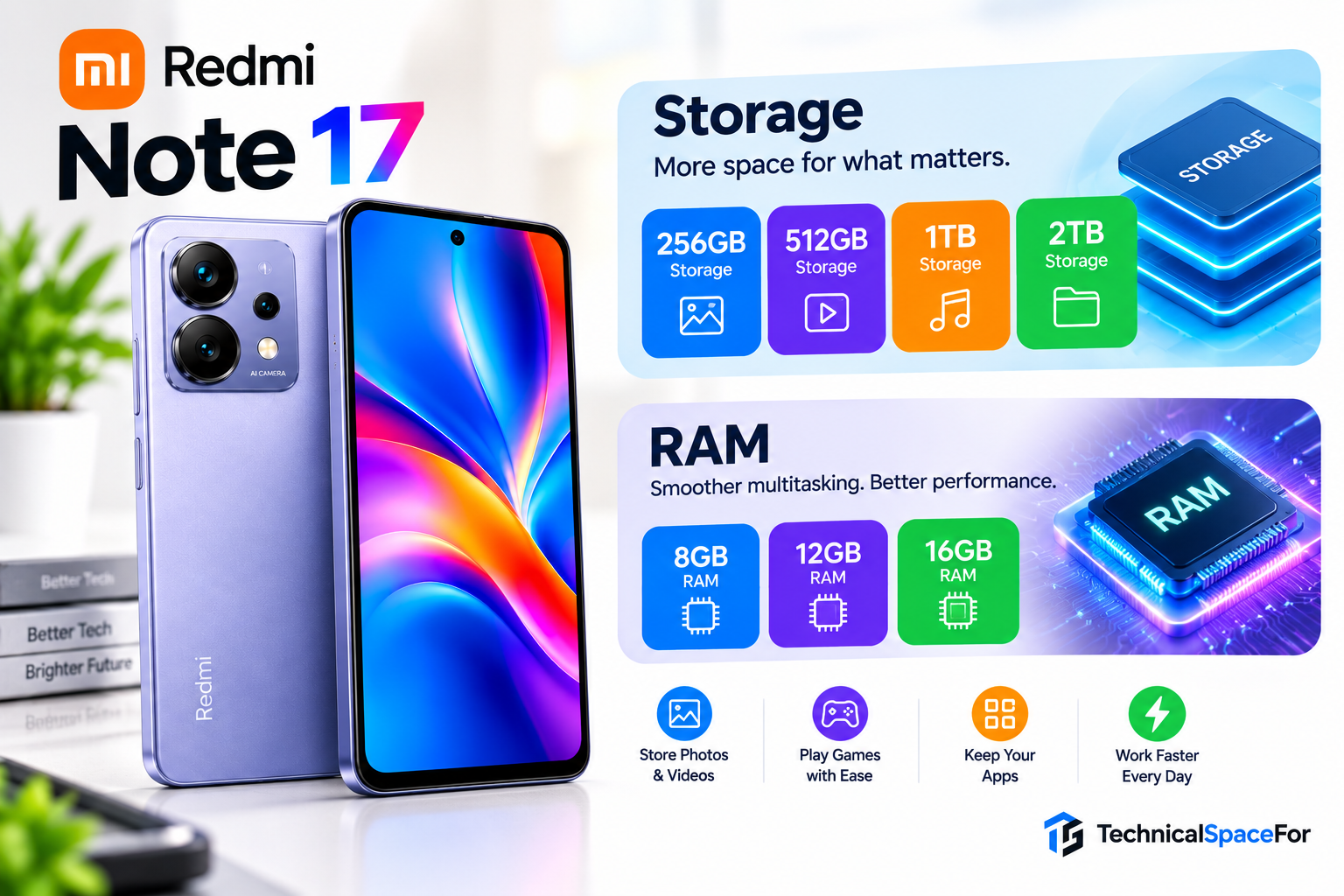
Redmi Note 17 Storage and RAM
Redmi Note 17 showcasing storage and RAM options for smoother performance
The Xiaomi Redmi Note 17 5G and 4G models come in variations that feature up to 8GB of physical memory and 256GB of storage, but depending on the market where they are sold, different options might be available; having more memory will prove useful to those users who have a lot of photos, videos, applications, and even video games, stored on their phone
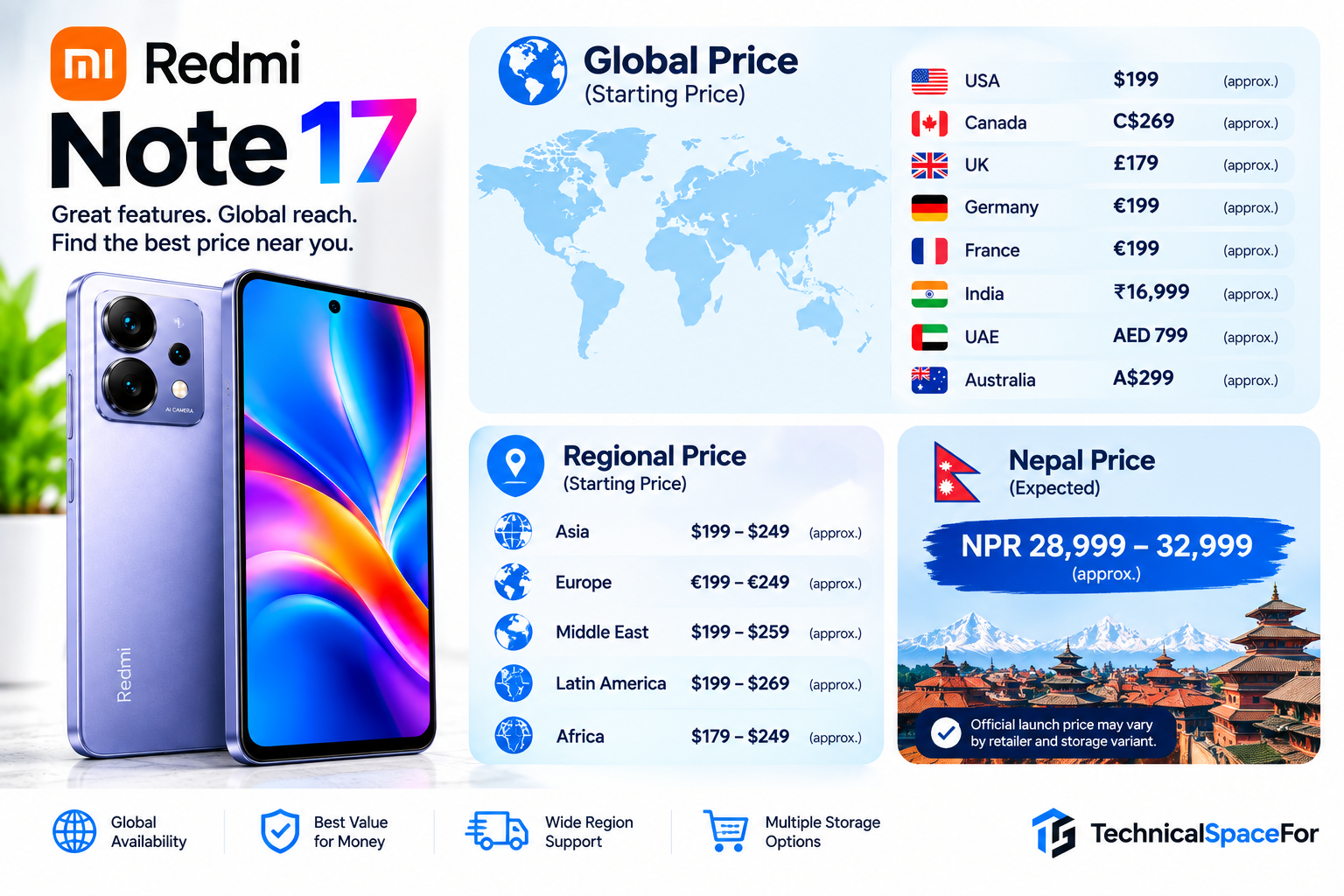
Redmi Note 17 Cost in the World, Region and Nepal
Redmi Note 17 pricing overview across global markets, regions and Nepal.
Costs of Redmi Note 17 phones vary depending on phone type, amount of RAM, storage space, market situation, taxes and promotional campaigns by the seller, based on approximate international costs it is estimated that Redmi Note 17 4G will cost around €250 for 4GB\128GB and €300 for 6GB/256GB, while Redmi Note 17 5G will cost €400 for 6GB/256GB, while Pro versions of those phones will cost from €500-€600, although the real regional price may be completely different in nepal Redmi Note 17 phones cost NPR 42999 for Redmi Note 17 4G (6/128GB) and NPR 69999 for Redmi Note 17 Pro Max (8/256GB). If some approximate international prices have been released then buyers should double check them
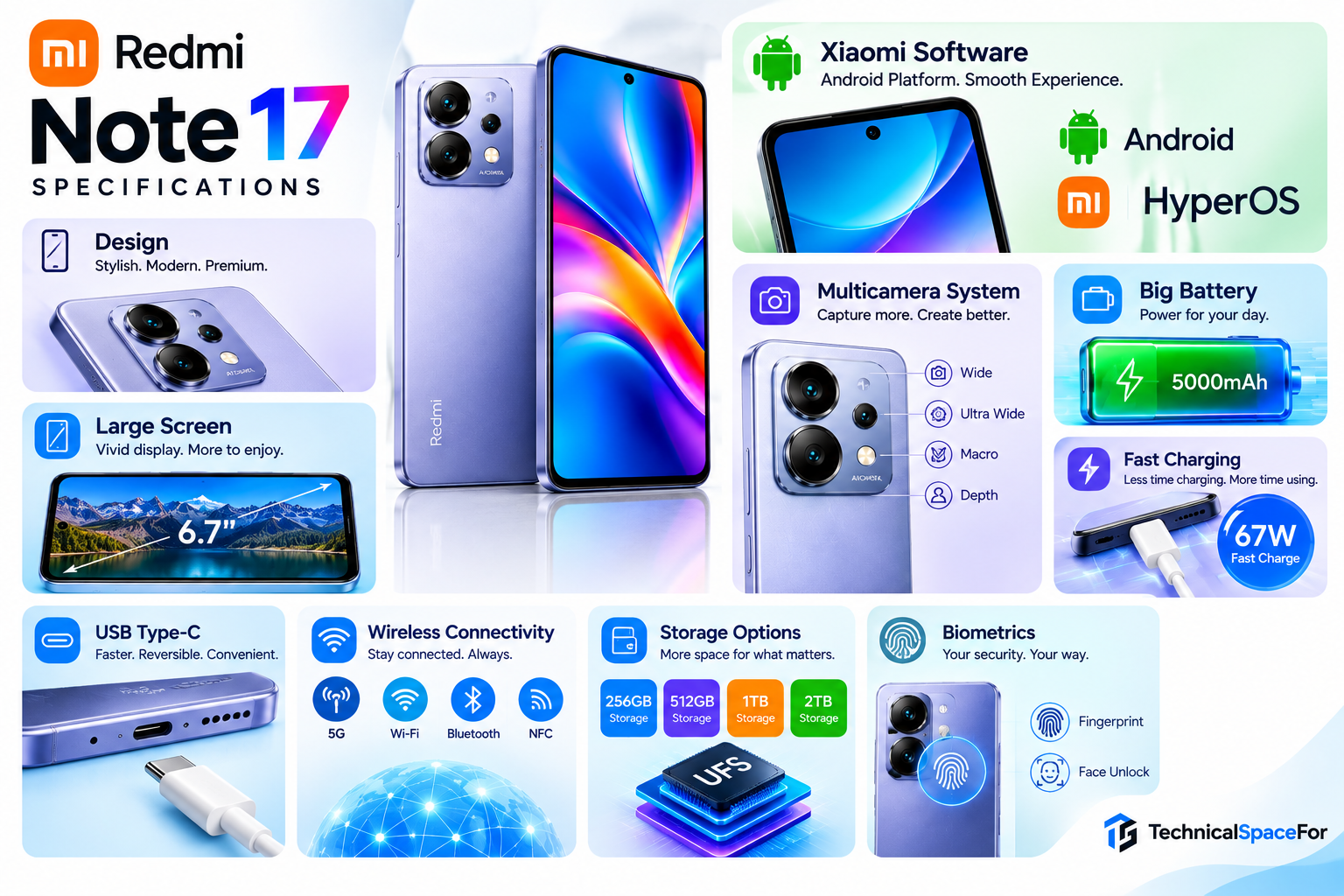
Redmi Note 17 Specifications
Redmi Note 17 showcasing its design, display, cameras, battery, storage and connectivity features
Here are some of the top things that users need to think about:
Redmi Note 17 design
Large screen phone
Xiaomi phone software running on Android platform
Multicamera system for photographs
Big battery capacity
Fast charging mechanism
USB Type-C connection
Wireless connectivity system
Storage options
Biometrics
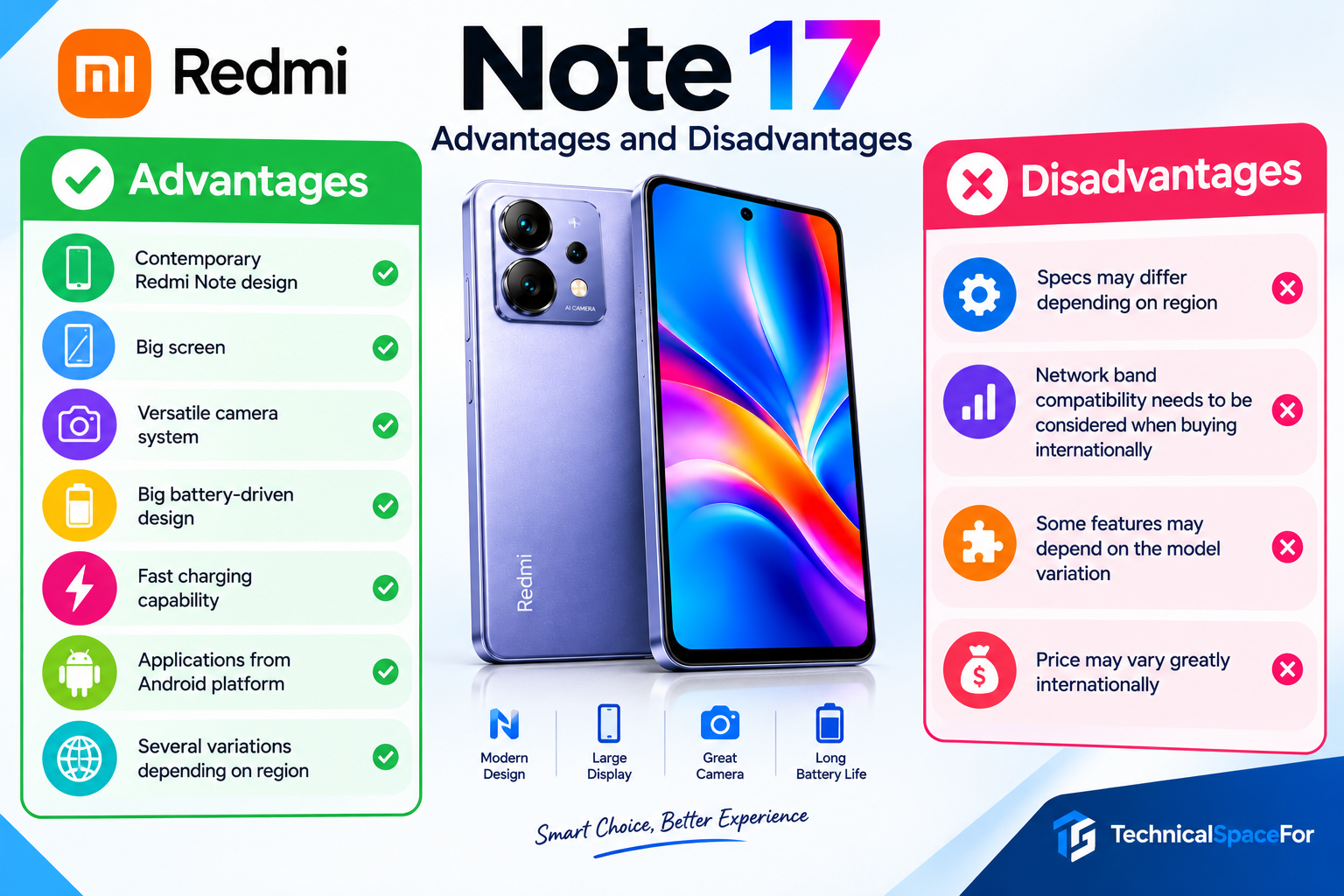
Redmi Note 17 Advantages and Disadvantages
Redmi Note 17 pros and cons, including design, display, camera, battery and regional limitations
Advantages
Contemporary Redmi Note design
Big screen
Versatile camera system
Big battery-driven design
Fast charging capability
Applications from Android platform
Several variations depending on region
Disadvantages
Specs may differ depending on region
Network band compatibility needs to be considered when buying internationally
Some features may depend on the model variation
Price may vary greatly internationally
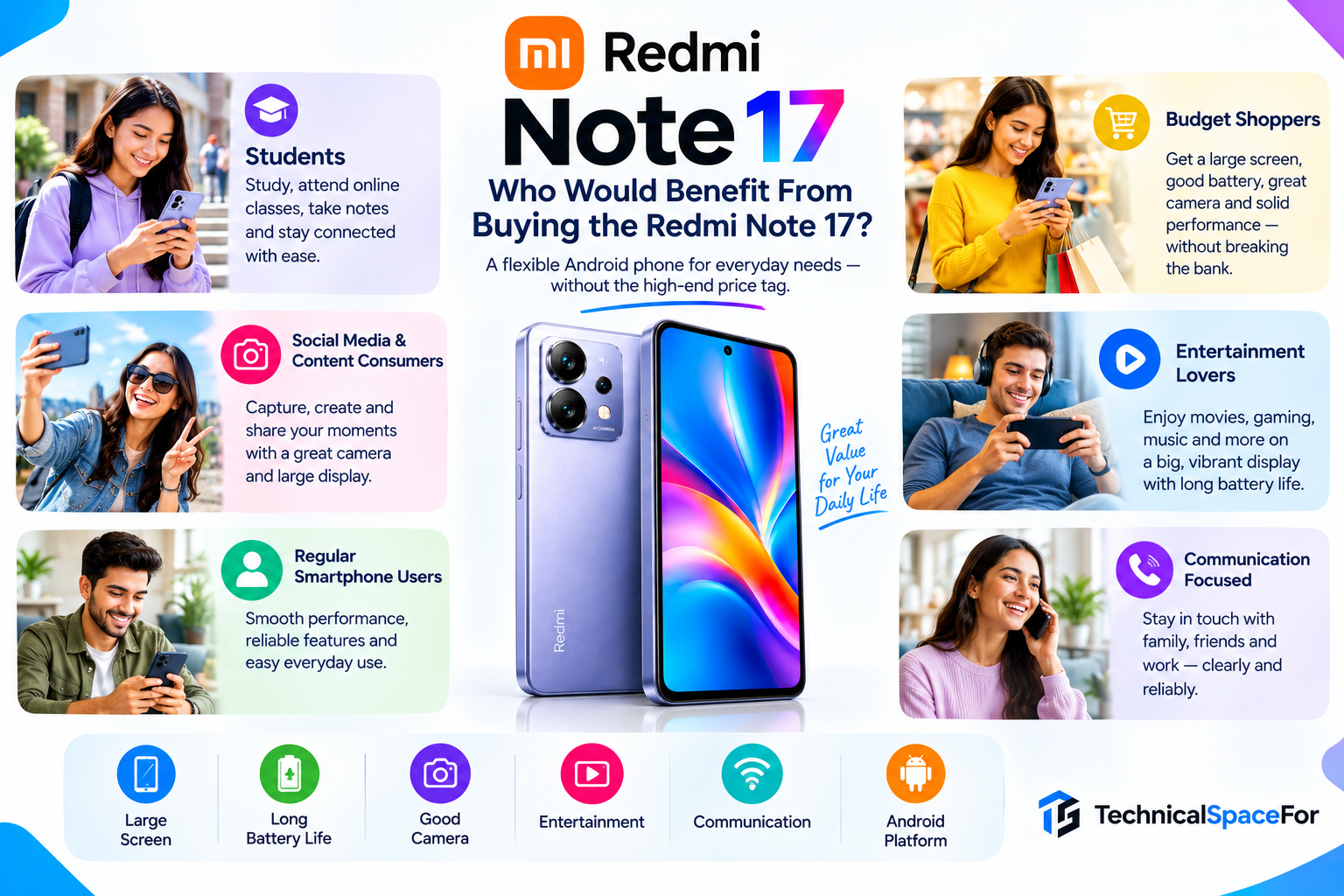
Who Would Benefit From Buying the Redmi Note 17?
Redmi Note 17 for students, content consumers, budget shoppers, entertainment and everyday use.
The Redmi Note 17 is meant to serve people who need a flexible and versatile Android phone for all kinds of activities but who are not interested in stepping into a high-end flagship category of mobile phones. This phone would suit students, social media and content consumers, regular smartphone users, budget shoppers looking for a large screen, good battery backup, good camera, entertainment, and communication.
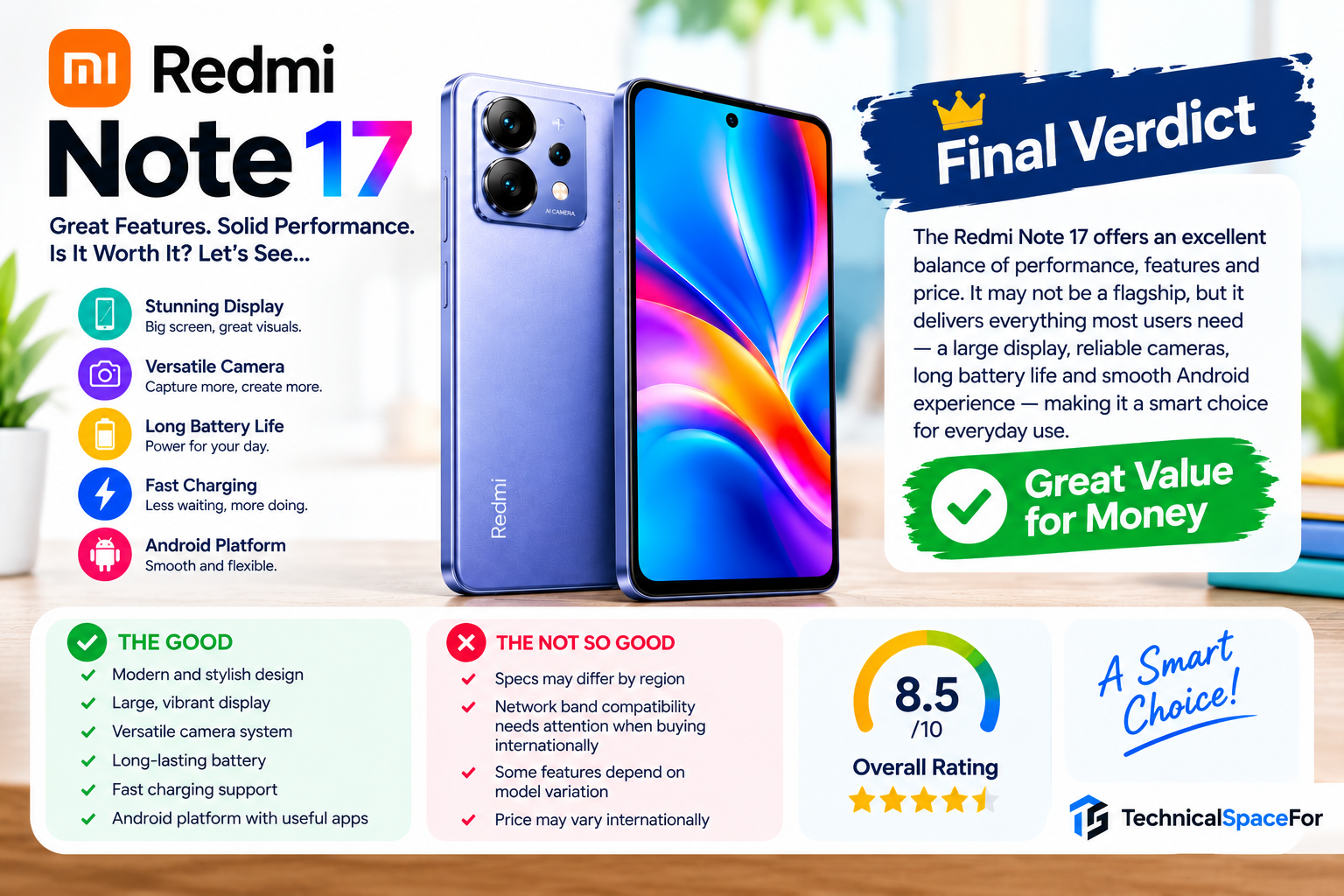
Redmi Note 17 Final Verdict
Redmi Note 17 final verdict covering display, camera, battery, performance and key features.
Redmi Note 17 is a multipurpose Android phone for diverse users across the world. It offers features like a high-definition screen, performance, camera functions, battery life, and connectivity for uses like video streaming, social networking, photography, gaming, surfing the internet, and communications depending on the configuration of RAM, storage, 4G, and 5G, specifications may differ from one market to another. Prospective buyers are advised to find out about their respective models in the area generally the Redmi Note 17 is a feature-centric smartphone targeted at customers who would like to have up-to-date hardware as well as practical functionality.
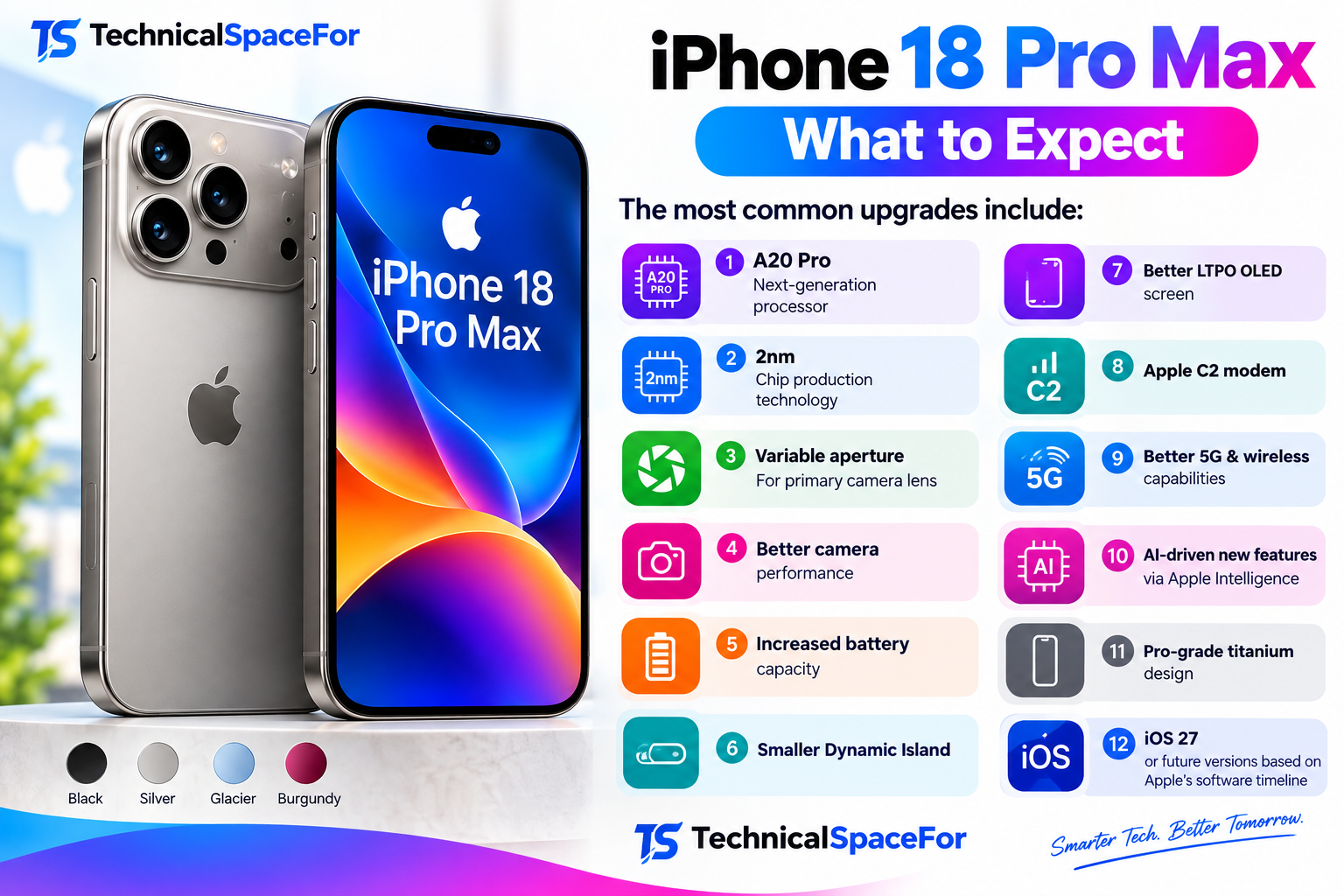
The iPhone 18 Pro Maxand the iPhone 18 Pro Max will reportedly be introduced by Apple in September 2026, coming packed with a host of interesting features and upgrades for its high-end iPhone lineups. Based on leaks and reports from inside the industry, some of the new features that may be found in the iPhone Pro models are a variable aperture lens system, the latest generation of the 2nm A20 Pro chip, improved battery capacity, a smaller Dynamic Island and many more AI-enabled features. In this article, let us discuss everything known about the new iPhones.
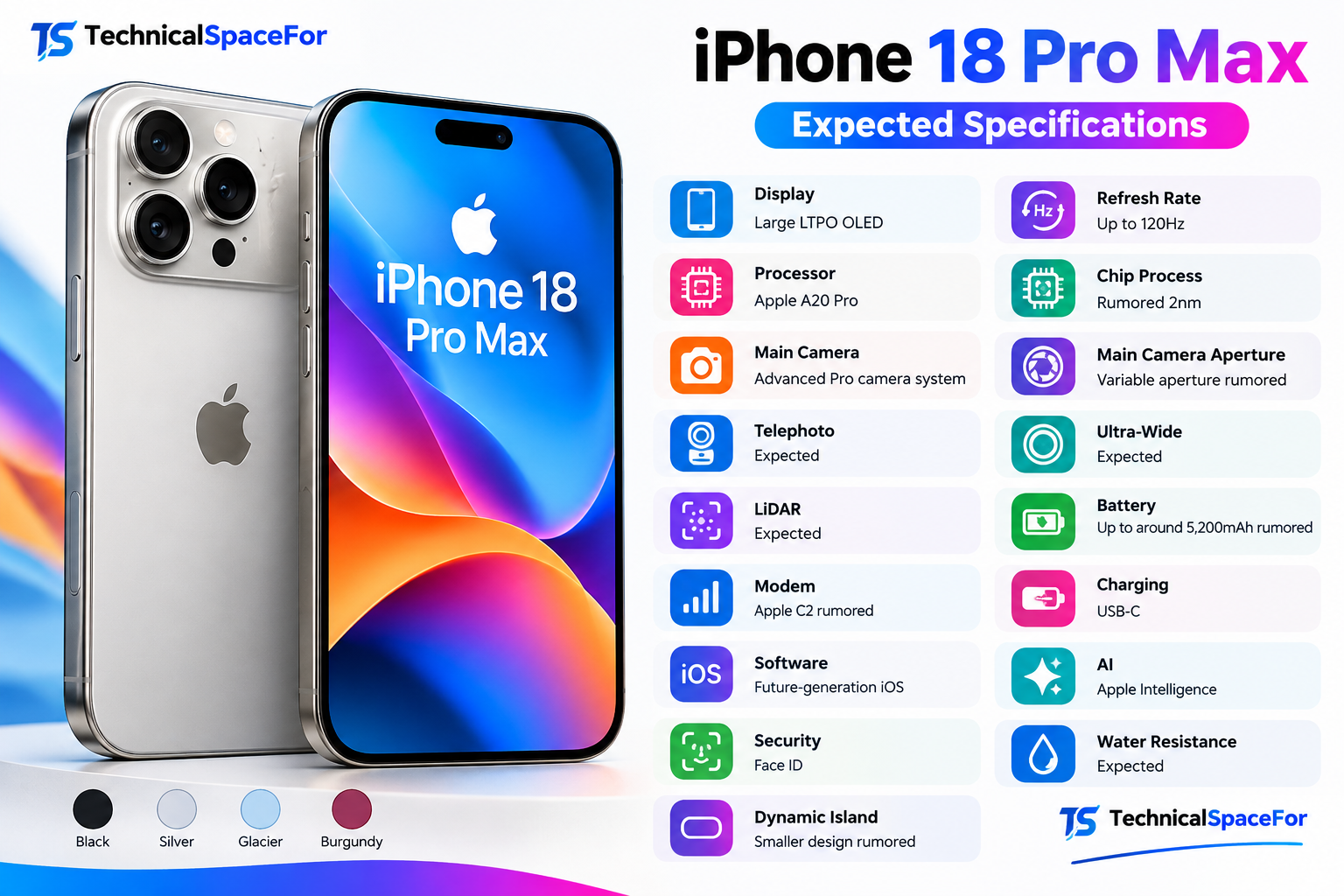
iPhone 18 Pro Max Expected Specifications
iPhone 18 Pro Max expected specs, including A20 Pro, advanced cameras, 120Hz LTPO OLED, 5,200mAh battery, Apple Intelligence, and USB-C.
Feature
iPhone 18 Pro Max — Expected
Display
Large LTPO OLED
Refresh Rate
Up to 120Hz
Processor
Apple A20 Pro
Chip Process
Rumored 2nm
Main Camera
Advanced Pro camera system
Main Camera Aperture
Variable aperture rumored
Telephoto
Expected
Ultra-Wide
Expected
LiDAR
Expected
Battery
Up to around 5,200mAh rumored
Modem
Apple C2 rumored
Charging
USB-C
Software
Future-generation iOS
AI
Apple Intelligence
Security
Face ID
Water Resistance
Expected
Dynamic Island
Smaller design rumored
iPhone 18 Pro Max: What to Expect
iPhone 18 Pro Max expected upgrades, including A20 Pro, 2nm chip, improved cameras, battery, AI, and smaller Dynamic Island.
iPhone 18 Pro Max may very well be a major step forward for the high-end iPhone range of devices by Apple.
The most common upgrades include:
A20 Pro next-generation processor
2nm chip production technology
Variable aperture for primary camera lens
Better camera performance
Increased battery capacity
Smaller Dynamic Island
Better LTPO OLED screen
Apple C2 modem
Better 5G & wireless capabilities
AI-driven new features via Apple Intelligence
Pro-grade titanium design
iOS 27 or future versions based on Apple’s software timeline
Though some of these features have been frequently discussed in leaks, Apple has not confirmed the final hardware specifications yet.
iPhone 18 Pro Max Expected Price
The iPhone 18 Pro Max is predicted to continue falling under Apple’s flagship premium pricing category, at a projected price tag of approximately $1,299 in the United States. However, prices may vary depending on the country due to factors such as taxes, exchange rates, import fees, and more the initial prices of the models range from CA$1,749 for the Canadian market, £1,299 for the British, €1,499 for the European, A$2,299 for the Australian, INR 1,84,900 to INR 1,94,9 these figures represent the estimates which are currently being made according to the market speculation. The official price by Apple can be different when the iPhone 18 Pro Max will be launched.
iPhone 18 Pro Max Launch Date
The launch date for the iPhone 18 Pro Maxwill be set for September 2026, which will follow the conventional iPhone release date for the year 2026. The iPhone 18 Pro and the iPhone 18 Pro Max will likely be released simultaneously with pre-orders starting soon after their official launch the first availability will be in September 2026, with an extended international launch to follow thereafter in late September or October. The Nepal availability could commence after the international launch, based on Apple’s schedule no exact date for the announcement, pre-ordering, and releasing is known yet, and thus these dates must be considered approximate until an official timetable from Apple becomes available.
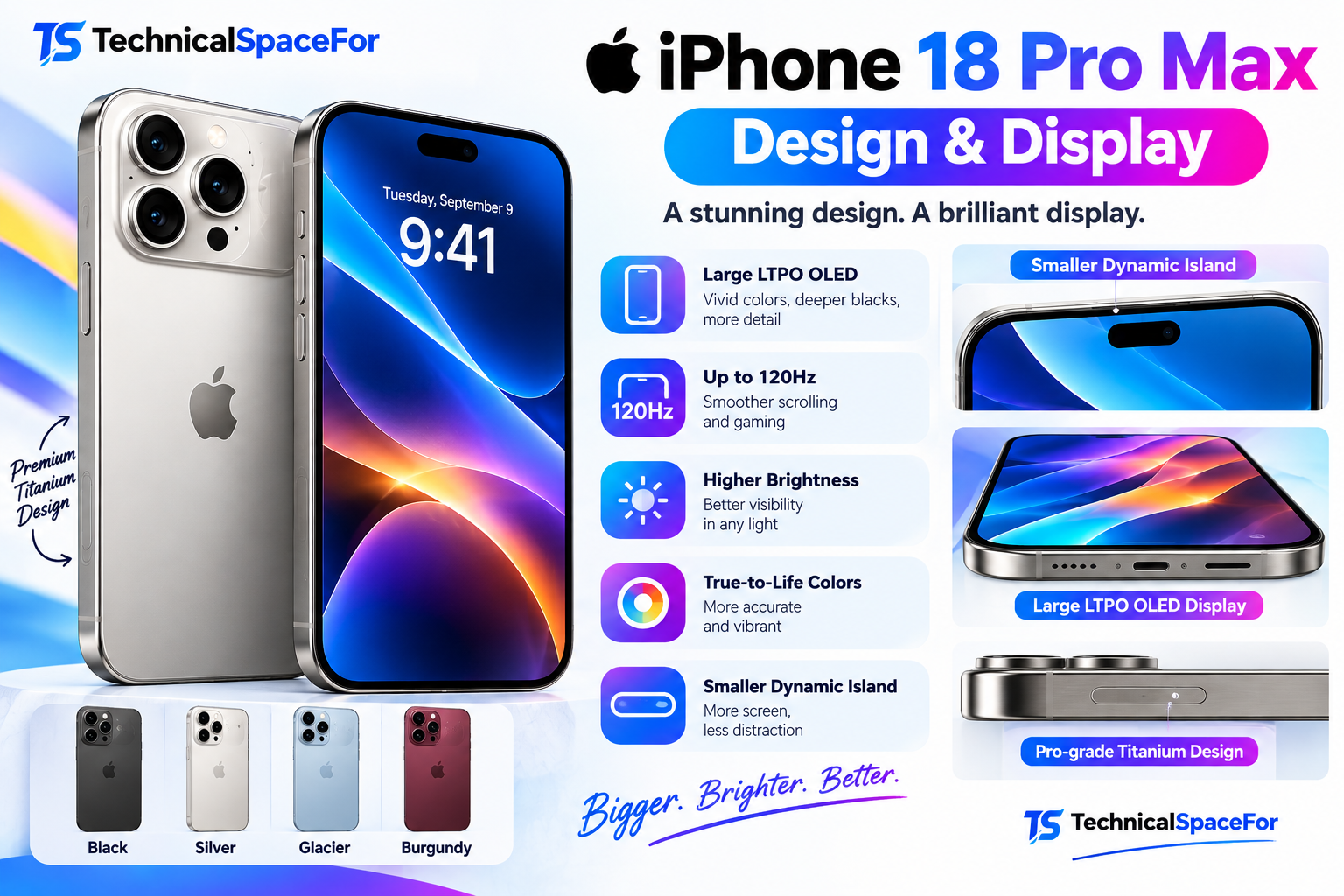
iPhone 18 Pro Max Design & Display
iPhone 18 Pro Max design with premium titanium, LTPO OLED display, 120Hz refresh rate, and smaller Dynamic Island.
It is anticipated that the iPhone 18 Pro Max will keep Apple’s Pro model features including metal body, glass back, sharp edges, tri-cameras, USB-C, Action Button, Camera Control, and dust and water resistance. One thing that may differ is the Dynamic Island which will get smaller, thus providing more space for screen usage, but it will still be possible to use Face ID and sensors the display on the phone is set to consist of an LTPO OLED panel featuring proMotion and having a refresh rate of 120Hz. Some upgrades in the display can include brighter display, HDR display, Always-On display, improved visibility outdoors, and increased efficiency. However, the exact dimensions of the screen and its resolution are still unknown.
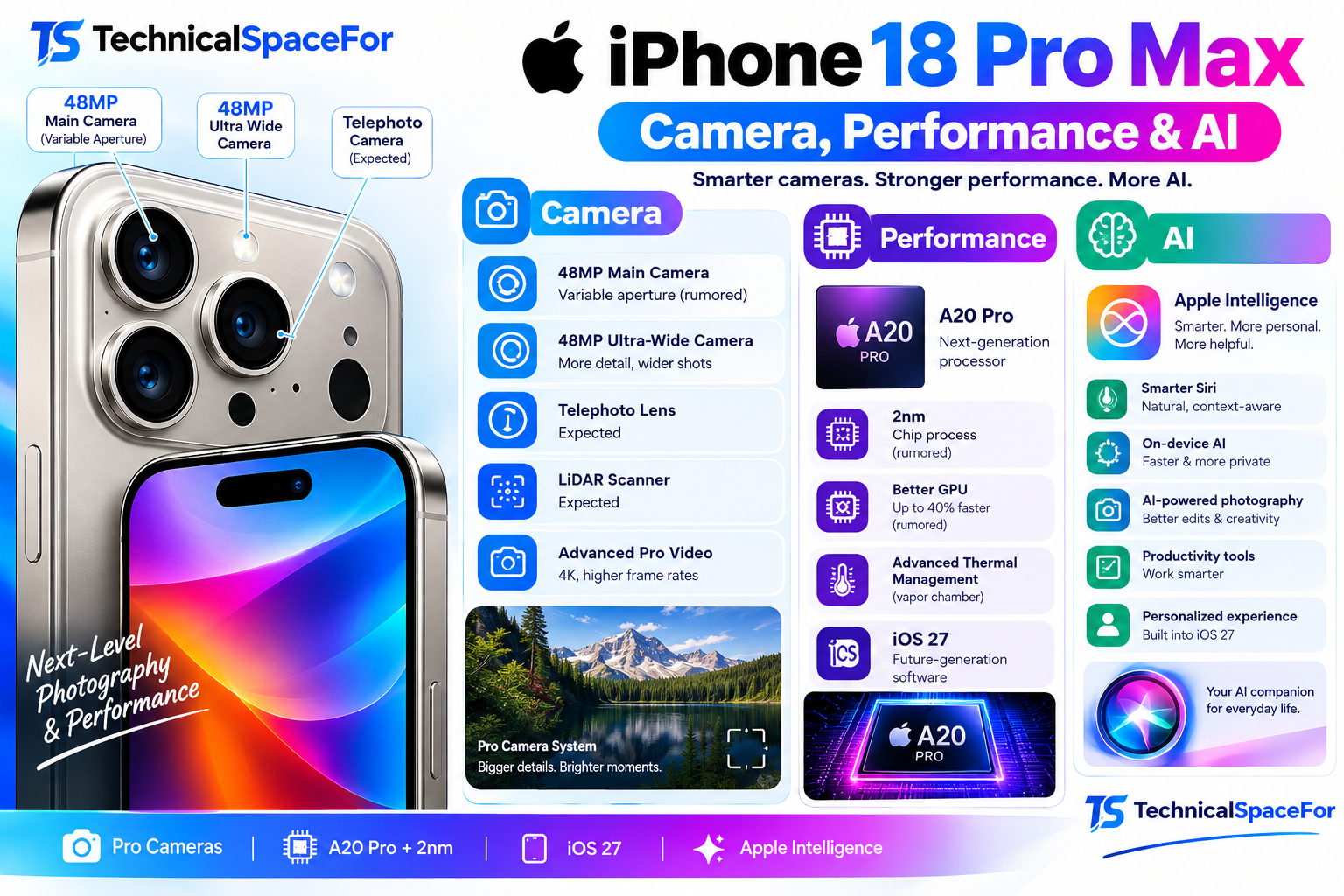
iPhone 18 Pro Max Camera, Performance & AI
iPhone 18 Pro Max expected camera upgrades, A20 Pro performance, 2nm technology, and Apple Intelligence features.
The iPhone 18 Pro Max might see some amazing upgrades with respect to its camera system. The most talked about upgrade could possibly be a variable aperture main camera, which could help in improving the phone’s photographic abilities in various ways. the Pro camera system will be retained, with main, ultra-wide, and telephoto cameras, and features like LiDAR, ProRAW, ProRes, computational photography, and stabilization technology. The next-generation A20 Pro chip may also improve camera processing regarding its performance, the iPhone 18 Pro Max will reportedly use the A20 Pro chip and may even go for a 2nm production process. Some advantages that can come from it are enhanced CPU and GPU performance, AI computing, gaming, video editing, and camera computations. this phone will have the ability to integrate with the most recent capabilities of Apple Intelligence, which could mean enhancements in Siri, generative AI, writing, images, intelligent notifications, personal assistance, and on-device AI integration. AI capabilities can differ based on region, language, hardware, and the final version of the software by Apple.
Please take note that the technical data on the camera, A20 Pro chipset, and AI technology have not been confirmed as yet by Apple.
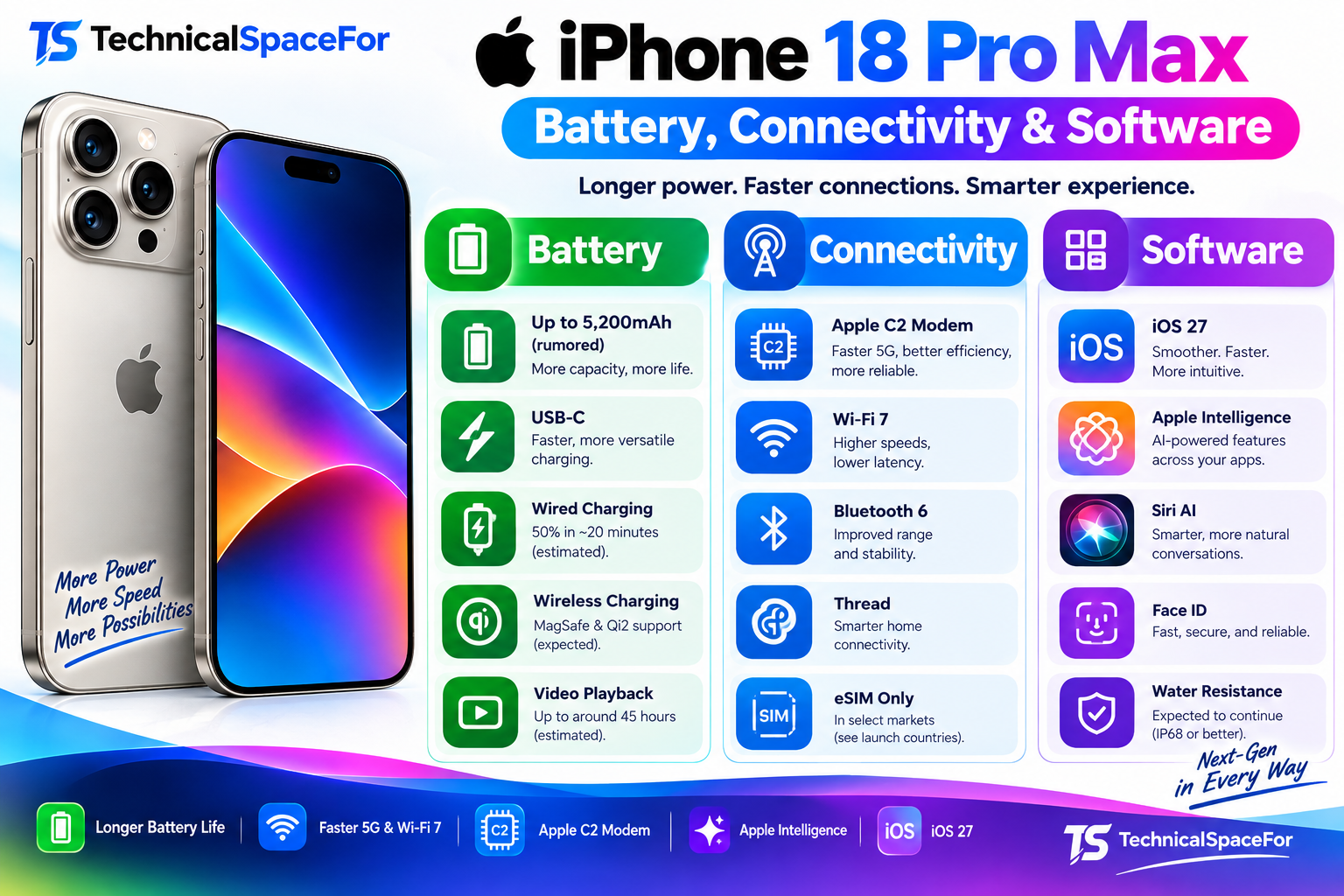
iPhone 18 Pro Max Battery, Connectivity & Software
iPhone 18 Pro Max expected battery, Apple C2 modem, Wi-Fi 7, iOS 27, and Apple Intelligence features.
The iPhone 18 Pro Max may come with a battery of around 5,200mAh according to some reports, but there has been no confirmation from Apple about the same. While a larger battery, an efficient processor, and an LTPO screen could help provide better battery life, how much battery one can actually get will depend upon many factors like brightness, 5G connectivity, gaming, streaming, camera, AI processing, apps, signal strength, and temperature there are rumors that the device will be equipped with Apple C2 modem, which may boost network efficiency. Connectivity will reportedly include 5G, Wi-Fi, Bluetooth, Ultra Wideband, NFC, satellite connectivity, and USB-C; however, specifications have not yet been officially confirmed regarding the software side of things, the iPhone 18 Pro Max is anticipated to be unveiled running a future iteration of iOS. This would emphasize the following: Apple Intelligence, privacy, security, customizability, multitasking, camera capabilities, and integration into the Apple ecosystem. Apple would also be providing multiple years of software updates.
Note: Battery Capacity, Specifications for the C2 Modem, Connectivity Standards, and Final Software Features are according to reports and assumptions and have not been officially confirmed by Apple.
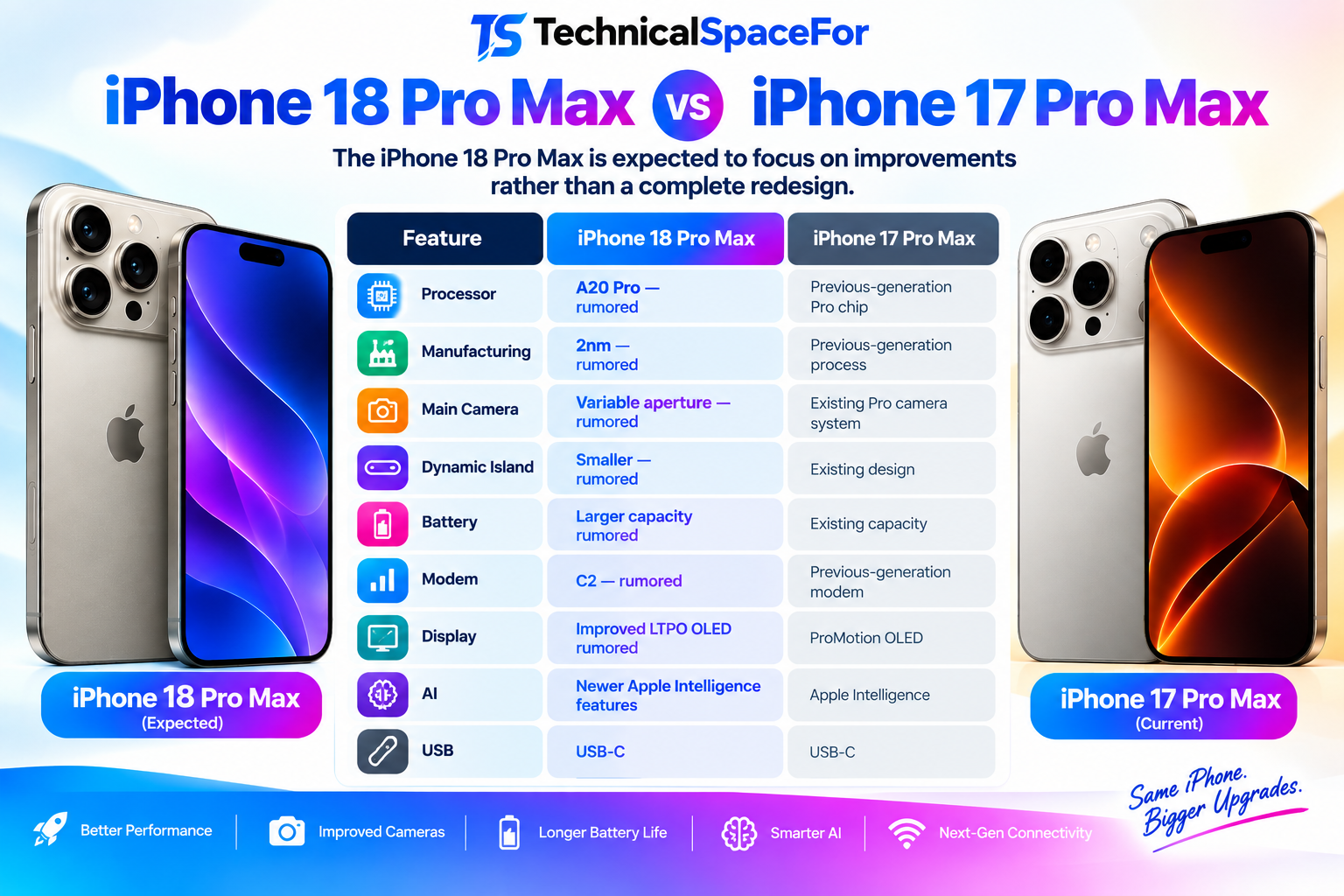
iPhone 18 Pro Max vs iPhone 17 Pro Max
iPhone 18 Pro Max vs iPhone 17 Pro Max comparison of processor, camera, battery, display, modem, AI, and USB-C.
The iPhone 18 Pro Max is expected to focus on improvements rather than a complete redesign.
Feature
iPhone 18 Pro Max
iPhone 17 Pro Max
Processor
A20 Pro — rumored
Previous-generation Pro chip
Manufacturing
2nm — rumored
Previous-generation process
Main Camera
Variable aperture — rumored
Existing Pro camera system
Dynamic Island
Smaller — rumored
Existing design
Battery
Larger capacity rumored
Existing capacity
Modem
C2 — rumored
Previous-generation modem
Display
Improved LTPO OLED rumored
ProMotion OLED
AI
Newer Apple Intelligence features
Apple Intelligence
USB
USB-C
USB-C
However, the real distinctions can only be ascertained once Apple launches its product.
iPhone 18 Pro Max: Key Expected Features
These are the main rumored features:
A20 Pro chip
2 nm processor technology
Variable aperture main camera
Enhanced Pro camera system
Increased capacity battery
Reduced size of Dynamic Island
More luminous LTPO OLED display
Apple C2 modem
Upgraded Apple Intelligence
USB-C port
Pro design
Energy-efficient power consumption
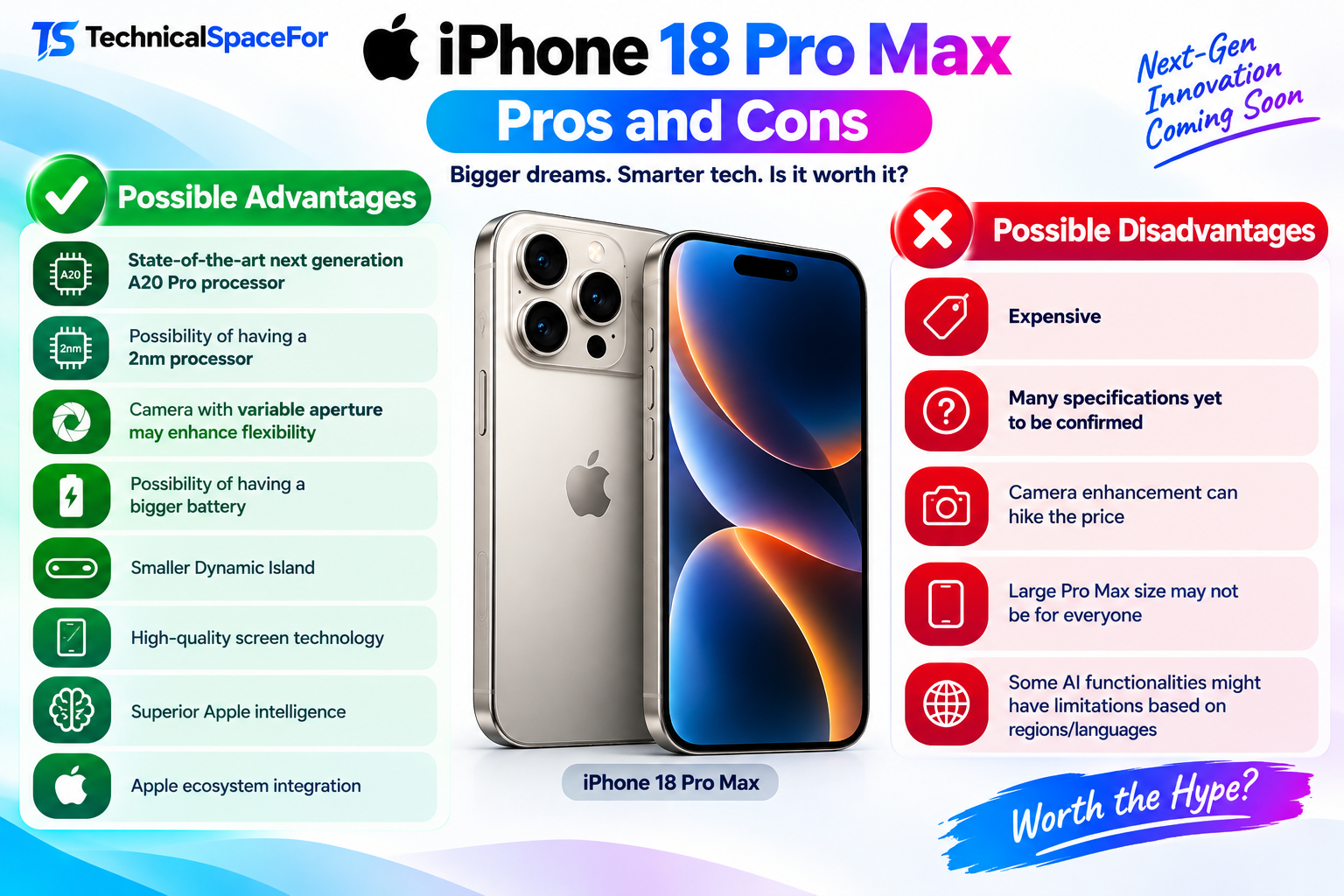
iPhone 18 Pro Max Pros and Cons
iPhone 18 Pro Max potential advantages and disadvantages, including performance, camera, battery, AI, price, and size.
Possible Advantages
State-of-the-art next generation A20 Pro processor
Possibility of having a 2nm processor
Camera with variable aperture may enhance flexibility
Possibility of having a bigger battery
Smaller Dynamic Island
High-quality screen technology
Superior Apple intelligence
Apple ecosystem integration
Possible Disadvantages
Expensive
Many specifications yet to be confirmed
Camera enhancement can hike the price
Large Pro Max size may not be for everyone
Some AI functionalities might have limitations based on regions/languages
iPhone 18 Pro Max Final Verdict
iPhone 18 Pro Max expected upgrades, including A20 Pro, camera improvements, battery, AI, and display technology.
If everything that is being reported regarding the phone at present turns out to be true, then the iPhone 18 Pro Max will turn out to be one of Apple’s most advanced phones. It will have a new A20 Pro chip, potential 2nm fabrication process, variable aperture cameras, large battery, improved display, reduced size Dynamic Island, and advanced AI capabilities nonetheless, it is critical that facts are distinguished from gossip. The company has not yet released official specifications and pricing on the products mentioned above for now, the iPhone 18 Pro Max is still one of the most talked about flagships, and we can be sure to learn more when Apple officially announces it TechnicalSpaceFor will update this article after the official confirmation of the iPhone 18 Pro Max specs, pricing, and release date by Apple.
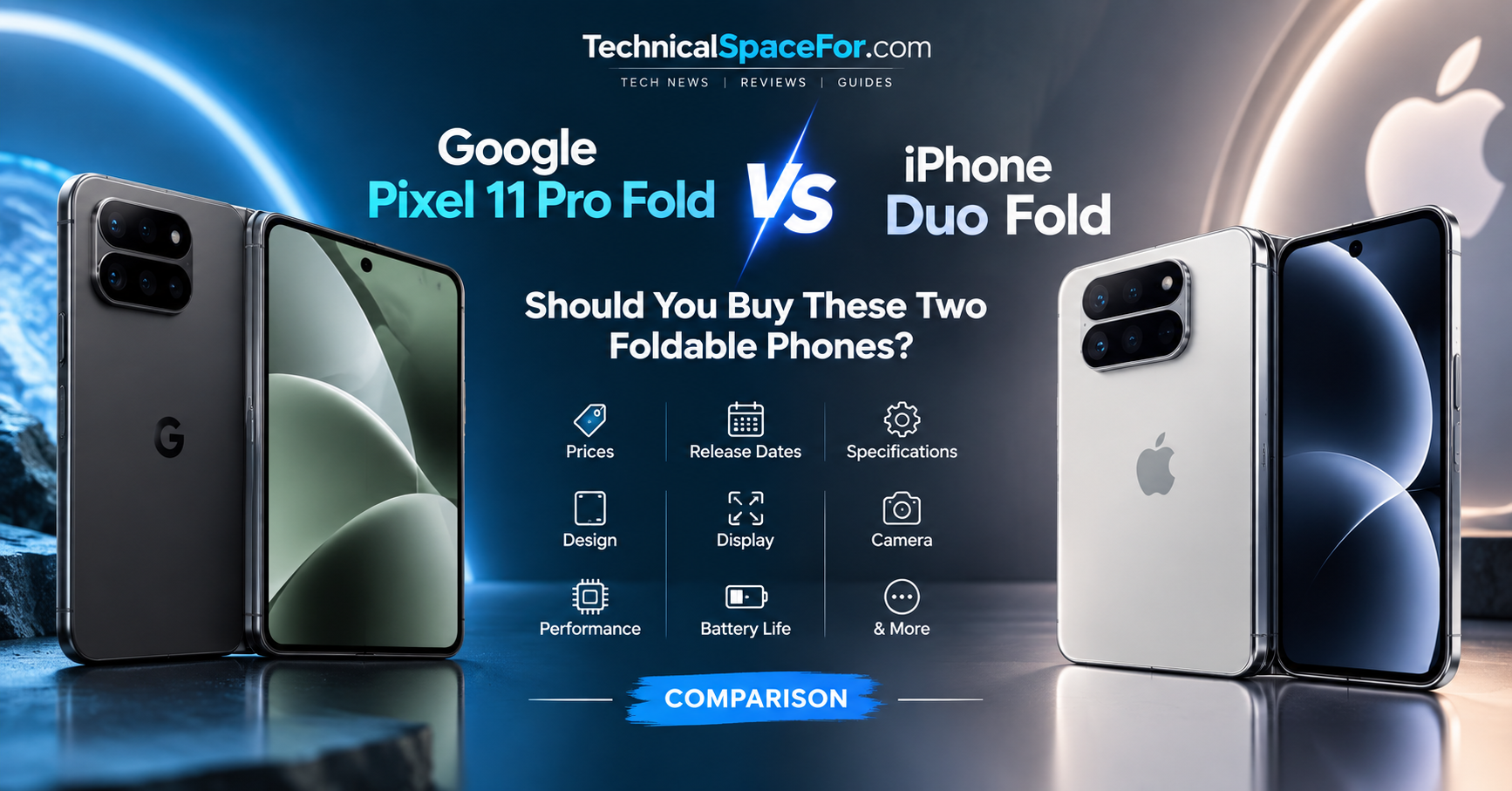
The world of foldable smartphones has become quite promising, with the Google Pixel 11 Pro Foldand Apple iPhone Duo Foldbecoming some of the premium foldable phones available on the market. the Pixel series from Google is renowned for having a pure Android operating system, computational photography, Google AI capabilities, and being deeply integrated with Google products. On the other hand, Apple has gained popularity due to the high-end hardware, iOS operating system, Apple silicon, camera technology, software support, and overall ecosystem. thus , the Pixel 11 Pro Fold vs iPhone Duo Fold is not just a comparison of technical specifications. In fact, both smartphones are based on different ideas about foldable phones. Now, in this comprehensive comparison, we will talk the price, launch date, design, screen choices, camera features, performance, operating system options, battery life, charging options, features, and user experience of about Google Pixel 11 Pro Fold and Apple iPhone Duo Fold.
It should be kept in mind that specifications and prices might differ from one market to another. For more details, you can visit Google Store and Apple.
Google Pixel 11 Pro Fold vs iPhone Duo Fold: Quick Comparison
Google Pixel 11 Pro Fold vs iPhone Duo Fold: Quick comparison of design, display, camera, performance, battery, AI, and software.
Feature
Google Pixel 11 Pro Fold
Apple iPhone Duo Fold
Brand
Google
Apple
Category
Premium Foldable Smartphone
Premium Foldable iPhone
Operating System
Android
iOS
Software Ecosystem
Google / Android
Apple
Main Focus
AI, Android, Pixel camera experience
iOS, Apple ecosystem, performance
Form Factor
Foldable
Foldable
Display
Foldable multi-display design
Foldable multi-display design
Camera
Pixel computational photography
Apple camera and image processing
Processor
Google Tensor platform
Apple silicon platform
Battery
Foldable smartphone battery
Foldable smartphone battery
Charging
USB-C
USB-C
AI
Google AI features
Apple Intelligence
Best For
Android and Google users
Apple ecosystem users
Google Pixel 11 Pro Fold vs iPhone Duo Fold: Price
Google Pixel 11 Pro Fold vs iPhone Duo Fold: Price comparison by market.
Price is one of the primary considerations that influence the choice of the foldable phone Google Pixel 11 Pro Fold is one of Google’s Pixel premium products, whereas iPhone Duo Fold can be considered an Apple’s foldable version of an iPhone Foldable smartphones usually have a higher price point than non-foldable flagships because of more complicated screens, mechanisms, flexible parts, and engineering inside.
In any case, for the consumer, the final price cannot be evaluated just from the basic configuration. There can be a number of different factors that will affect the actual price.
Price Comparison
Market
Pixel 11 Pro Fold
iPhone Duo Fold
United States
Check Google Store
Check Apple
India
Check regional availability
Check Apple India
Nepal
Local market pricing may vary
Local market pricing may vary
Other Markets
Varies
Varies
For the accurate pricing use the official product pages:
Google Pixel 11 Pro Fold:
https://store.google.com/us/?hl=en-US®ionRedirect=true/
There is also the aspect of release date, which may vary from one country to another depending on how Google or Apple wants to roll out their new products this implies that consumers should look for the official shops in their countries rather than depending on the international release dates alone Pixel 11 Pro Fold is part of the Pixel series from Google, while the iPhone Duo Fold falls under the iPhone series of Apple Inc.
Design and Build Quality
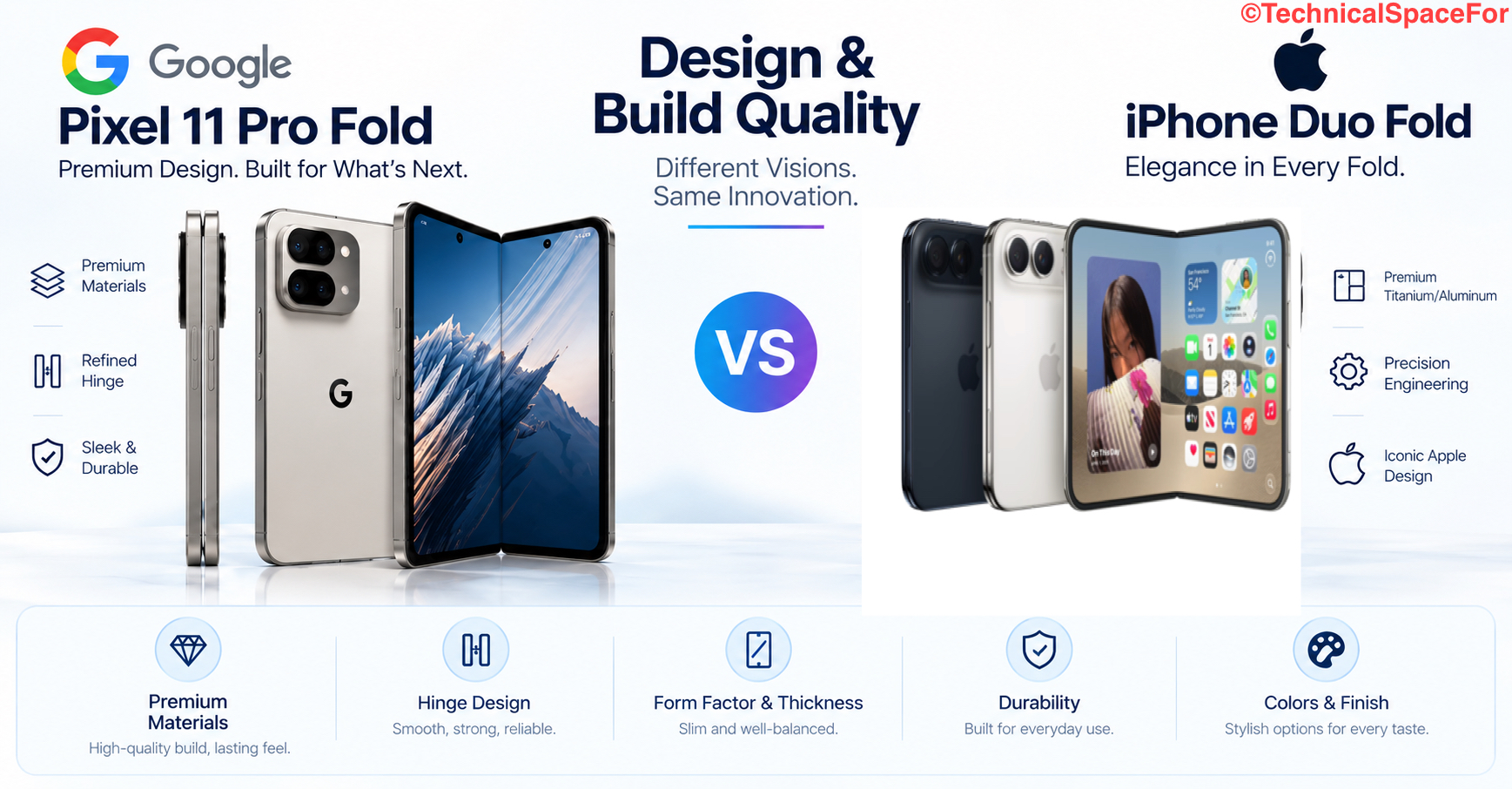
Pixel 11 Pro Fold vs iPhone Duo Fold: Design and build quality comparison.
Google Pixel 11 Pro Fold
Pixel 11 Pro Fold is an example of foldable phones that offer a conventional phone experience to the users when closed but have a large display when opened. This device is beneficial for users who multitask or need to read files, browse, watch movies, photoediting , or using various apps. The design philosophy of Pixel includes having a distinct camera bar and a flagship look.
iPhone Duo Fold
This iPhone product falls under the category of foldable smartphones. Asof designing the product under a traditional iPhone structure, the foldable smartphone is designed so be compact in its closed position but larger once opened up. It is predicted that the materials used, the design of the hinge, and that it will animations of the iOS operating system will be key considerations in this phone’s design.
Foldable Design: What Makes These Phones Different?
One key benefit of both phones is the form factor. In case of a conventional smartphone, there is just one screen. In case of a foldable smartphone, there is a possibility of having a large screen without the need of carrying a tablet. When Foldable Smartphones are Useful
Multitasking
Video watching
Reading
Internet surfing
E-mail and document writing
Social networking
Photoshopping
Playing games
Getting work done
However, there are also some drawbacks with foldables in the form of added weight, increased complexity of the hinge system, and increased cost of repairs.
Pixel 11 Pro Fold vs iPhone Duo Fold:Display Comparison
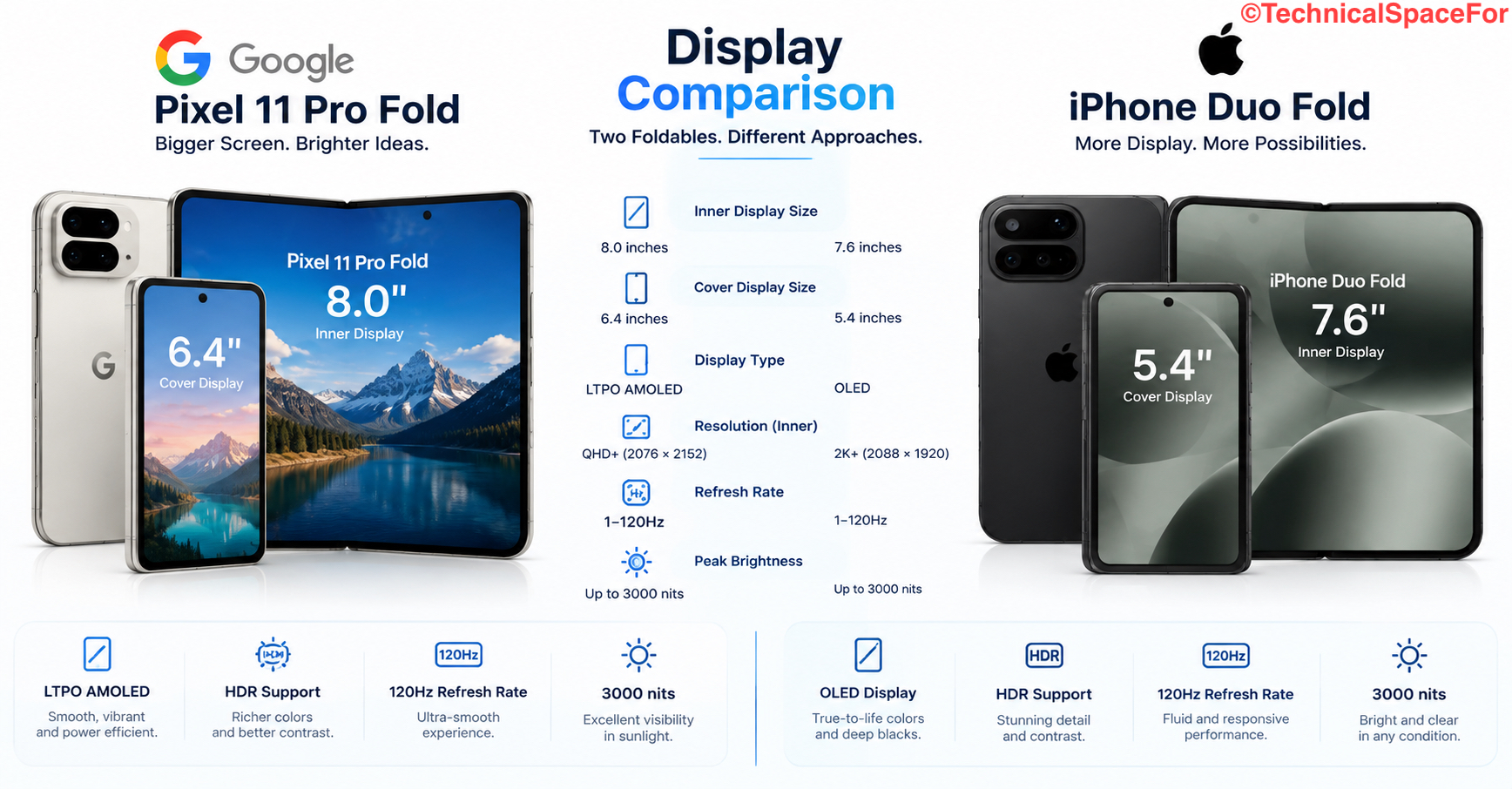
Pixel 11 Pro Fold vs iPhone Duo Fold: Display size, type, resolution, and refresh rate comparison.
Display technology forms a crucial part of a foldable phone. Pixel 11 Pro Fold Displayvery Pixel 11 Pro Fold is built based on Google’s foldable device concept, which offers an external display for conventional smartphone operation and an enlarged internal display in the case of unfolding. The enlarged internal display could offer more space for multitasking, entertainment, and other functions. iPhone Duo Fold Display The iPhone Duo Fold is another phone that tries to combine the conventional smartphone experience with an enlarged display in the process of unfolding. iOS from Apple has agreatest strength in that regard, considering the tight integration between the software and hardware from the company.
Display Experience
Where differences will matter most for typical usage are:
Size of the screen
Resolution
Refresh rate
Brightness
Visibility of fold
Ratio of aspect
Accuracy of color
Visibility outdoors
Support for multitasking
Optimization for apps
It’s better to consider the use case of the bigger screen, rather than a particular spec.
Pixel 11 Pro Fold vs iPhone Duo Fold: Camera Comparison
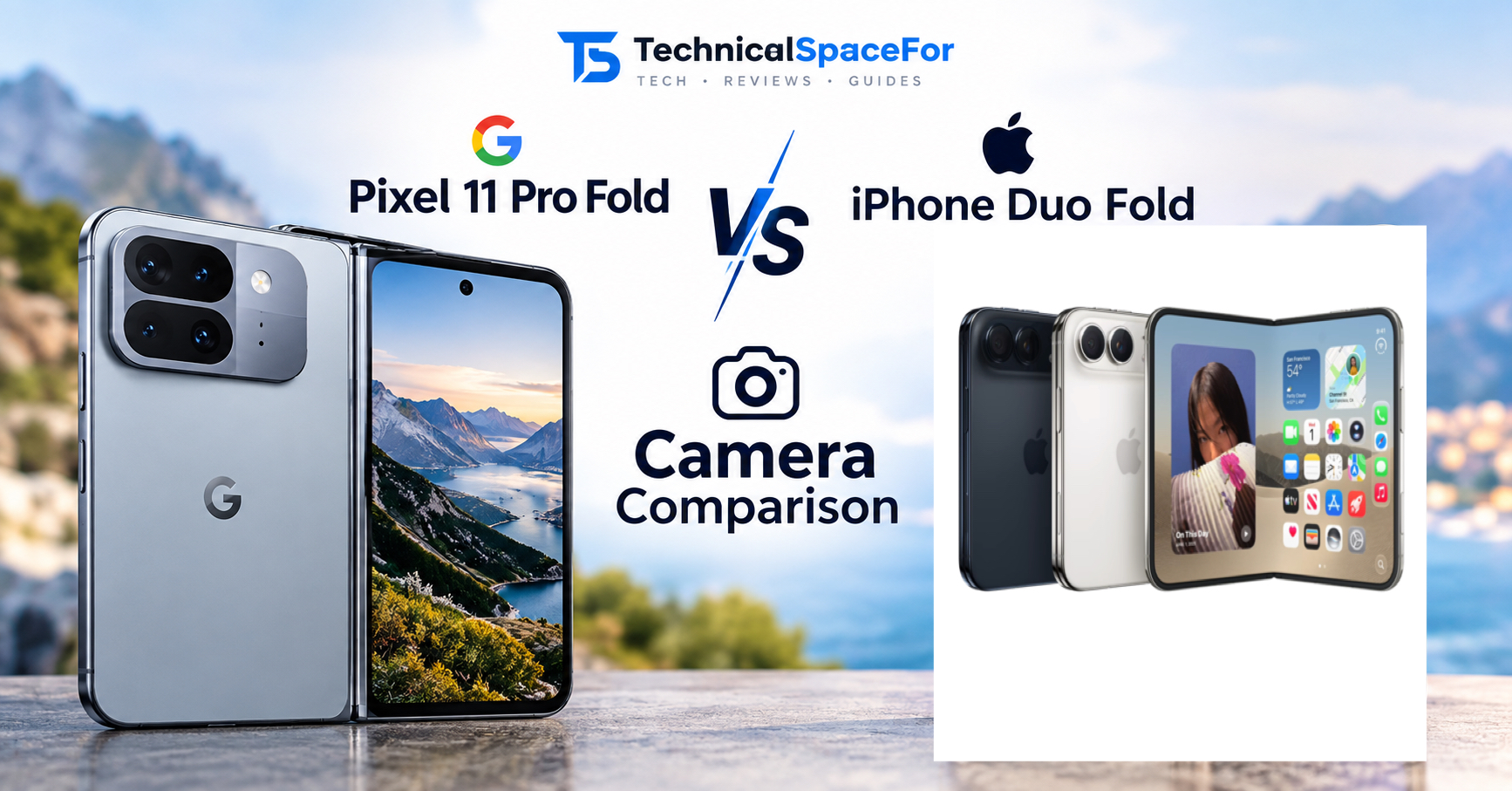
Pixel 11 Pro Fold vs iPhone Duo Fold: Camera Comparison
One more area where Google and Apple differ significantly in their approaches is camera capabilities. Pixel 11 Pro Fold Camera: Google Pixel phones have long been distinguished by their emphasis on computational photography. The Pixel models utilize Google image-processing algorithms and AI-enabled photography features to boost:
HDR
Low light photography
Portraits
Skin color toning
Sharpness
Computational zoom
Video processing
AI editing
The Pixel 11 Pro Fold is definitely an interesting choice for those looking for a camera tightly linked to Google’s computational photography system.
iPhone Duo Fold Camera: On the other hand, the camera of Apple smartphones is a combination of great hardware and software developed by Apple . For those who are into creating videos or social media posts, the iPhone is very significant. The camera of iPhone Duo Fold will also be beneficial thanks to the interaction with iOS and other parts of the Apple ecosystem.
Pixel 11 Pro Fold vs iPhone Duo Fold: Camera Features
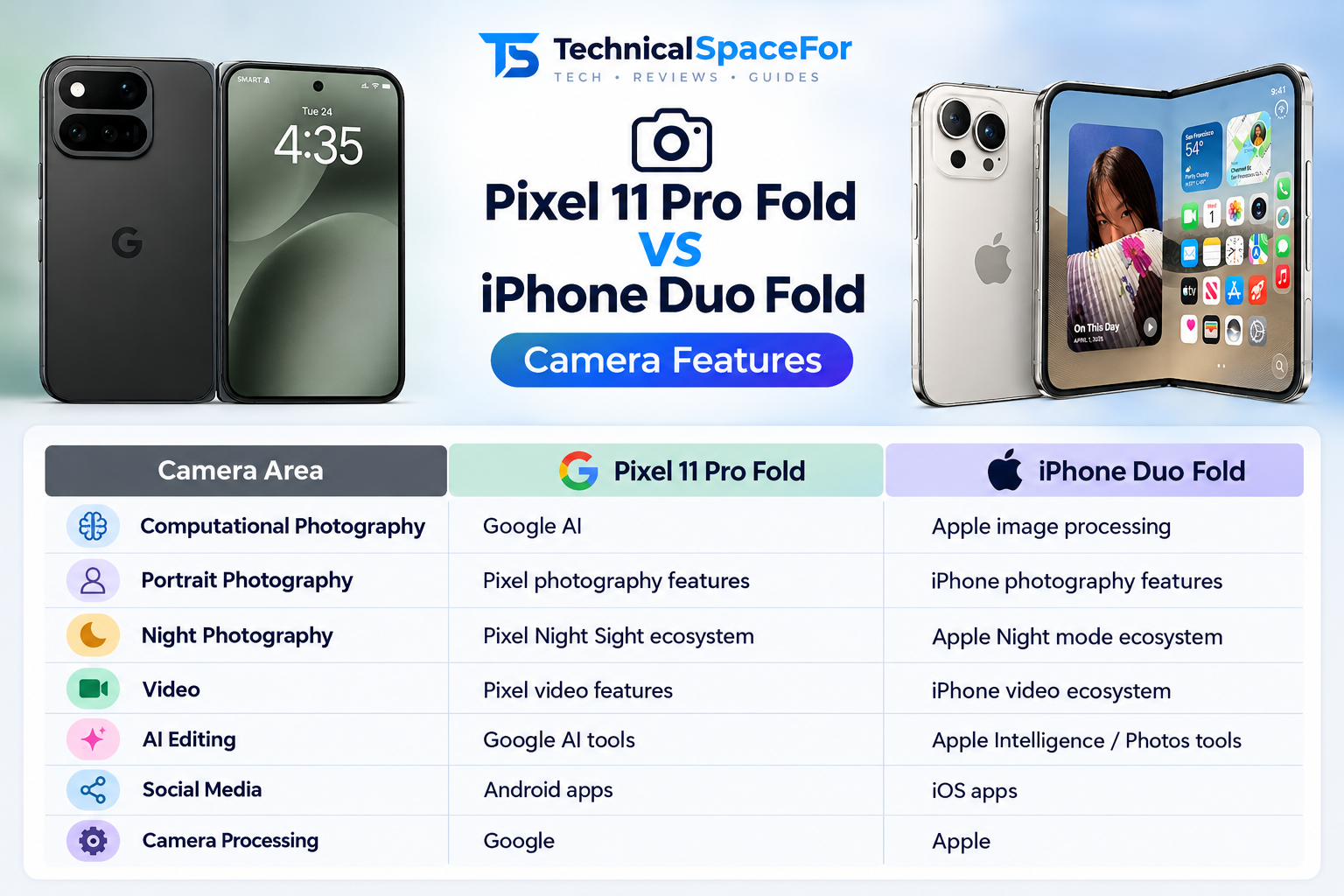
Pixel 11 Pro Fold vs iPhone Duo Fold: Camera Features Compared
Camera Area
Pixel 11 Pro Fold
iPhone Duo Fold
Computational Photography
Google AI
Apple image processing
Portrait Photography
Pixel photography features
iPhone photography features
Night Photography
Pixel Night Sight ecosystem
Apple Night mode ecosystem
Video
Pixel video features
iPhone video ecosystem
AI Editing
Google AI tools
Apple Intelligence / Photos tools
Social Media
Android apps
iOS apps
Camera Processing
Google
Apple
Camera hardware and its capabilities need to be verified with the current specifications available for each individual market.
Performance Comparison
Performance is yet another significant difference between Google and Apple. Performance of Pixel 11 Pro Fold:
The Pixel smartphones run on Google’s Tensor platform. The Google Tensor platform was built not just for processing speed but also AI and machine learning performance. This makes Google’s Tensor platform especially suited to applications such as:
Generative AI
Photography
Voice recognition
Translation
Phone calls
Google Assistant/Gemini experience
Machine learning on-device
Performance of iPhone Duo Fold:
The foldable iPhone runs on Apple’s silicon platform, developed alongside the hardware. The chip design by Apple focuses on high CPU and GPU performance, efficiency, machine learning performance, photography, video processing, and iOS performance.
Software and AI
Software can prove to be an important deciding factor when choosing either the Pixel 11 Pro Fold or iPhone Duo Fold. The former is about Android and Google software along with Gemini AI, whereas the latter is all about iOS, Apple Intelligence, and integration into the Apple ecosystem. Finally, your choice will depend on your preference for Google Android software or Apple software.
Multitasking and Productivity
The Pixel 11 Pro Fold takes advantage of the advanced multi-tasking capabilities of Android, such as split-screen apps, floating windows, and large-screen optimizations. The iPhone Duo Fold may be a highly productive device, depending on how well Apple optimizes iOS and third-party applications for the bigger screen size.
For both phones, it is essential to maintain a good battery life and efficiency amid complicated engineering aspects. Battery life will depend on usage, settings, 5G, games, video streaming, camera quality, AI capabilities, and other factors.
Charging is to be assessed according to wired and wireless charging speed, accessories, battery life maintenance, and battery health. The durable build of each phone is another important aspect to consider, which includes hinge, foldable screen, water and dust protection, materials, and reparability.
As for the connectivity, both devices should have a number of current characteristics, including 5G, Wi-Fi, Bluetooth, NFC, GPS, USB-C, etc.
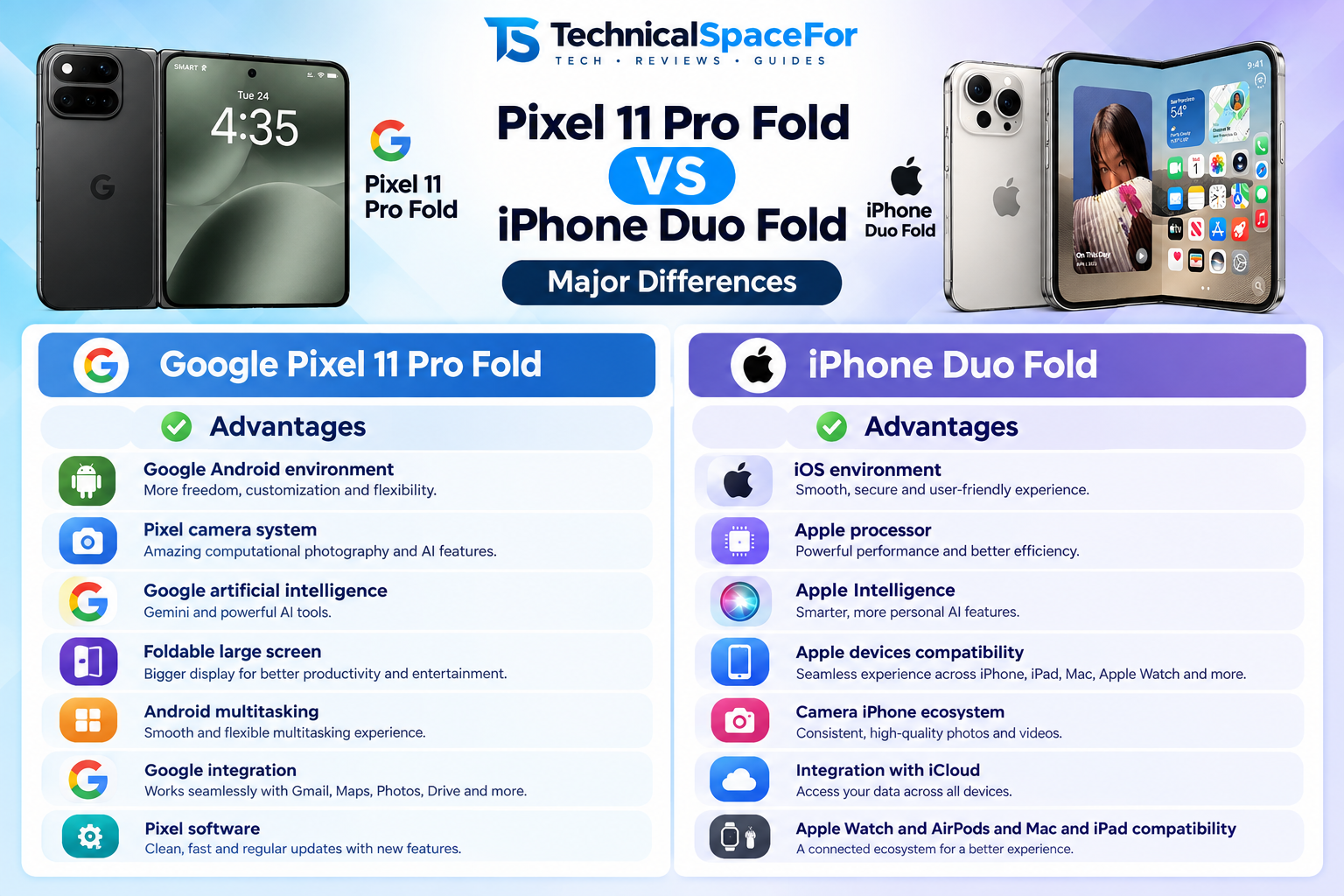
Pixel 11 Pro Fold vs iPhone Duo Fold – Major Differences Google Pixel 11 Pro Fold
Pixel 11 Pro Fold vs iPhone Duo Fold: Major Differences Compared
Advantages:
Google Android environment
Pixel camera system
Google artificial intelligence
Foldable large screen
Android multitasking
Google integration
Pixel software
iPhone Duo Fold
Advantages:
iOS environment
Apple processor
Apple Intelligence
Apple devices compatibility
Camera iPhone ecosystem
Integration with iCloud
Apple Watch and AirPods and Mac and iPad compatibility
Which Is Superior for Gaming?
The gaming experience depends on the CPU, GPU, cooling system, optimized games , display refresh rates, and consistency.
Both of these phones cater to the high-end market. There may be differences in game availability and optimization for both platforms.
Another aspect to look is the foldable display ,that might offer more immersion in games.
Which One Is More Productive?
Both the foldable design makes bothdevices interesting to use when it comes to productivity .the Pixel 11 Pro Fold has an advantage due to the multitasking features of Android and the productivity suite offered by Google, while the iPhone Duo Fold has an advantage due to its ecosystem and ability to integrate with iCloud and other Apple products.
Which is the Better Phone for a Photographer?
It depends on the values that one cherishes pixel phones offer computational photography and advanced artificial intelligence image processing technologies from Google, whereas iPhones are renowned for their emphasis on photography and video recording in particular. For those who prefer to use Google products, the Pixel 11 Pro Fold is a better choice; whereas for those who own iPhones, Mac , Apple Watch , AirPodS, or iPad , the iPhone Duo Fold is the perfect choice.
Pixel 11 Pro Fold vs iPhone Duo Fold: Pros and Cons
Pixel 11 Pro Fold vs iPhone Duo Fold: Strengths and Weaknesses Compared
Google Pixel 11 Pro Fold
Strengths
Android foldable device
AI from Google
Google Pixel photography
Big inner display
Stellar Google ecosystem
Multitasking on Android
Weaknesses
Complexity due to folding design
Expensive price tag
Folding display needs careful use
Market availability may differ
iPhone Duo Fold
Strengths
Foldable experience on iOS
Apple silicon
Apple ecosystem compatibility
Apple Intelligence
Luxurious foldable design
Camera and video ecosystem
Weaknesses
Expensive premium price
Complicated foldable hardware
Optimization of iOS apps for foldable screens will matter
Availability and price by region may differ
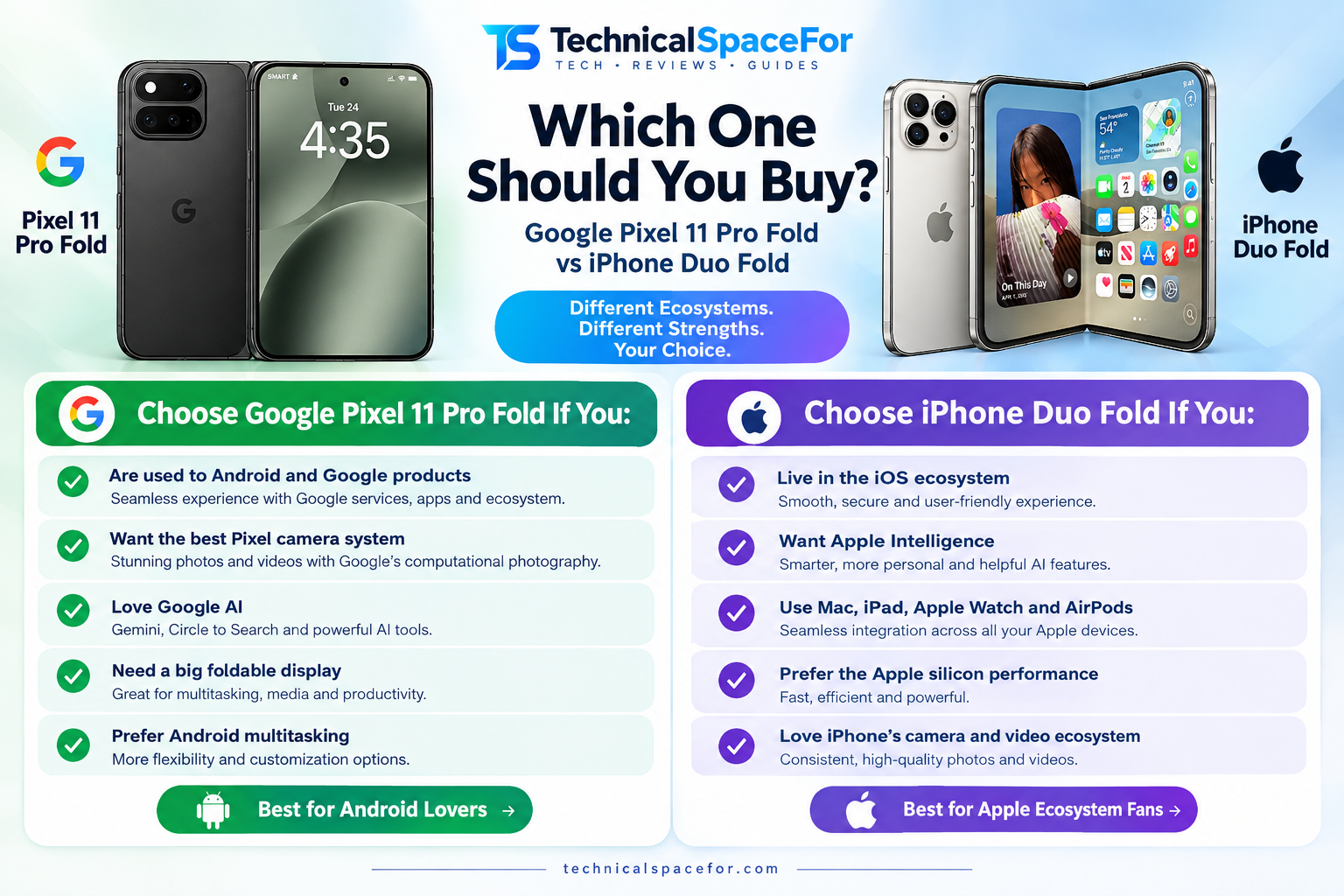
Which One Should You Buy? Google Pixel 11 Pro Fold vs iPhone Duo Fold
Pixel 11 Pro Fold vs iPhone Duo Fold: Which Foldable Fits You?
In this situation, there is always a decision that will not suit everyone. However, if you are used to using Android, Google products, Pixel camera system, Google AI, and Android multitasking, the Google Pixel 11 Pro Fold is a better option.
However, if your life revolves around iOS, Apple Intelligence , Apple silicon, iCloud, Mac, Apple Watch, AirPods, and other Apple devices, then the iPhone Duo Fold should be your target device. The main difference between these two phones is not only in their cameras, processors, and screens.
Final Comparison
The comparison of Google Pixel 11 Pro Fold vs iPhone Duo Fold is about different concepts of the future of smartphones. On the one hand, Google presents Pixel with Android, AI, computational photography, and Google software ecosystem in foldable phones. On the other hand, Apple presents an iPhone experience in foldable phones with iOS, Apple silicon, Apple Intelligence, and its hardware ecosystem.
When making your decision to buy one of the two models, consider the price, display experience, camera options, battery performance, software, durability, storage capacity, and the compatibility of each phone with other devices and services of your choice. The Pixel 11 Pro Fold should be considered by the owners of Android and Google ecosystem, and iPhone Duo Fold should be taken by the owners of the Apple ecosystem.
Questions People Ask
Which phone is better – Pixel 11 Pro Fold or iPhone Duo Fold?
While both products are meant to be in the upper segment of foldables, they have some unique features. Pixel 11 Pro Fold uses Android and Google technology, and iPhone Duo Fold iOS and Apple technology
What is the Difference Between Pixel 11 Pro Fold and iPhone Duo Fold?
There are several differences between these phones including the following – their operating system, software ecosystem, artificial intelligence platform, cameras, processing, and hardware design principles.
Which is better for its camera, the Pixel 11 Pro Fold or the iPhone Duo Fold?
Cameras will always depend on the use case, but Google prefers computational photography, and Apple likes to focus more on their image processing and video capabilities.
Battery Life Comparision
The battery life of each device depends on several factors including usage, brightness settings, network conditions, app usage, gaming, camera usage, and the frequency of using the bigger inner screen.
Are foldable smartphones worth investing in?
There are people who would find it helpful to have a device that has a bigger screen for multitasking and entertainment purposes, but at the same time is small enough to carry around in your pocket when folded.
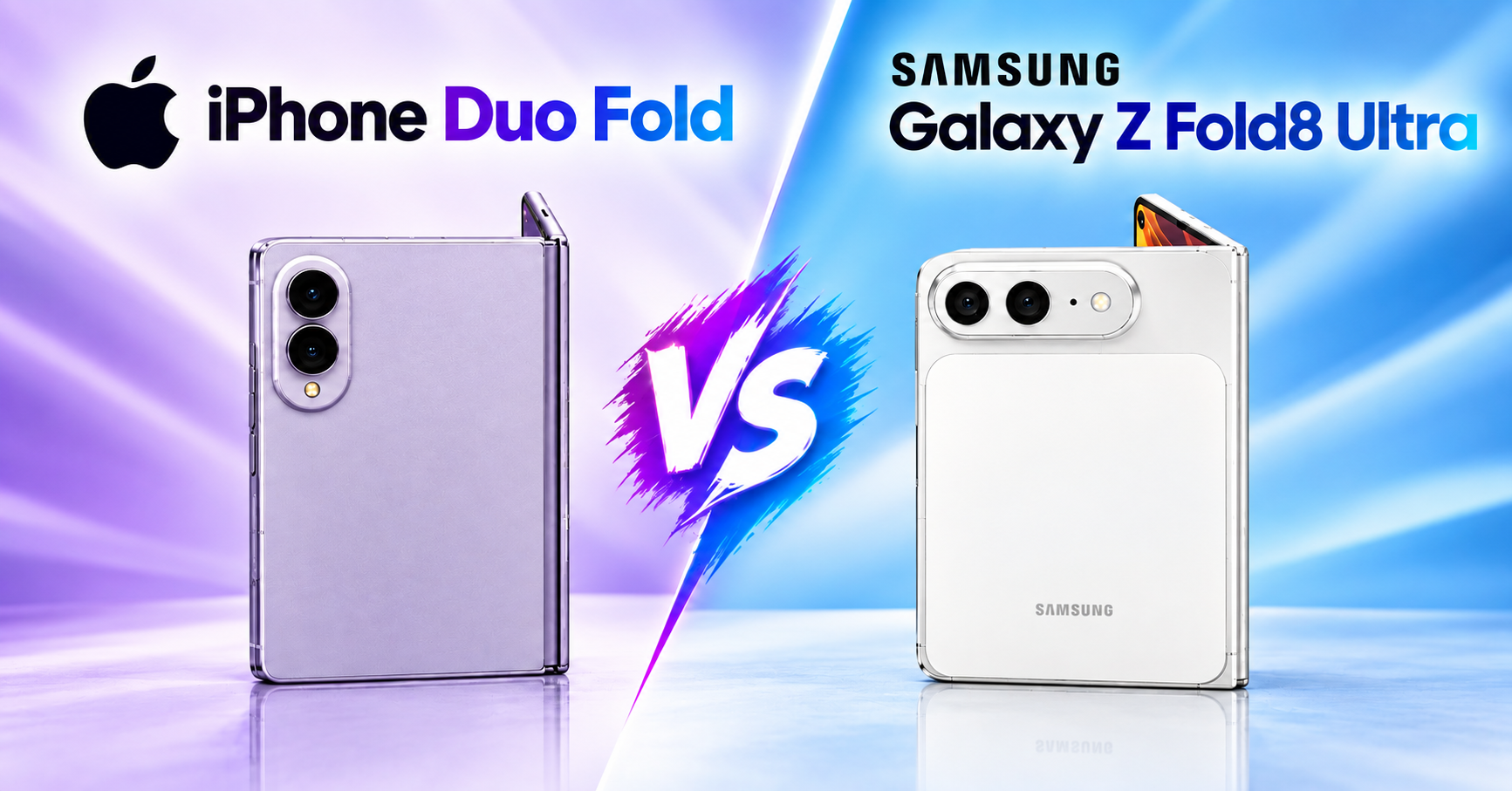
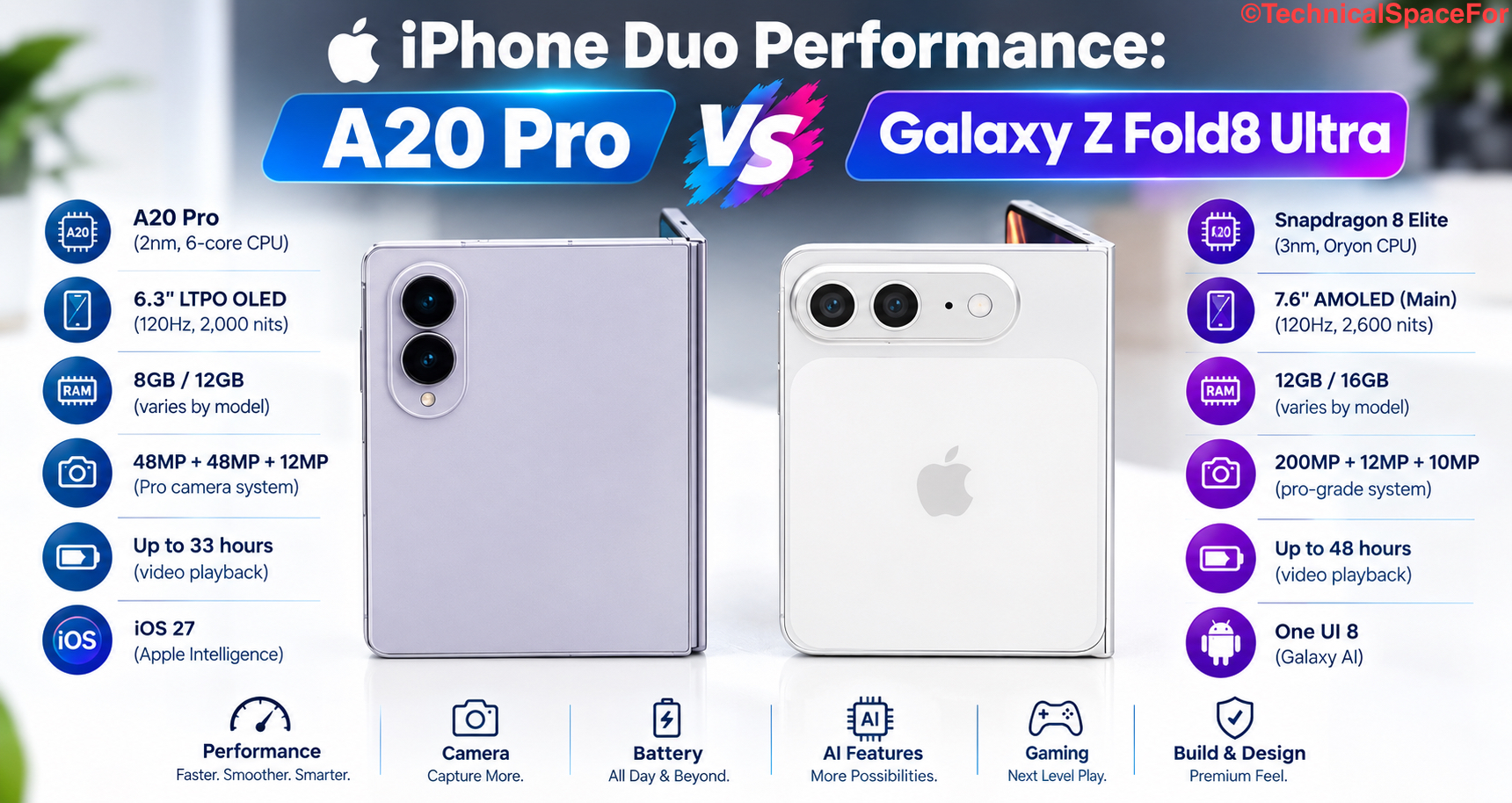
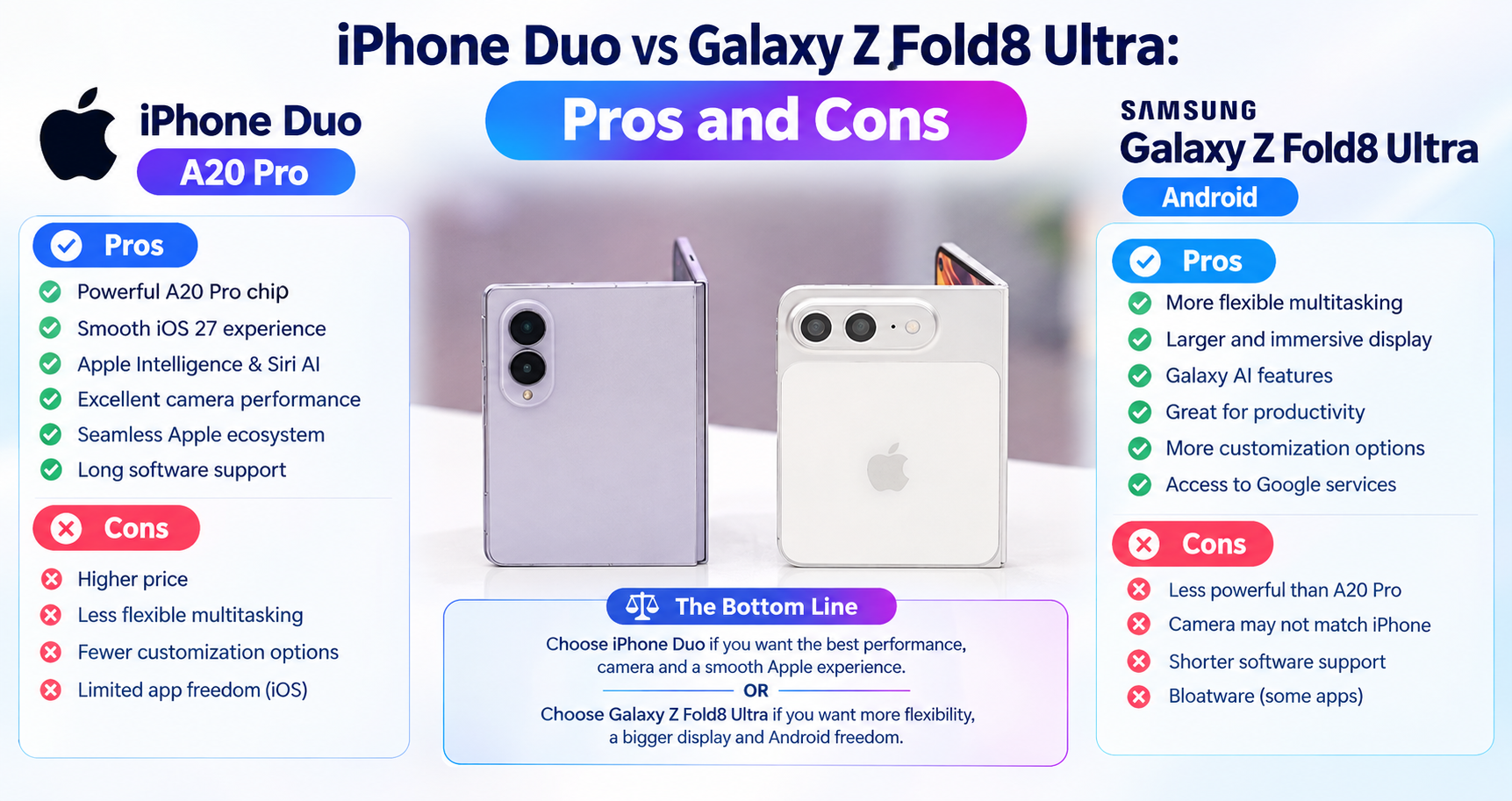
iPhone Duo VS Samsung Galaxy Z Fold8 Ultra: Which One Is Worth Buying? Prices, Specifications, Design, Display, Camera, Performance, Battery and Features Compared Apple has finally entered the foldable‑phone category with the iPhone Duo Fold while Samsung keeps focusing on users who want a large‑screen phone that can also act as a tablet apple’s first foldable iPhone Duo Fold mixes an inner display, a 5.4‑inch outer display the A20 Pro chip, dual‑battery design, a 48‑megapixel Fusion camera system, iOS 27 Apple Intelligence and a titanium‑based build. Apple says the iPhone Duo Fold is the iPhone ever when opened Samsung Galaxy Z Fold8 Ultra on the hand targets users who value a big Android workspace, multitasking, productivity, Samsung Galaxy AI and the flexibility of the Galaxy ecosystem So which foldable is better and worth buying? The answer depends heavily on whether you prefer Apple’s ecosystem and software experience or Samsung’s Android multitasking and foldable phone approach.
iPhone Duo vs Samsung Galaxy Z Fold8 Ultra: Quick Comparison
Feature
iPhone Duo Fold
Samsung Galaxy Z Fold8 Ultra
Operating System
iOS 27
Android
Inner Display
7.6-inch Super Retina XDR
Large foldable display
Outer Display
5.4-inch Super Retina XDR
Cover display
Refresh Rate
ProMotion
High-refresh-rate display
Processor
Apple A20 Pro
Samsung flagship processor
Main Camera
48MP Fusion
Samsung multi-camera system
Ultra-Wide
48MP Fusion Ultra Wide
Ultra-wide camera
Battery
Dual-battery architecture
Large-capacity foldable battery
Charging
Fast wired + MagSafe/Qi2
Fast wired + wireless charging
Authentication
Touch ID
Fingerprint/biometric security
Water/Dust Resistance
IP68
Foldable durability rating
AI
Apple Intelligence + Siri AI
Galaxy AI
Stylus
Apple Pencil support coming later
S Pen/foldable productivity support may vary
Starting Price
$1,999
Check Samsung official pricing
Best For
Apple users, cameras, iOS, portability
Multitasking, Android, productivity
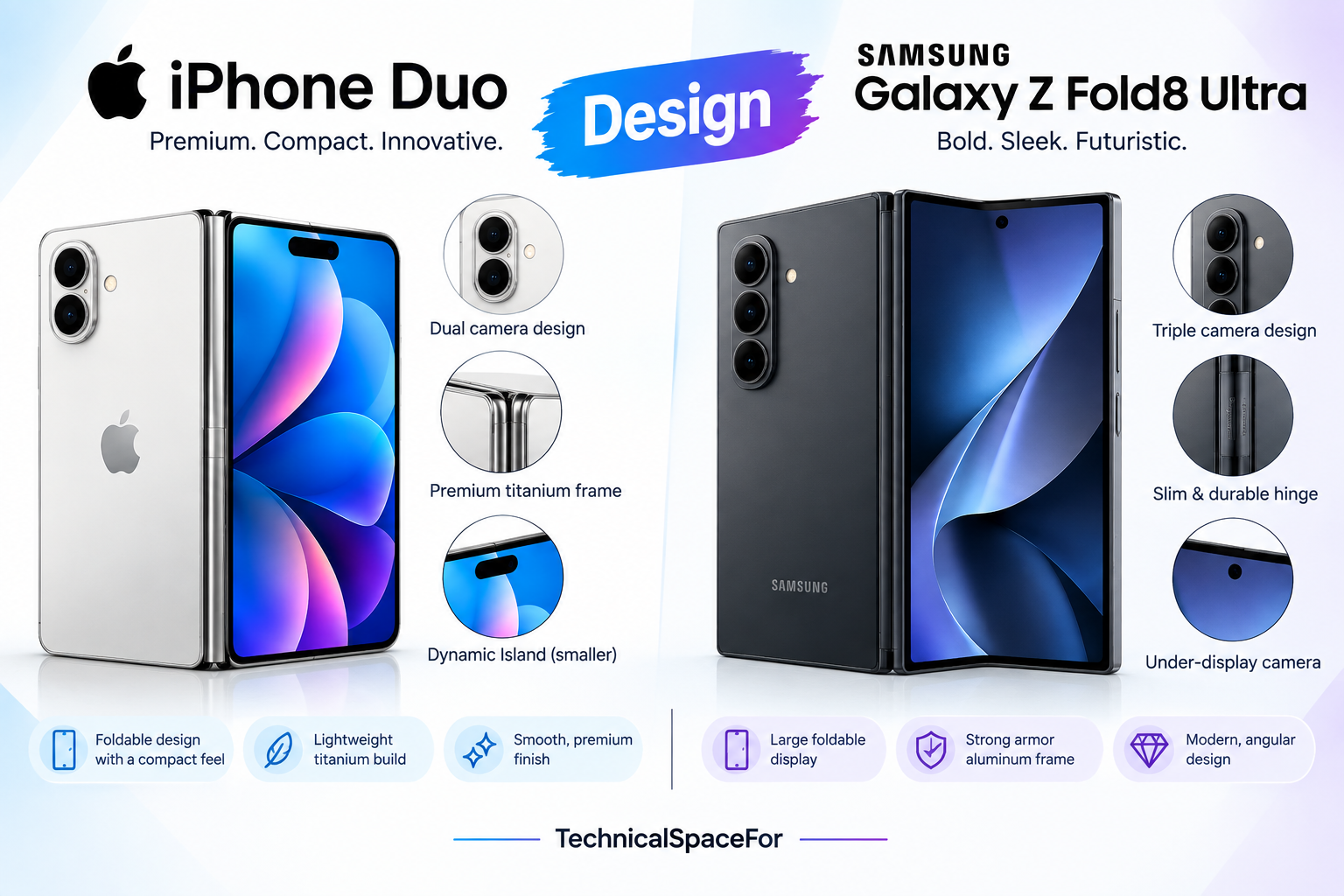
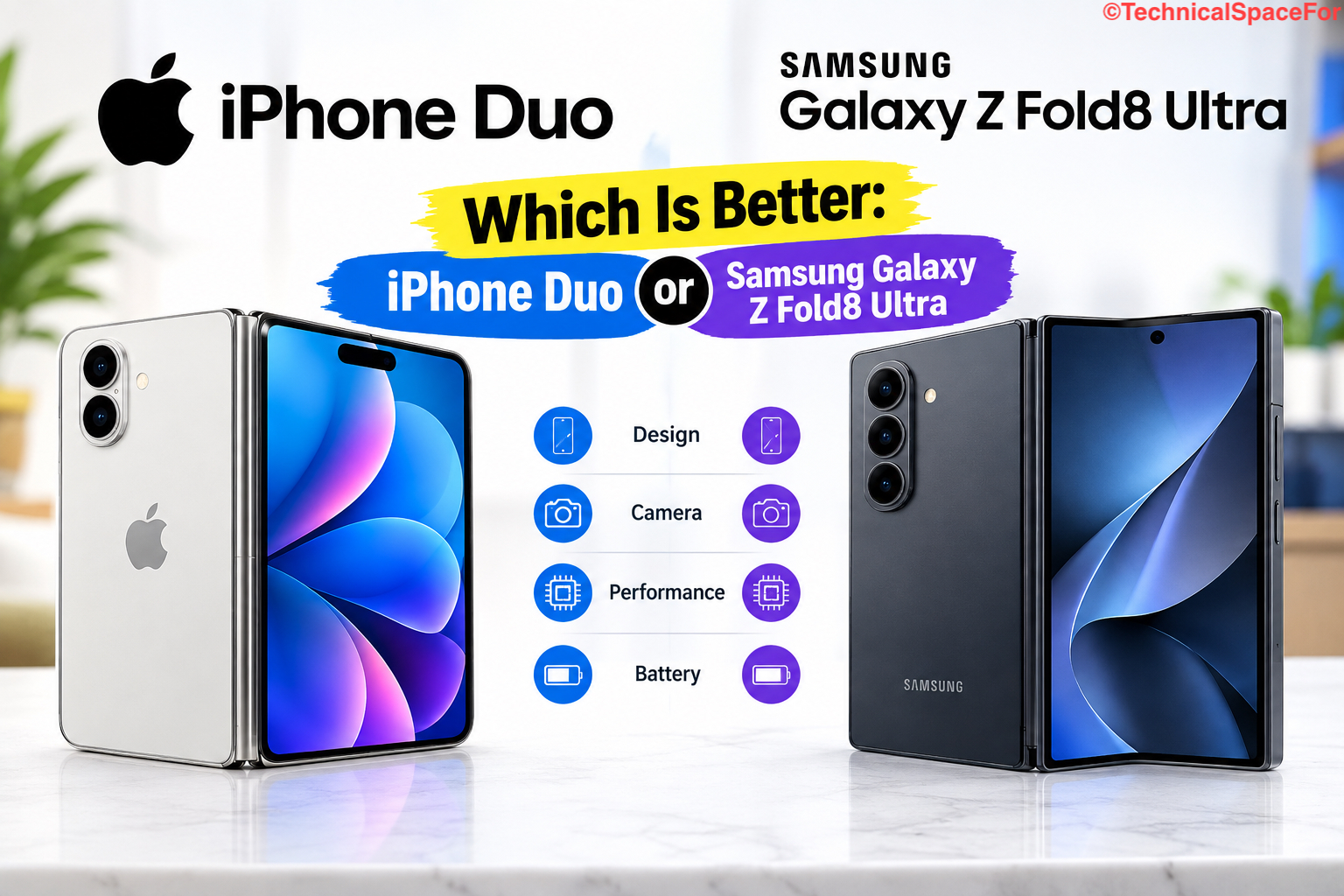
iPhone Duo vs Galaxy Z Fold8 Ultra: Design
iPhone Duo vs Galaxy Z Fold8 Ultra — a closer look at their premium foldable designs, hinges, cameras, and displays.
Design is one of the differences between these two foldable phones and it really catches the eye.
The iPhone Duo is Apple’s foldable design. When iPhone Duo is closed iPhone Duo shows a 5.4‑inch outer display. When iPhone Duo opens a 7.6‑inch inner display appears Both displays have the aspect ratio, which makes the content move smoothly from one screen to the other. Apple uses grade 5 titanium to build the enclosure Creates a refined hinge that contains over 100 small parts. Apple also protects iPhone Duo, with Ceramic Shield. Gives iPhone Duo an IP68 rating, which means iPhone Duo can resist splashes, water and dust Galaxy Z Fold8 Ultra follows Samsung’s well‑known book‑style design. Galaxy Z Fold8 Ultra goes further by offering a premium, large‑screen smartphone experience.
Design Winner: Tie
If you like Apple’s premium titanium build and small closed design the iPhone Duo looks very appealing. I think the iPhone Duo feels solid and stylish and the iPhone Duo keeps a profile.
If you, like Samsung’s foldable shape and Android multitasking the Galaxy Z Fold8 Ultra is probably the pick. The Galaxy Z Fold8 Ultra folds smoothly. Lets you run many apps at once and the Galaxy Z Fold8 Ultra feels like a tool.
iPhone Duo vs Samsung Galaxy Z Fold8 Ultra Display Comparison
I think display quality is crucial for any phone The iPhone Duo offers two Super Retina XDR displays. I see the display at 7.6 inches and the outer display at 5.4 inches. Apple says both displays support Pro Motion, Always – On mode, and can reach up to 3,000 nits of outdoor brightness The inner display also has a nano – texture finish that reduces glare and reflections. It hides the crease better.
Samsungs advantage is its experience with AMOLED displays. Samsung has a experience with AMOLED displays . The Galaxy Z Fold series has traditionally focused on giving users a tablet workspace inside a smartphone.
Display Winner: iPhone Duo
Based on the Apple specifications supplied the iPhone Duo has a mix of a large inner display, 120 – Hz Pro Motion technology, Always – On mode, and 3,000 – nit peak outdoor brightness.
Performance: A20 Pro vs Galaxy Z Fold8 Ultra
A20 Pro vs Galaxy Z Fold8 Ultra — which delivers better performance?
Performance could become one of the strengths for Apple’s foldable. I think Performance will be an advantage for Apple’s foldable. The iPhone Duo uses the A20 Pro, which ‘s in the same family of processors that Apple uses in its current Pro iPhones. Apple says that the 6‑core CPU can be up to 20 percent faster than the A19 Pro, and the 7‑core GPU can be up to 40 percent faster while using power. Apple also says that the A20 Pro has a 16‑core Neural Engine, which gives twice the compute power for on‑device AI models. The chip is made with a 2‑nanometer process Provides provides 50 percent more unified memory bandwidth. The iPhone Duo also has a custom vapor chamber and an advanced thermal‑management system. Apple claims that this gives up to 35 percent sustained performance than to the iPhone 17 Pro.
Samsung’s flagship foldable puts a lot of emphasis on long‑term multitasking and Android productivity.
Performance Winner: iPhone Duo
I think the iPhone Duo is a strong contender when it comes to raw chip performance and on-device AI capabilities.
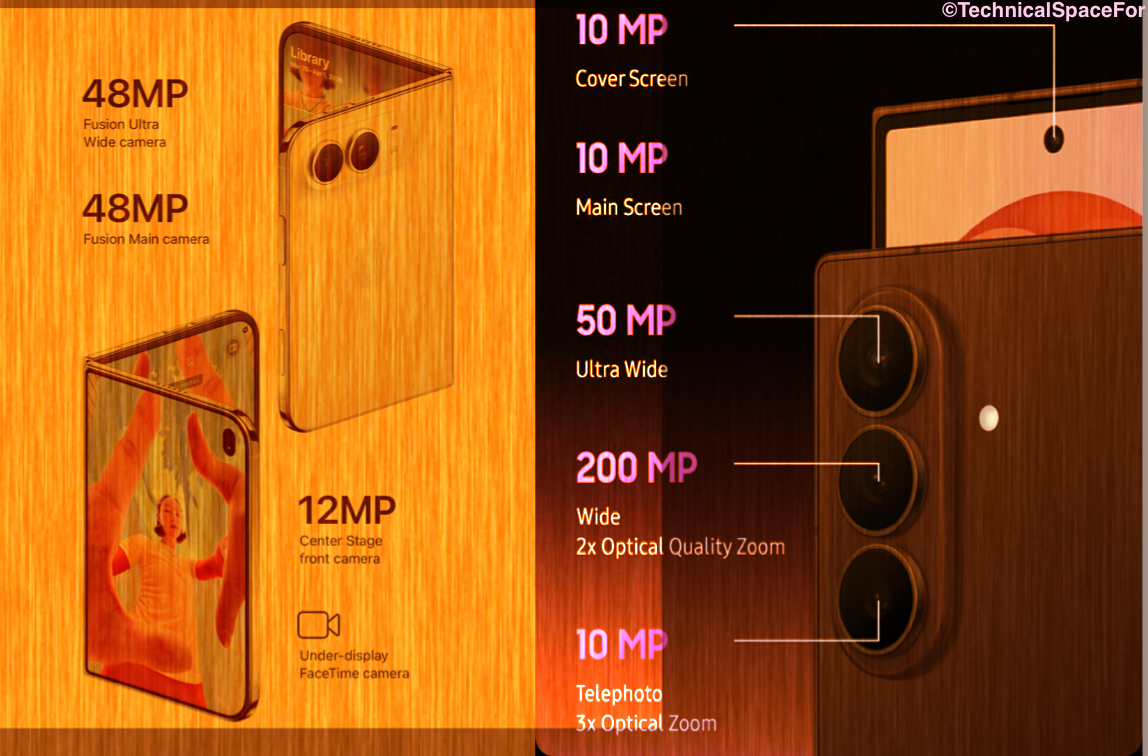
iPhone Duo vs Samsung Galaxy Z Fold8 Ultra Camera Comparison
iPhone Duo Fold vs Galaxy Z Fold8 Ultra Which foldable has the better camera?
I think camera performance is another area where Apple is taking an approach. The iPhone Duo brings a 48MP Fusion Main camera that offers quality 2x telephoto capability. Apple says that the main camera uses a sensor, a fast aperture and sensor‑shift optical image stabilization the iPhone Duo also includes a 48MP Fusion Ultra‑Wide camera that supports photography I think the folding design creates some camera features.
Smart Take
The phone uses AI directly on the device to study a scene and take a photo automatically when the subjects are ready.
Duo Preview
The outer screen works as a preview letting people being photographed see how the shot looks while the camera is being used from the back.
Kid Cue
The outside screen shows fun animations to catch childrens attention when taking pictures.
Duo FaceTime
People can join a FaceTime call using the display opening up fresh ways to connect during group video chats Video recording is also strong the main camera can record in 4K at 120 frames, per second with Dolby Vision. Cinematic effects can be added after recording up, to 60fps.
Camera Winner: iPhone Duo
If you care a lot, about photography, video recording and Apple’s camera system then the iPhone Duo seems to be the better choice.
Samsung still stays very competitive for people who want a flexible multi‑camera set and Android photography tools. Samsung offers a lot of options.
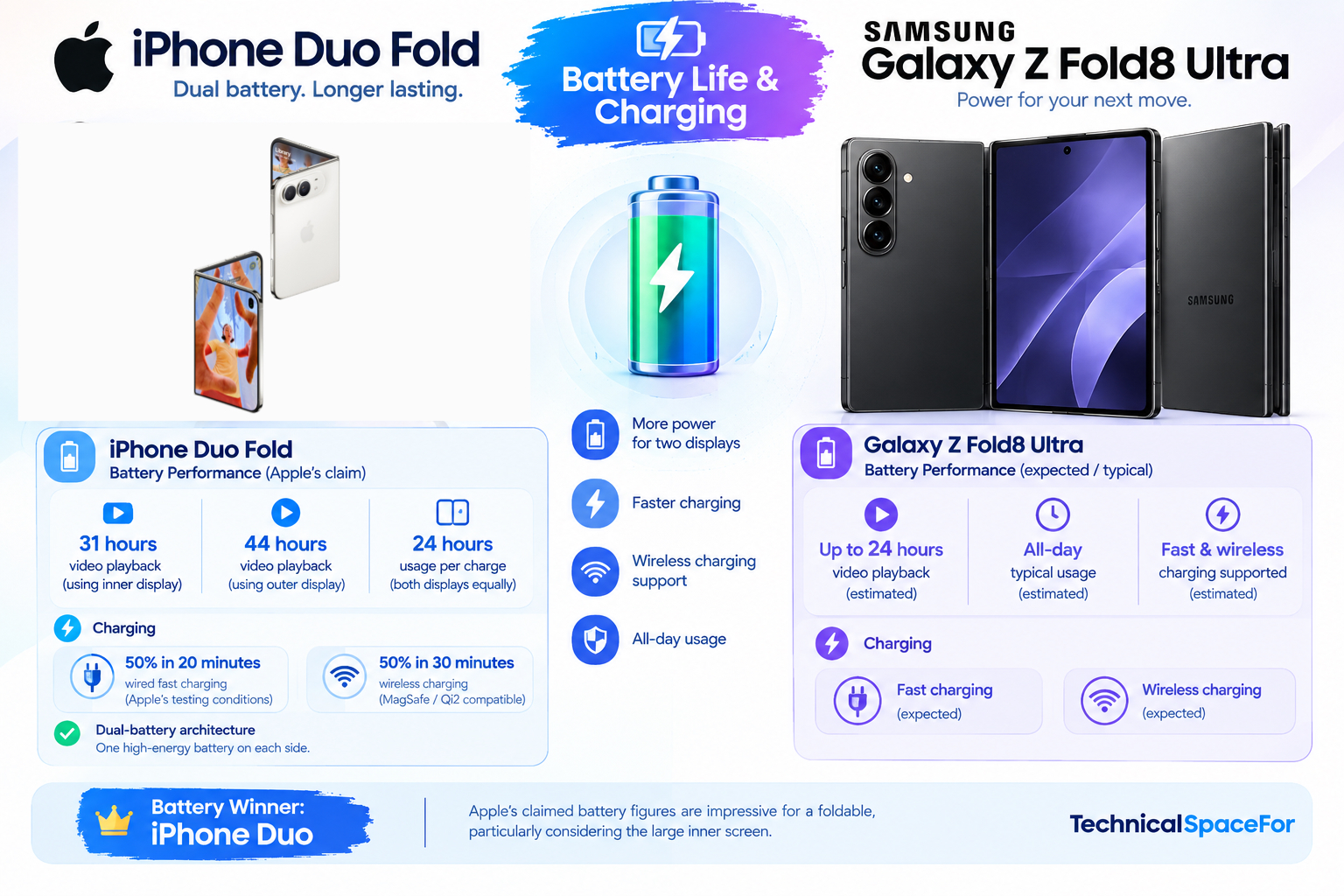
iPhone Duo vs Samsung Galaxy Z Fold8 Ultra Battery Life and Charging
iPhone Duo Fold 31h inner display, 44h outer display, and fast charging. Battery Winner: iPhone Duo.
Foldable phones must power two displays so battery performance is very important. Apple uses a dual‑battery architecture inside the iPhone Duo placing one high‑energy battery on each side of the device.
Apple rates the iPhone Duo for:
Up to 31 hours of video playback using the display
Up to 44 hours of video playback using the outer display
Up to 24 hours of usage per charge when both displays are used equally
I notice that the iPhone Duo can reach 50 % charge in about 20 minutes with wired fast charging, under Apple’s testing conditions. Wireless charging can reach 50 % in 30 minutes with compatible MagSafe or Qi 2 charging.
Battery Winner: iPhone Duo
Apple’s claimed battery figures are impressive for a foldable, particularly considering the large inner screen.
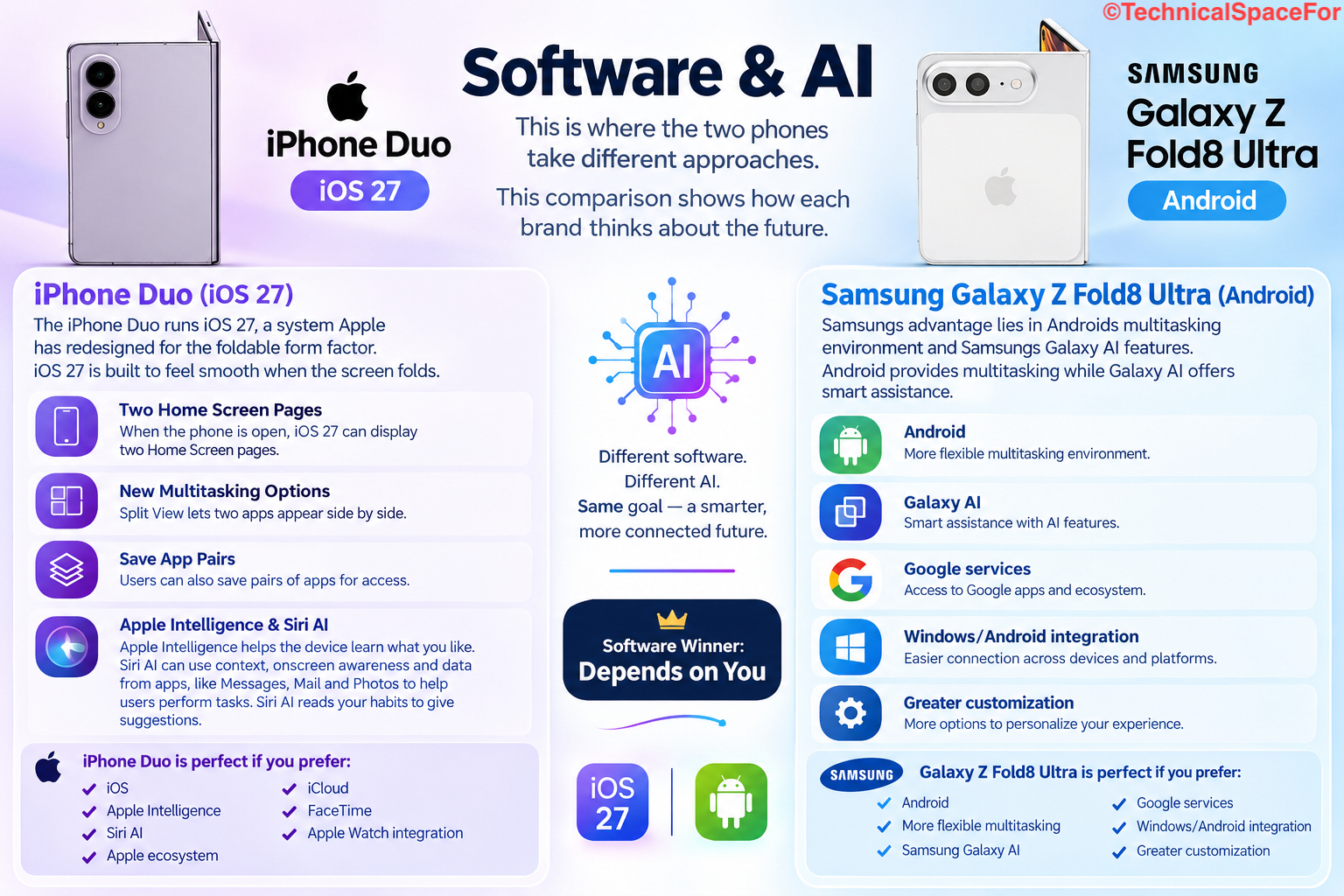
iPhone Duo vs Samsung Galaxy Z Fold8 Ultra Software and AI
iOS 27 vs Android — Apple Intelligence vs Galaxy AI. Which one fits you?
This is where the two phones take different approaches.
This comparison shows how each brand thinks about the future.
The iPhone Duo runs iOS 27 a system Apple has redesigned for the foldable form factor.
IOS 27 is built to feel smooth when the screen folds.
When the phone is open iOS 27 can display two Home Screen pages. Give new multitasking options.
Split View lets two apps appear side by side.
Users can also save pairs of apps for access.
The iPhone Duo also supports Apple Intelligence and the new Siri AI.
Apple Intelligence helps the device learn what you like.
Siri AI can use context, onscreen awareness and data from apps, like Messages, Mail and Photos to help users perform tasks.
Siri AI reads your habits to give suggestions.
Samsungs advantage lies in Androids multitasking environment and Samsungs Galaxy AI features.
Android provides multitasking while Galaxy AI offers smart assistance.
Software Winner: Depends on You
Choose iPhone Duo if you prefer:
iOS
Apple Intelligence
Siri AI
Apple ecosystem
iCloud
FaceTime
Apple Watch integration
Choose Galaxy Z Fold8 Ultra if you prefer:
Android
More flexible multitasking
Samsung Galaxy AI
Google services
Windows/Android integration
Greater customization
iPhone Duo vs Samsung Galaxy Z Fold8 Productivity and Multitasking
Foldable phones are more, than smartphones now. Foldable phones help with productivity. Enable multitasking in everyday life.They are becoming productivity tools. The iPhone Duo features a 7.6-inch display. This size gives users plenty of room to run two apps at the time. Apple is emphasizing Split View. It allows multiple app windows to be open at once. Users can also save app pairs for access. Apple is planning to support Apple Pencil using USB-C this year. Apple says that using Apple Pencil will become easier for everyone, with this change .This means users can take notes. They can sketch. They can mark up documents on either display. Samsungs Fold series has long been a choice for Android multitasking. It has also been an option for productivity.
Productivity Winner: Samsung Galaxy Z Fold8 Ultra
If you want your foldable to act like a tablet and a productivity workstation Samsung Galaxy Z Fold8 Ultra is a very good choice. Samsung Galaxy Z Fold8 Ultra is a pick, for people who use their device for work.
iPhone Duo vs Samsung Galaxy Z Fold8 Ultra Durability
Durability is one of the concerns when buying a foldable phone Apple has taken a serious approach with the iPhone Duo.
The phone uses:
Grade 5 titanium
Ceramic Shield
Ceramic Shield 2
High-strength glass
Reinforced internal structures
A precision hinge
IP68 water and dust resistance
Apple says Ceramic Shield 2 on the front provides 3x better scratch resistance than the previous generation The internal folding display also includes a scratch-resistant coating, nano-textured cover layer, high-strength glass and a titanium plate beneath the display.
Durability Winner: iPhone Duo
On paper, Apple’s combination of titanium construction, reinforced folding-display layers and IP68 protection makes the iPhone Duo extremely compelling.
iPhone Duo vs Samsung Galaxy Z Fold8 Ultra Connectivity
The iPhone Duo is eSIM-only worldwide. Apple says its eSIM design helps save internal space while providing flexibility and security. The phone supports Wi-Fi 7, Bluetooth 6, and Thread through Apple’s N1 wireless networking chip. It also uses Apple’s C2 cellular modem system, including mmWave support in the U.S. This can be a major consideration for international buyers because eSIM support depends on the carrier.
Connectivity Winner: Tie
Both devices aim for top-tier connectivity. The iPhone Duos focus on only support around could be a drawback. This might matter to buyers in areas where eSIM is not well supported by carriers or where network coverage ‘s still limited. In some cases, users may prefer SIM cards. So while both devices offer connectivity, the lack of flexibility with eSIM options could tip the balance for certain people. That’s why the win goes to a tie.
iPhone Duo vs Samsung Galaxy Z Fold8 Ultra Price Comparison
I just saw that the iPhone Duo begins at $1,999, in the United States. The iPhone Duo comes with 256GB of storage.
Apple offers:
256GB
512GB
1TB
2TB
iPhone Duo is available, in Star White and Night Sky. Pre‑orders start on October 16 the phone becomes available on October 23.
I think the high starting price makes the iPhone Duo feel like a premium choice when you compare it to the Galaxy Z Fold8 Ultra. If you are thinking about buying you should check Samsung’s U.S. Pricing. See what promotional offers are available because Samsung often offers trade‑in discounts and launch promotions.
Price Winner: Samsung
If Samsungs trade‑in offers and promotions cut the price a lot the Galaxy Z Fold8 Ultra can give value and the Galaxy Z Fold8 Ultra offers worth.
iPhone Duo vs Galaxy Z Fold8 Ultra: Pros and Cons
iPhone Duo vs Galaxy Z Fold8 Ultra — which foldable is right for you?
iPhone Duo Pros
Premium foldable design
7.6-inch inner display
5.4-inch outer display
A20 Pro chip
Strong AI capabilities
48MP main camera
48MP ultra-wide camera
4K 120fps Dolby Vision
Titanium construction
IP68 rating
Excellent battery claims
MagSafe and Qi2
iOS 27
Apple Intelligence
Siri AI
Up to 2TB storage
iPhone Duo Cons
Very high $1,999 starting price
eSIM-only design
Apple Pencil support comes later
New first-generation foldable design
Some AI features have regional/language limitations
Foldable repair costs could be significant
Samsung Galaxy Z Fold8 Ultra Pros
Large foldable Android workspace
Strong multitasking experience
Mature Samsung foldable ecosystem
Galaxy AI features
Android customization
Productivity-focused software
Strong Samsung ecosystem
Trade-in and promotional opportunities
Samsung Galaxy Z Fold8 Ultra Cons
Premium pricing
Foldable design can be heavier than a conventional smartphone
Large internal display increases power requirements
Some features may vary by region
Buyers should verify final camera, battery and charging specifications before purchase
Which Is Better: iPhone Duo or Samsung Galaxy Z Fold8 Ultra?
iPhone Duo or Galaxy Z Fold8 Ultra? Compare design, camera, performance, and battery to see which foldable phone wins.
The answer depends on what you want from a phone If you are already using Apple products and enjoy being, in the Apple ecosystem then the iPhone Duo is the choice. It brings together Apples A20 Pro chip, iOS 27 Apple Intelligence, a 48MP camera system, a premium titanium frame and a big 7.6-inch screen inside.
For users who prefer Android freedom multitasking features Samsung’s own foldable software and a large display that helps with work and productivity the Galaxy Z Fold8 Ultra is the better pick.
Who Should Buy the iPhone Duo?
You should consider the iPhone Duo if you:
Already use an iPhone
Own an Apple Watch, Mac or iPad
Prefer iOS
Want Apple’s first foldable
Care about video recording
Want strong on-device AI
Want a premium titanium design
Prefer MagSafe
Want up to 2TB storage
Want Apple’s ecosystem integration
Who Should Buy the Galaxy Z Fold8 Ultra?
The Galaxy Z Fold8 Ultra makes more sense if you:
Prefer Android
Need advanced multitasking
Want a large-screen productivity device
Prefer Samsung’s software
Use Google services heavily
Want greater Android customization
Want Samsung Galaxy AI
Want a foldable that can replace a small tablet
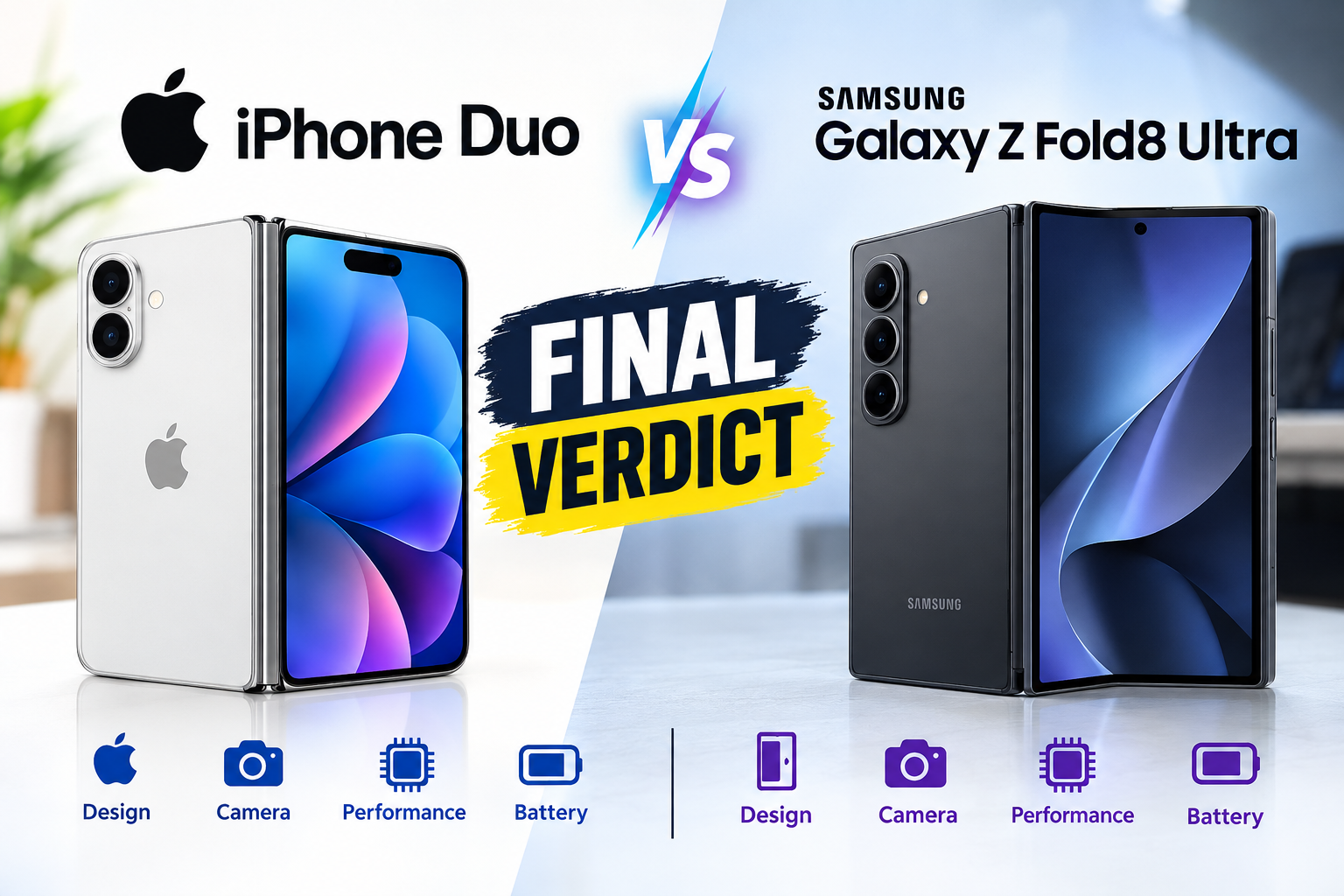
iPhone Duo vs Samsung Galaxy Z Fold8 Ultra: Final Verdict
iPhone Duo vs Galaxy Z Fold8 Ultra — which foldable phone wins?
Apple is bringing the traditional iPhone experience into a foldable design. The iPhone Duo combines a 7.6-inch display, A20 Pro performance, 48MP cameras, iOS 27, Apple Intelligence, dual batteries and titanium construction in a device starting at $1,999.
Samsung’s approach is more focused on the productivity potential of a foldable Android phone.
Best Overall for Apple Users: iPhone Duo
Best for Android Multitasking: Galaxy Z Fold8 Ultra
Best for Apple Ecosystem: iPhone Duo
Best, for Productivity: Galaxy Z Fold8 Ultra
Best Camera/Video Features: iPhone Duo
Best Value: Galaxy Z Fold8 Ultra, depending on Samsung promotions
Innovative First-Generation Experience: iPhone Duo
Final Recommendation
If you have been waiting for an iPhone the iPhone Duo is arguably the most exciting Apple product in this category. It brings together the A20 Pro performance, a 7.6-inch screen, 48MP cameras, iOS 27 and Apple’s new foldable-specific software. All of that makes it a strong contender in the flagship space.
But let’s be clear—this phone comes with a price tag. At $1,999 the iPhone Duo is not a budget- option If what matters most to you is productivity, Android flexibility and multitasking then the Samsung Galaxy Z Fold8 Ultra might be the choice.
In short: pick the iPhone Duo if you’re, in the Apple ecosystem and want a tier camera and software experience. Go with the Galaxy Z Fold8 Ultra if you need Android freedom, multitasking and daily productivity tools.
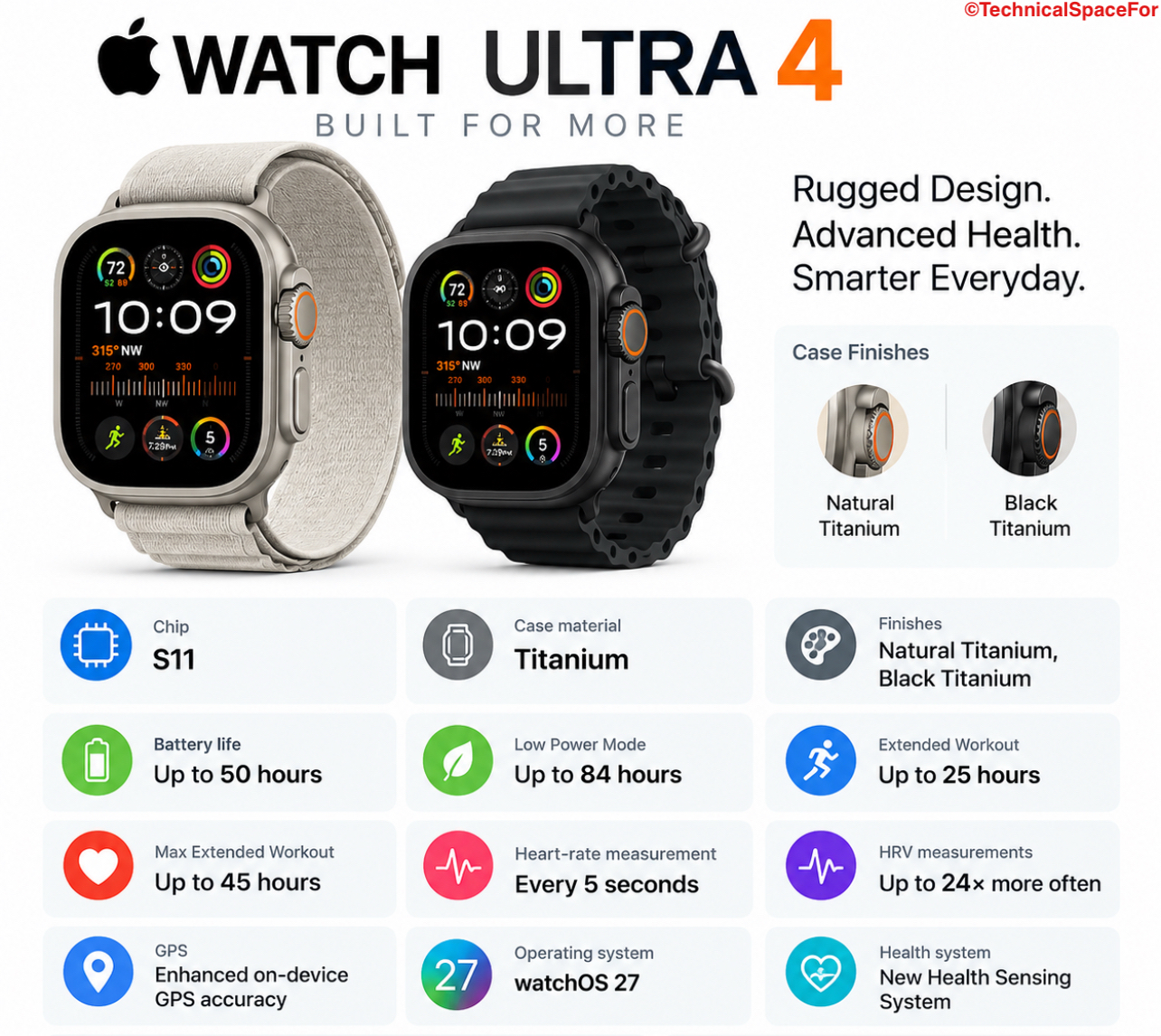
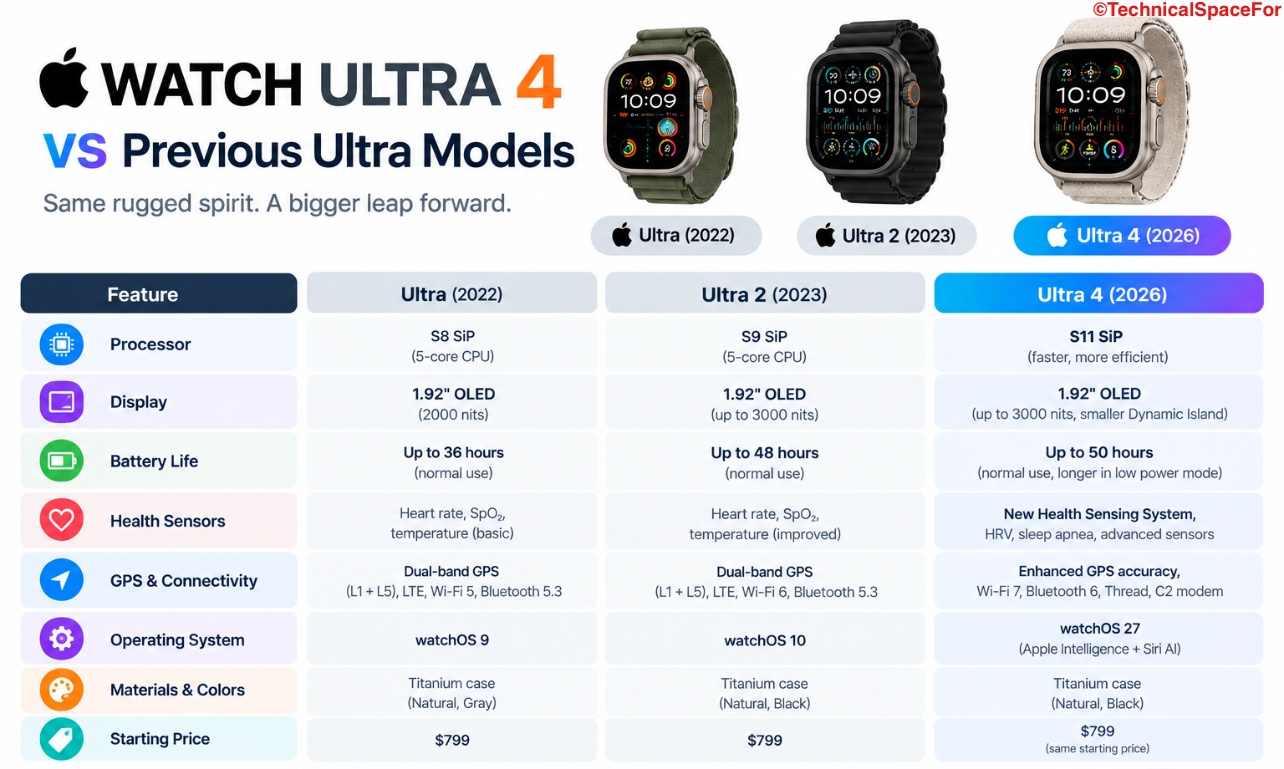
The Apple Watch Ultra 4 is Apples high-end smartwatch. It is made for sports. It is made for adventures. It is made for health. It is made for fitness. It is made for safety. It is made for features. Apple officially introduced the Apple Watch Ultra 4 on September 9. Apple introduced the Health Sensing System with this release. This watch has the S11 chip. It has GPS accuracy. It has faster charging. It has Apple Intelligence-powered features. The Apple Watch Ultra 4 costs $799 in the U.S. It has Natural and Black titanium finishes. Pre-orders for the Apple Watch Ultra 4 started on September 9. The Apple Watch Ultra 4 became available in stores on September 18, 2026. The Apple Watch Ultra 4 can last up to 50 hours. It can last up to 84 hours in Low Power Mode. It can track workouts for up to 45 hours. The Apple Watch Ultra 4 is built for activities. The Apple Watch Ultra 4 is made to keep up with athletes. The Apple Watch Ultra 4 is made to keep up with adventurers. The Apple Watch Ultra 4 is made to keep up with users.
Apple Watch Ultra 4 Specification
Apple Watch Ultra 4: rugged titanium design, S11 chip, up to 50 hours of battery life, advanced health tracking, enhanced GPS, and Apple Intelligence. Starting at $799.
The Apple Watch Ultra 4 specs are all, about health tracking, outdoor fitness, battery life, smart features and toughness.
Specification
Apple Watch Ultra 4
Chip
S11
Case material
Titanium
Finishes
Natural Titanium, Black Titanium
Battery life
Up to 50 hours
Low Power Mode
Up to 84 hours
Extended Workout
Up to 25 hours
Max Extended Workout
Up to 45 hours
Heart-rate measurement
Every 5 seconds
HRV measurements
Up to 24× more often
GPS
Enhanced on-device GPS accuracy
Operating system
watchOS 27
Health system
New Health Sensing System
Smart features
Apple Intelligence and Siri AI
Starting price
$799
The new S11 chip powers the Health Sensing System the new S11 chip also unlocks smart features that will come with watchOS 27.
Apple Watch Ultra 4 Release Date
Apple officially announced Apple Watch Ultra 4 on September 9 2026.
Pre‑orders began on the day and Apple Ultra 4 will become available in stores starting Friday, September 18 2026. Apple says Apple Watch Ultra 4 will be available, in the United States and than fifty additional countries and regions
Apple Watch Ultra 4 Release Timeline
Event
Date
Official announcement
September 9, 2026
Pre-orders
September 9, 2026
In-store availability
September 18, 2026
Starting price
$799
Apple Watch Ultra 4 Price
Apple Watch Ultra 4 starts at $799, offering a rugged titanium design, advanced health tracking, enhanced GPS, long battery life, and powerful smart features.
The Apple Watch Ultra 4 price starts at $799 in the United States.
Apple also offers an Apple Upgrade leasing option in the U.S. Starting payments can be as low as $24.99 per month for 24 months although this is a lease, than a traditional purchase.
Model
Starting Price
Apple Watch Ultra 4
$799
Apple Upgrade 24-month lease
$24.99/month
Apple Upgrade 12-month lease
$44.99/month
Taxes, trade-in values and regional pricing can all affect the amount you pay. Each of these factors plays a role in determining the cost. Taxes vary depending on where you live. Trade-in values depend on the condition and demand, for your vehicle. Regional pricing means prices can differ from one area to another. All of these elements come together to shape the number you see.
Apple Watch Ultra 4: Pros and Cons
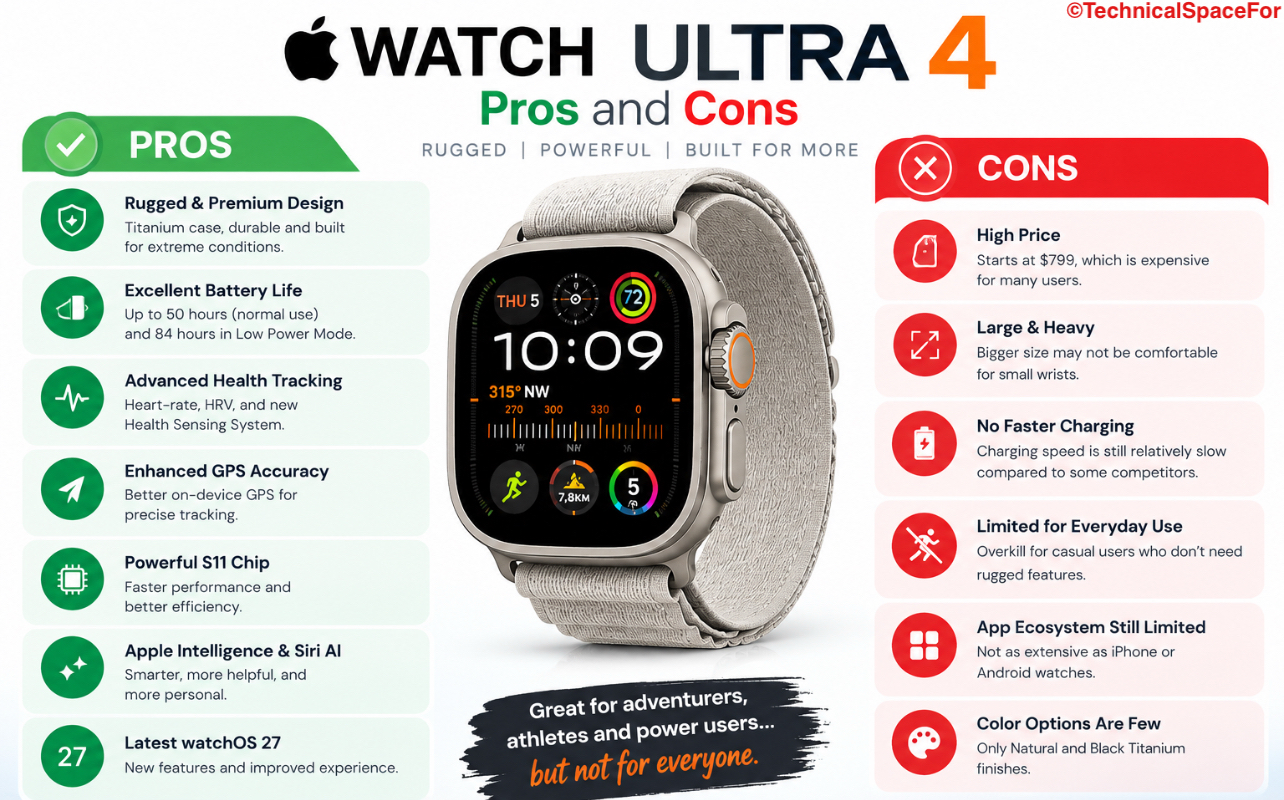
Apple Watch Ultra 4 offers rugged design, long battery life, advanced health features, and powerful performance—but its $799 price and large size may not suit everyone.
Pros
Powerful S11 chip
Advanced Health Sensing System
Heart-rate measurements taken often
Better HRV tracking
New Readiness score to help you know how your body is ready
Up to 50 hours of battery life in regular use
Up to 84 hours in Low Power Mode
Up to 45 hours of outdoor workout tracking
Improved GPS accuracy, for better location tracking
Apple Intelligence and Siri AI working together
New Audio Intelligence features that make listening smarter
Available in natural and black titanium finishes
Advanced safety and fitness features to keep you protected and motivated
Cons
$799 starting price
Some smart features are released later or in beta
Siri AI availability changes, by language and region
Certain Apple Smart features need hardware
Battery performance changes based on how you use it and its connectivity
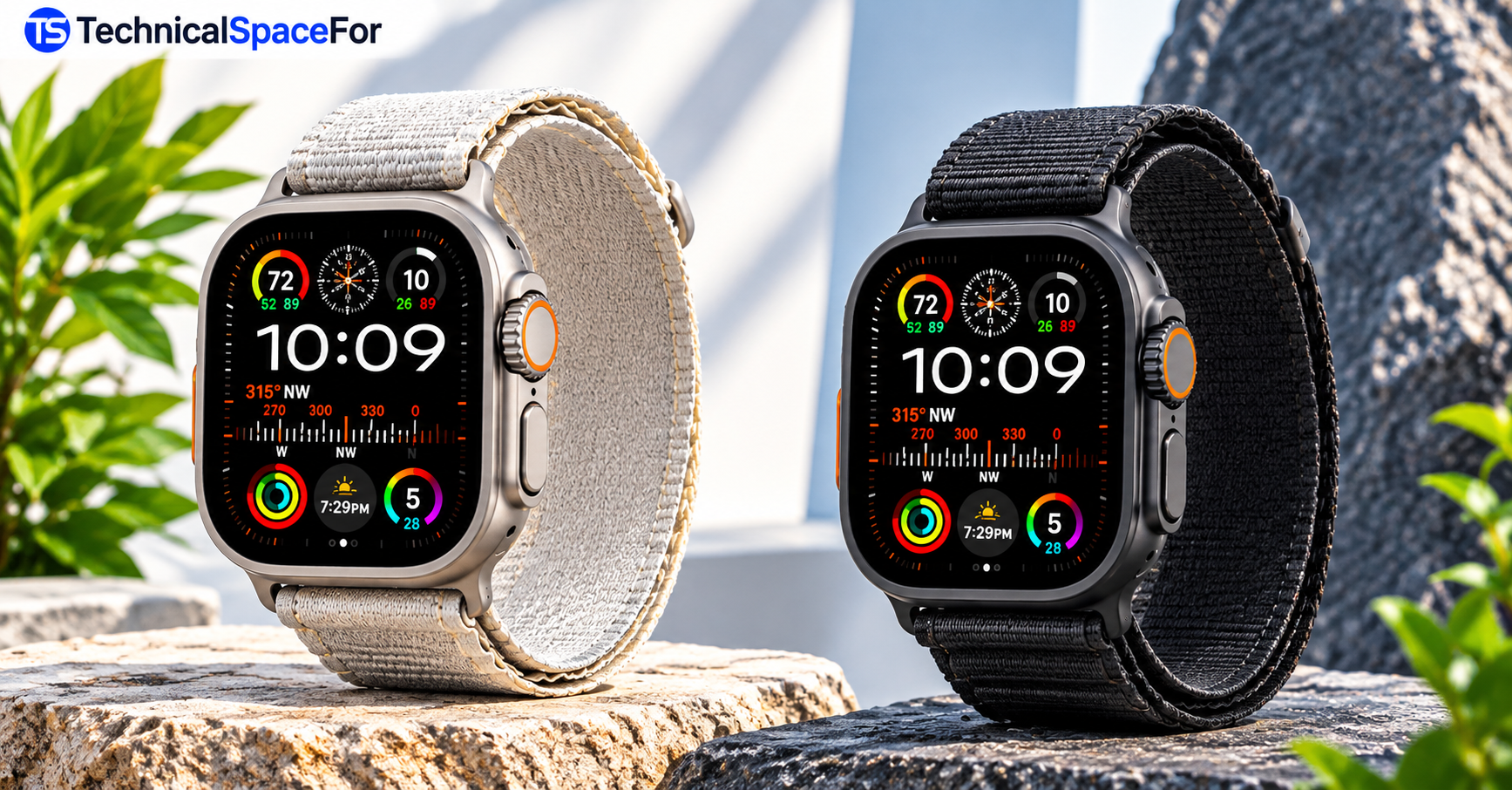
Apple Watch Ultra 4 Design
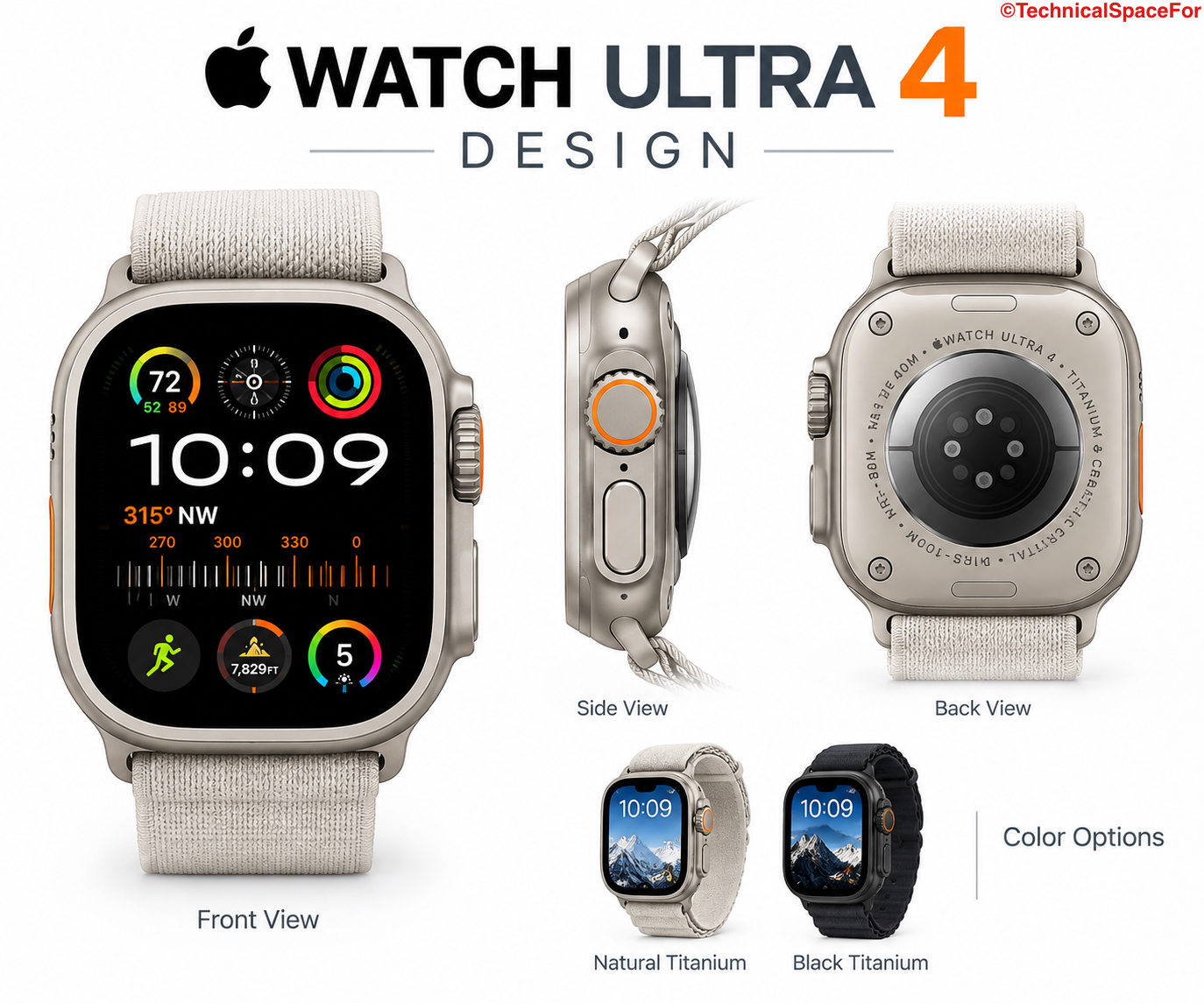
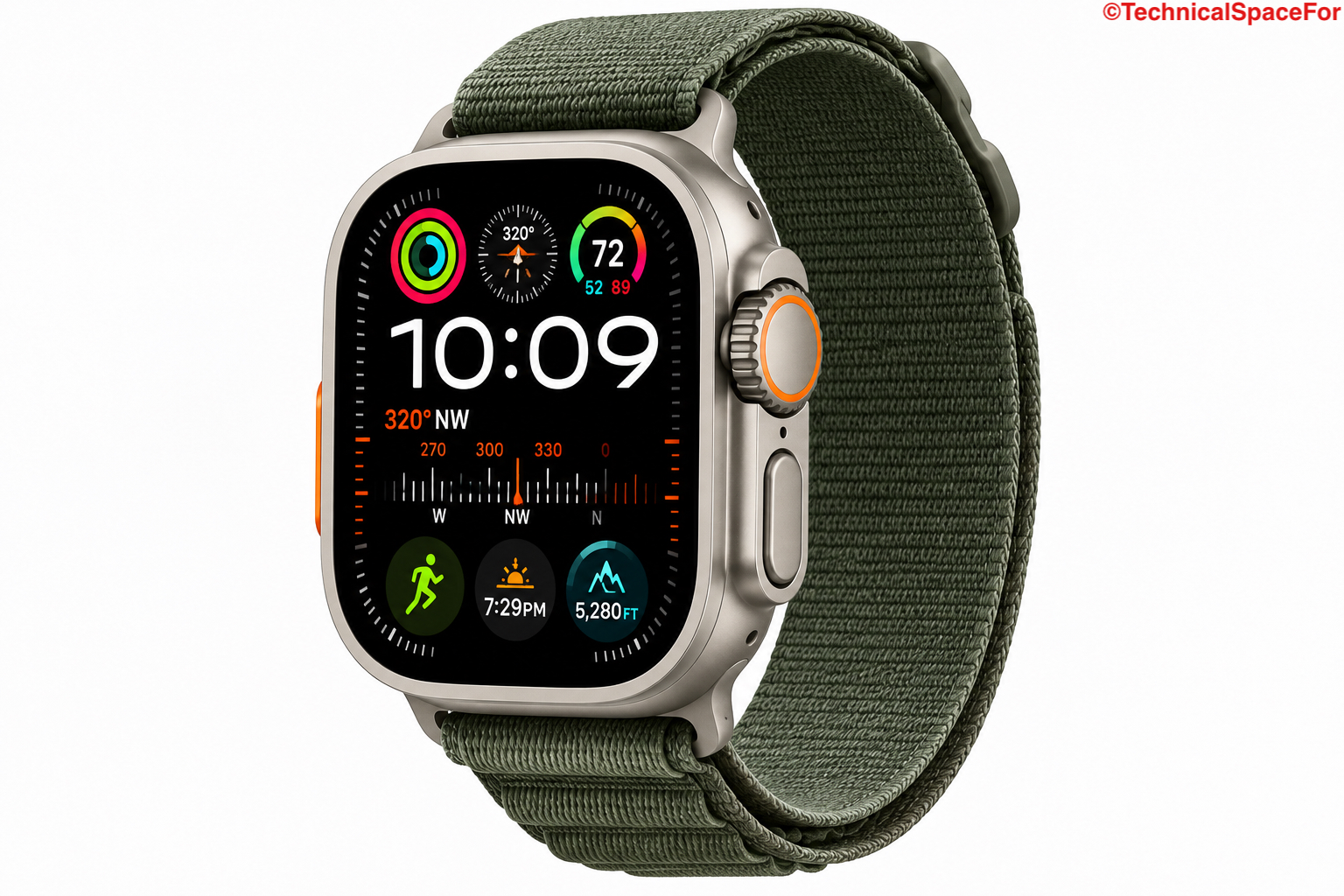
Meet the Apple Watch Ultra 4 design — rugged titanium construction, a bold display, precision controls, and Natural Titanium or Black Titanium finishes.
The Apple Watch Ultra 4 design keeps going with Apples Ultra idea and gives a high-end titanium look.
The watch comes in two finishes:
Natural titanium
Black titanium
Apple calls the Apple Watch Ultra 4 its capable Apple Watch. Apple says the Apple Watch Ultra 4 has an bright display. Apple says the Apple Watch Ultra 4 is made for workouts, adventures and everyday use.
Apple Watch Ultra 4 Bands
Apple has also introduced new band colors.
Trail Loop:
Dark Umber
Sand
Burgundy
Alpine Loop:
Desert
Dark Olive
Burgundy
Ocean Band:
Translucent Gray
Translucent Kelp
Translucent Black
I am excited that the Ocean Band is now made from a silicone material.
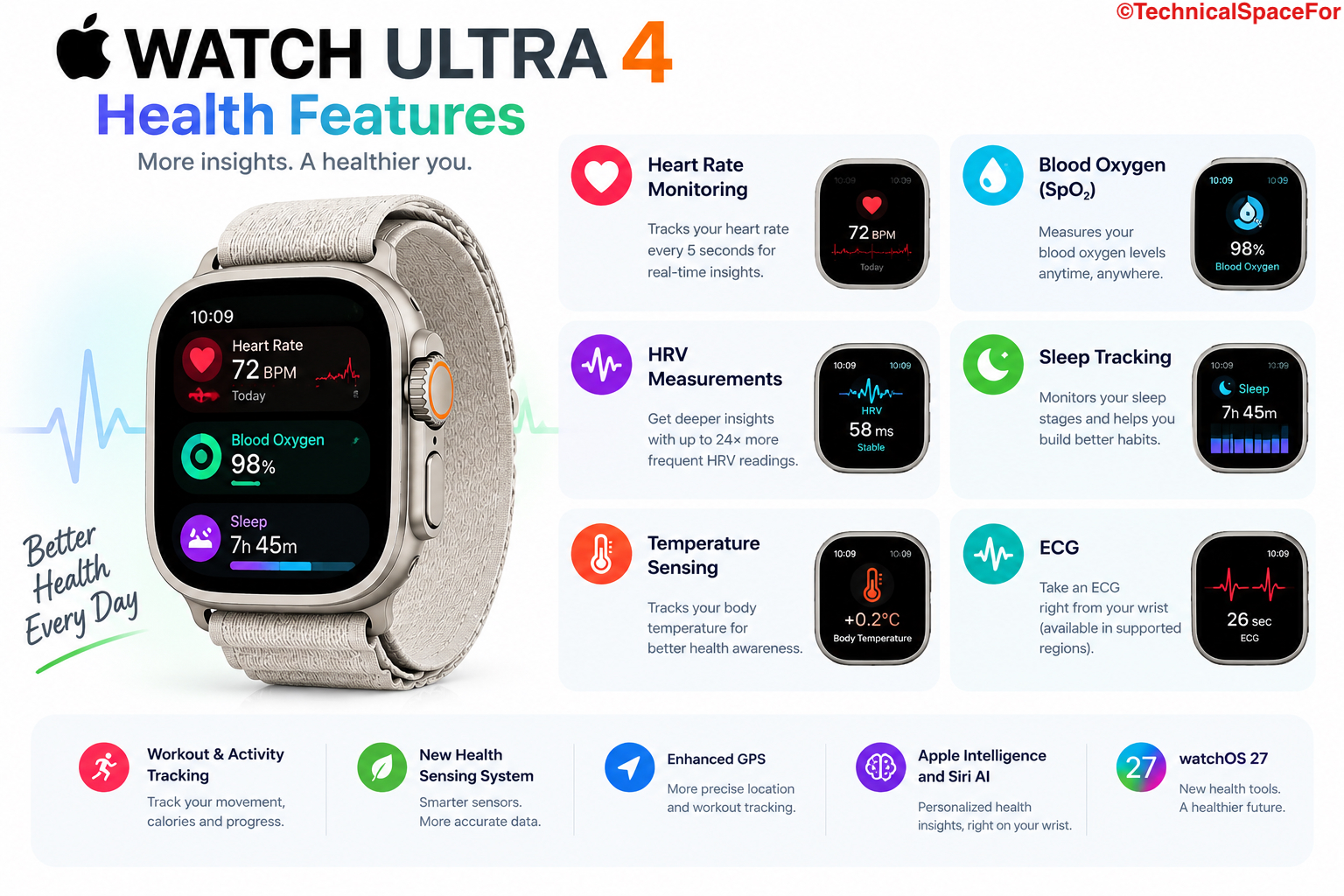
Apple Watch Ultra 4 Health Features
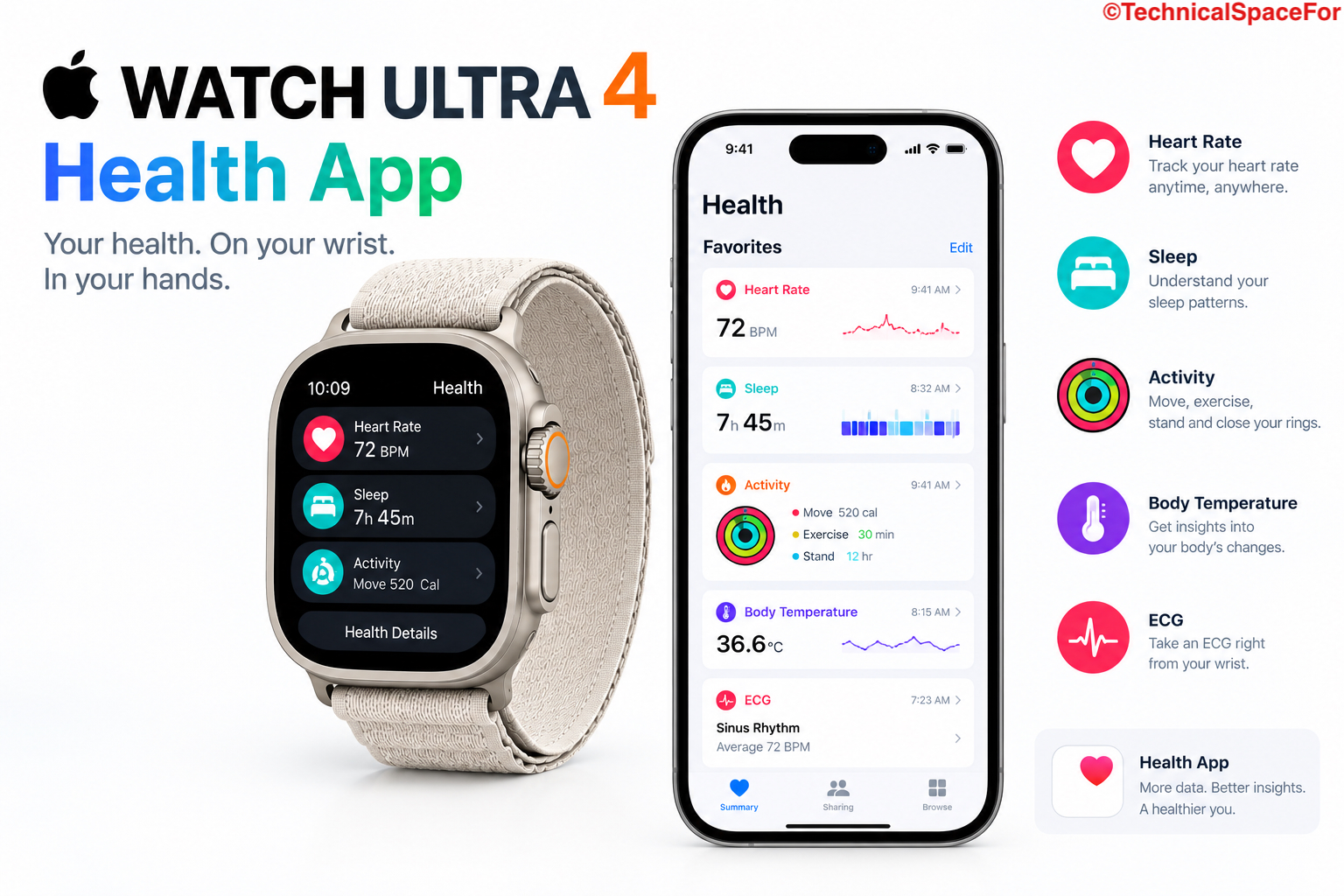
Apple Watch Ultra 4 brings advanced health tracking to your wrist with frequent heart-rate and HRV measurements, sleep tracking, ECG, temperature sensing, and a new Health Sensing System.
Health tracking is one of the improvements in the Apple Watch Ultra 4. Apple has introduced a Health Sensing System that combines new optical and electrical heart sensors with the S11 chip. Apple says this system offers its accurate heart-rate sensing in a wearable. The system checks heart rate every five seconds during the day giving detailed information, about fitness and the bodys condition. The Apple Watch Ultra 4 also tracks heart-rate variability often. HRV measurements can be taken up to 24 times frequently.
Apple Watch Ultra 4 Readiness Feature
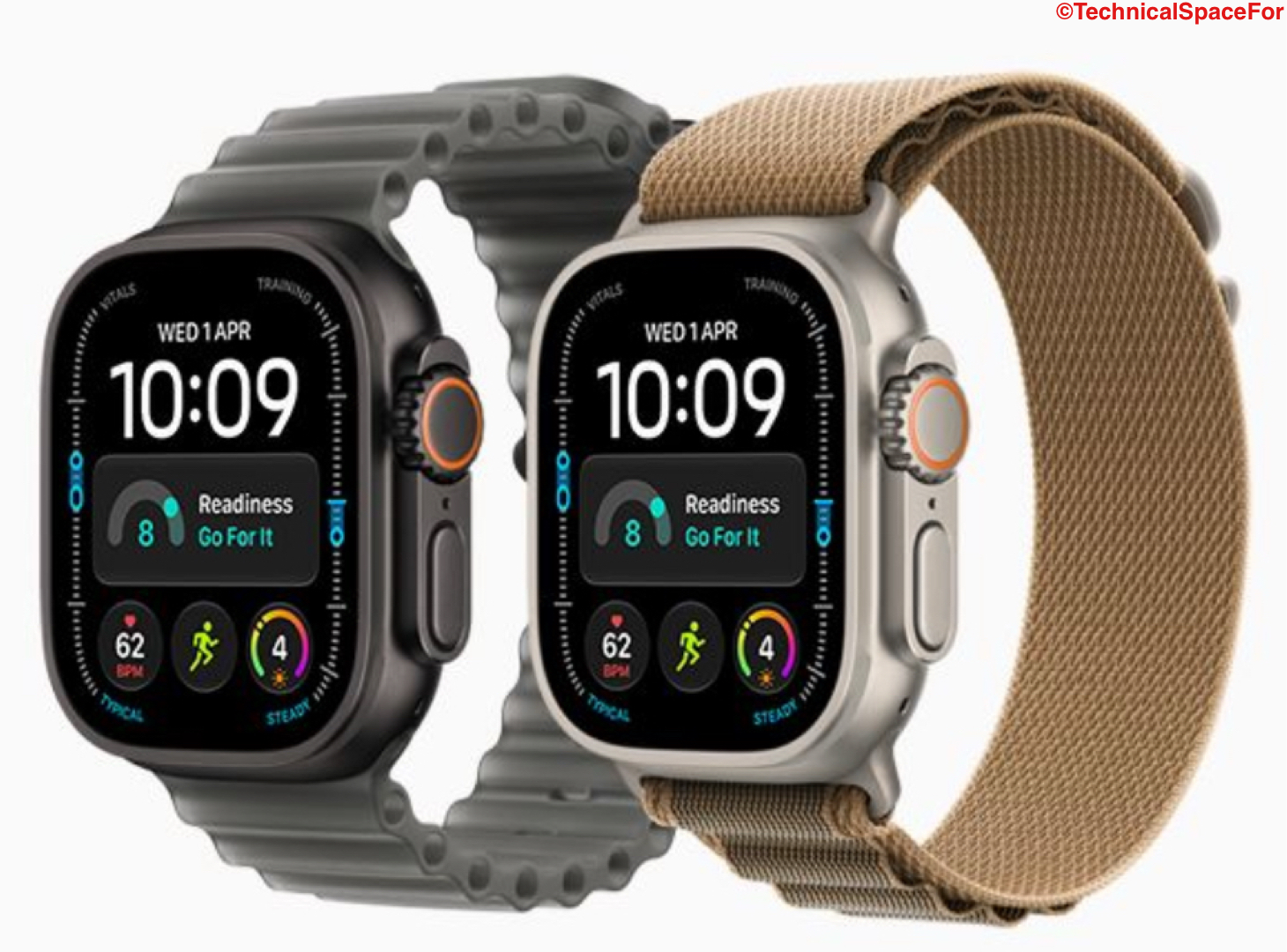
One of the interesting new Apple Watch Ultra 4 features is Readiness readiness looks at activity, training load, vital signs and sleep score readiness then gives a number between zero and ten readiness then suggests actions such as Recover, Pace Yourself Ready and Go For It readiness score can shift during the day when new health and activity data appear for athletes and active people Readiness can help decide if the body is ready, for another workout or if more rest is needed.
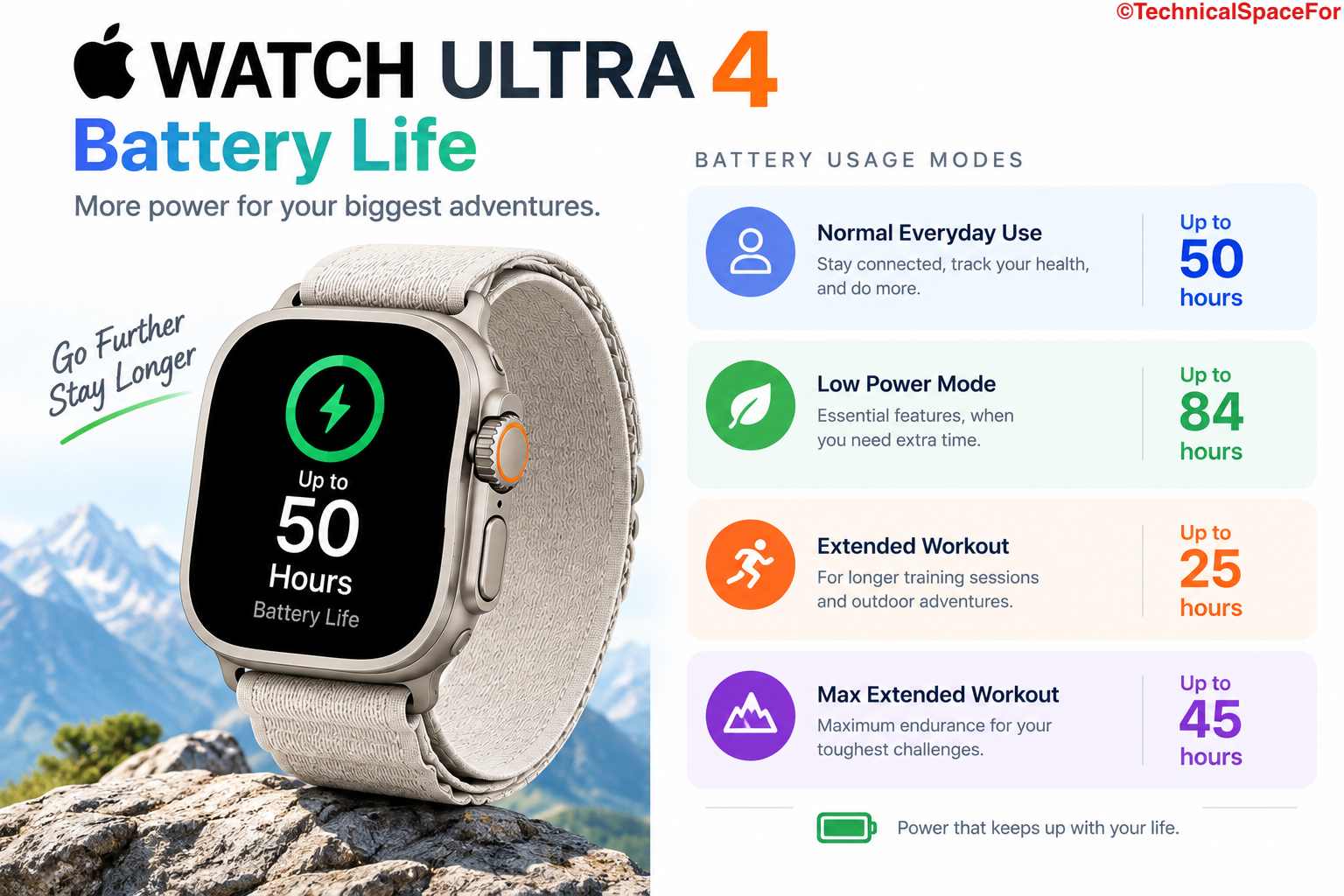
Apple Watch Ultra 4 Battery Life
Apple Watch Ultra 4 delivers impressive endurance with up to 50 hours of everyday use, 84 hours in Low Power Mode, and up to 45 hours during Max Extended Workout.
Battery life is another upgrade with the Apple Watch Ultra 4 It can last up to 50 hours with daily use. When you switch to Low Power Mode Apple says the battery can go long as 84 hours that’s a jump in how long the watch stays charged
Watch Ultra 4 Battery Performance
Usage Mode
Battery Life
Normal everyday use
Up to 50 hours
Low Power Mode
Up to 84 hours
Extended Workout
Up to 25 hours
Max Extended Workout
Up to 45 hours
The watch also supports charging. Apple says that 15 minutes of charging can give up to 18 hours of battery life. This is especially useful for long-distance athletes. The Max Extended workout mode can track runs, walks and hikes for, up to 45 hours. It keeps GPS readings every second during activities.
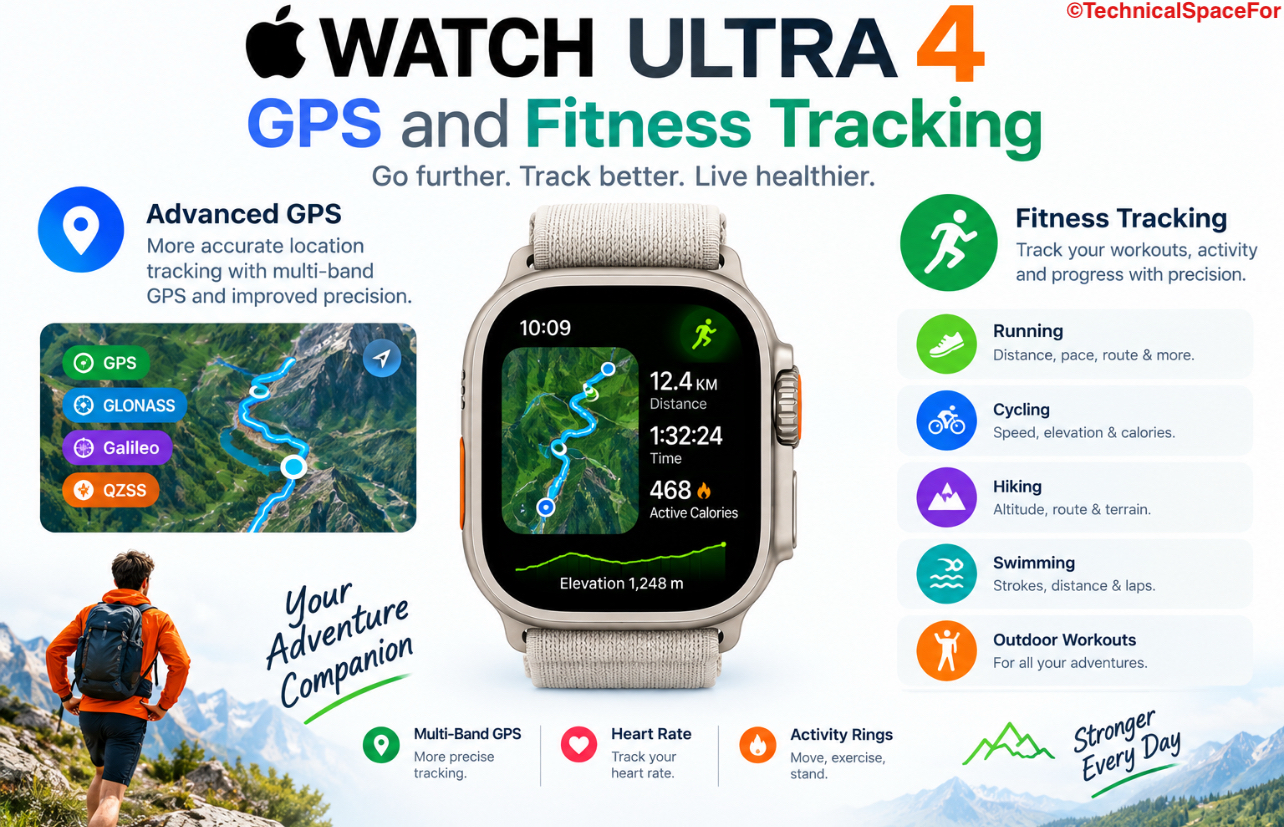
Apple Watch Ultra 4 GPS and Fitness Tracking
Go further with Apple Watch Ultra 4. Enhanced GPS accuracy and advanced fitness tracking help you monitor running, cycling, hiking, swimming, workouts, and daily activity.
Apple Watch Ultra 4 is built for outdoor workouts. Apple says Apple Watch Ultra 4 offers its accurate on‑device GPS in a sports watch. Apple Watch Ultra 4’s new Extended Workout mode can give up to 25 hours of outdoor workout tracking with GPS and heart‑rate readings for even longer sessions. Apple Watch Ultra 4 Max Extended Workout supports, up to 45 hours of tracking.
This makes the Apple Watch Ultra 4 especially interesting, for:
Marathon runners
Trail runners
Hikers
Cyclists
Outdoor athletes
Ultra-distance competitors
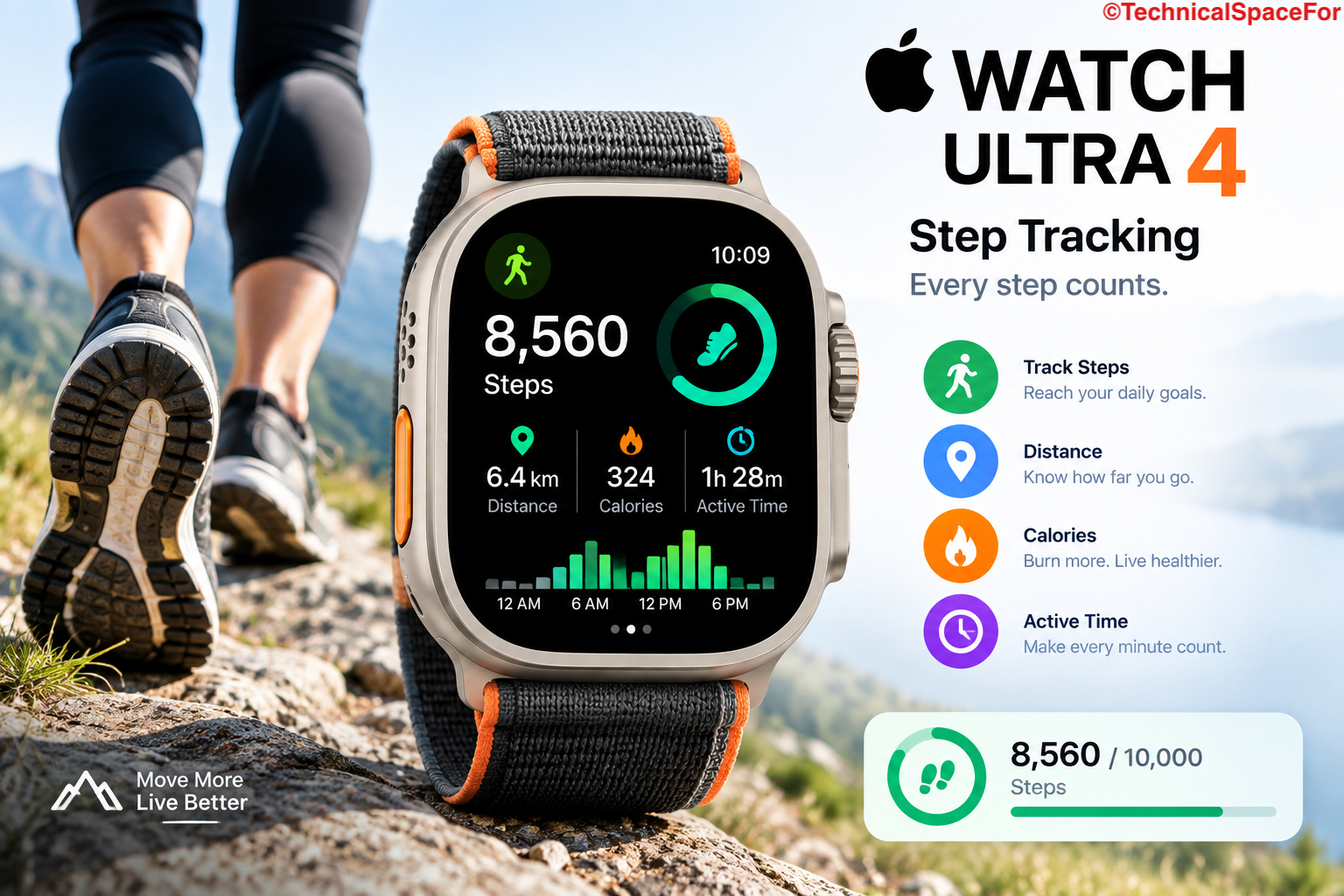
Apple Watch Ultra 4 Step Tracking
Track every step with Apple Watch Ultra 4. Monitor steps, distance, calories, and active time to stay motivated and reach your daily fitness goals.
Apple has updated the pedometer model in the Apple Watch Ultra 4 by using machine-learning algorithms and the S11 chip the watch is built to deliver distance measurements during indoor walking and running workouts It also improves step counting for use. Apple says the Apple Watch Ultra 4 offers the accurate step tracking of any smartwatch a new Steps complication lets users view their step count, on the watch face.
Apple Watch Ultra 4 and Apple Intelligence
The Apple Watch Ultra 4 goes beyond smartwatch features with Apple Intelligence on watchOS 27 Siri AI brings context understanding and broader knowledge directly to the wrist A new Siri app allows users to continue conversations and access Apple Intelligence capabilities while using the Apple Watch Ultra 4 This represents a shift, for Apple Watch making it more intelligent and useful without requiring users to constantly reach for their iPhone.
Apple Watch Ultra 4 Audio Intelligence
Another important new feature is Audio Intelligence the Apple Watch Ultra 4 can use its built‑in microphone the S11 chip, Apple Intelligence models and Private Cloud Compute to provide smart audio features these include:
Sound Recognition
Sound Recognition can let users know about sounds such as:
Sirens
Alarms
Doorbells
A baby crying
I think the feature is very useful, for users who’re deaf or hard of hearing. The feature helps users a lot.
Live Rewind
Live Rewind can show the 15 seconds of a conversation, as a text snippet. This happens after you press the Digital Crown twice.
Siri Recap
Siri Recap can create summaries of your conversations this helps you remember the details later You can quickly check what was discussed without going through the chat. It’s useful for keeping track of moments the summaries are simple and easy to read.
Shazam
Shazam can identify music playing near the user display the song title and artist on the Apple Watch Apple says that Shazams Audio Intelligence features are designed with privacy, in mind and do not create or store recordings Shazam keeps user privacy safe the Apple Watch shows the title instantly the Audio Intelligence features never record or store any audio.
Apple Watch Ultra 4 watchOS 27
Apple Watch Ultra 4 runs watchOS 27 and watchOS 27 introduces new features.
Key watchOS 27 additions include:
I am excited about the app grid.
I am thrilled by the single-handed tap gesture.
I appreciate the Stack widget suggestions.
I love the Siri AI feature.
I am happy with the Workoightsut Buddy improvements.
I enjoy the Siri Modular watch face.
I find the perimenopause and menopause support, in Cycle Tracking very helpful.
I appreciate the expanded fitness ins.
The new handed tap gesture is created to help people use Smart Stack widgets more easily. The handed tap gesture makes it simple to interact with Smart Stack widgets when only one hand is available.
Apple Watch Ultra 4 Health App
Track your health in one place with Apple Watch Ultra 4 and the Health app. Monitor heart rate, sleep, activity, body temperature, and ECG data.
Apple is redesigning the Health app on iPhone the new app adds an Insights tab and a Longevity tab the Longevity tab has a Health Age feature that looks at health metrics compared to a persons actual age Apple Watch Ultra 4 users can now see a picture of their long‑term health and fitness data instead of only looking at daily numbers.
Watch Ultra 4 Privacy Features
Privacy is another part of the new intelligent features. Apple says the S11 chip includes a Secure Exclave that processes audio in a hardware environment. Raw audio used for processing is not accessible, to the operating system, apps, the user or Apple. Raw audio is immediately deleted after processing. Users can also control whether users want to use individual Audio Intelligence features.
Watch Hermès Ultra 4
Apple is also offering the Apple Watch Hermès Ultra 4 in titanium the Hermès version has a Grand H titanium band, with an extension mechanism that fits over a wetsuit apple also introduces the Fathom wonder watch face, which shows ocean depth pictures and many animated views.
Watch Ultra 4 Sustainability
Apple says the Apple Watch Ultra 4 contains forty‑five percent recycled material in this watch the titanium case is made from one hundred percent recycled titanium the battery uses one hundred percent recycled cobalt apple also says that the electricity used in manufacturing comes from energy sources throughout its supply chain, such, as wind and solar power
Apple Watch Ultra 4 vs Previous Ultra Models
Apple Watch Ultra 4 vs Ultra and Ultra 2: see how the latest model compares in performance, battery life, health tracking, GPS, connectivity, and smart features.
The Apple Watch Ultra 4 is about making improvements, in important areas instead of just putting in a new processor.
The biggest changes are:
Health: A health sensing system with more frequent measurements to keep track of your well-being throughout the day.
Fitness: A new Readiness score helps you know when your body is ready for a workout. Step tracking is better than ever. There are advanced workout modes for more detailed activity insights.
Battery: You can expect up to 50 hours of use. When using Max Extended Workout tracking the battery lasts up to 45 hours.
Intelligence: Siri AI is now part of the experience and new Audio Intelligence features enhance how you interact with your device.
GPS: Apple says this sports watch has the accurate, on-device GPS available.
Together these upgrades make the Apple Watch Ultra 4 a significant evolution of Apple’s high‑end smartwatch lineup.
Is Apple Watch Ultra 4 Worth Buying?
The Apple Watch Ultra 4 stands out for people who care deeply about health tracking, outdoor activities, battery life, GPS precision, and smartwatch capabilities. At $799, it’s not just a smartwatch; the combination of the S11 chip, the new Health Sensing System, the Readiness feature, better battery life, advanced GPS, and Apple Intelligence makes it one of Apple’s most powerful wearables. For users who mainly want notifications, basic fitness tracking, and standard smartwatch functions, this model still delivers. however for athletes, hikers, runners, adventurers, and anyone seeking Apple’s top-tier wearable experience, a less expensive Apple Watch might offer better value. that said, the Apple Watch Ultra 4 is much easier to justify for those who want a powered device with top-tier performance and features.
Apple Watch Ultra 4: Final Verdict
Apple Watch Ultra 4 is a powerful choice for athletes, adventurers, and power users, offering rugged durability, long battery life, advanced health tracking, and enhanced GPS.
The Apple Watch Ultra 4 is an improvement that takes Apples high-end smartwatch even further in health, fitness, outdoor activities, and artificial intelligence. The key features include the Health Sensing System, the S11 chip, the Readiness score , better GPS, longer battery life, quicker charging, and features powered by Apple Intelligence. It can last up to 50 hours in use, 84 hours in Low Power Mode, and 45 hours for maximum workout tracking. This makes the Apple Watch Ultra 4 very appealing to people who do in long-distance sports and enjoy being active. It starts at $799, in within the premium smartwatch category. For people who want the advanced mix of health monitoring, fitness tracking, safety, intelligence, and a strong design, the Apple Watch Ultra 4 is an exciting new choice.
The Apple Watch Series 12 is Apples smartwatch. It is made to track health. It is made to monitor fitness. It is made to offer performance. It is made to provide features. It has a Health Sensing System. It has the S11 chip. It has frequency heart rate and HRV measurements. It has a Readiness score. It has Audio Intelligence features. The price starts at $399, in the U.S. The Apple Watch Series 12 comes in 42 mm and 46 mm sizes. Pre-orders start on September 9 2026. Availability starts on September 18 2026.
Apple Watch Series 12 Key Specifications
Apple Watch Series 12 — Smarter Health. A Brighter Future. Discover the S11 chip, advanced health sensing, improved HRV tracking, up to 24-hour battery life, watchOS 27, and more. Starting at $399.
Specification
Apple Watch Series 12
Sizes
42mm / 46mm
Chip
Apple S11
Health System
New Health Sensing System
Heart Rate
Higher-frequency sensing
HRV
Up to 24× more frequent
Readiness Score
0–10
Battery Life
Up to 24 hours
Outdoor Workout
Up to 10 hours
Fast Charging
15 minutes = up to 12 hours additional battery
Materials
Aluminum, Titanium, Ceramic
Ceramic Shield 2
Yes, on aluminum models
Software
watchOS 27
Siri AI
Yes, beta rollout
ECG
Yes
Sleep Tracking
Yes
Sleep Apnea Notifications
Yes
Emergency SOS
Yes
Starting Price
$399
New Health Sensing System
One of the upgrades in Apple Watch Series 12 is its Health Sensing System Apple says Series 12 offers its accurate heart-rate sensing in a wearable. The system uses optical and electrical heart sensors along with the S11 chip for continuous health monitoring The watch can now check heart rate every five seconds during the day giving regular updates, about fitness and body condition.
More Frequent HRV Monitoring
Heart rate variability, also called HRV receives an upgrade, on Apple Watch Series 12 Apple says HRV measurements can now be taken up to twenty‑four times often and these HRV measurements appear in a new section of the Heart Rate app. The watch also offers two kinds of HRV data: Recovery HRV and overall HRV These HRV measurements help users see how recovery improves and how overall health and fitness patterns change.
New Readiness Score
Apple Watch Series 12 introduces a Readiness feature. This feature helps users understand how ready their body might be for the day. It looks at things including recent activity, training load, vital signs and sleep score. Based on this information it gives a score from 0 to 10. The score comes with suggestions, like Recover, Pace Yourself Ready or Go For It. The Readiness Score can change during the day as more health and activity data comes in.
Apple Watch Series 12 Release Date
Apple announced the Apple Watch Series 12 on September 9 2026. The Apple Watch Series 12 is available for pre-orders in the U.S. And many other countries. The Apple Watch Series 12 will be available, in stores starting on Friday, September 18 2026 If you are a buyer in the United States, you will find that the Apple Watch Series 12 starts at a price of $399. The Apple Watch Series 12 is available for $399 to U.S buyers I think the Apple Watch Series 12 offers value for the price.
Apple Watch Series 12 Price
Apple Watch Series 12 Price: Starting at $399 Discover the latest Apple Watch Series 12 with advanced health sensing, S11 chip, up to 24-hour battery life, watchOS 27, and more.
The Apple Watch Series 12 starts at:
Model
Starting Price
Apple Watch Series 12
$399
Apple offers leasing in the United States. Apple customers who are eligible can get a 42mm Series 12 starting at $11.99, per month for a period of 24 months The advertised monthly payment is based on Apple’s lease program. That does not necessarily mean the watch is owned at the end of the lease term. Apple’s lease program does not guarantee ownership when the lease ends.
Apple Watch Series 12 Battery Life
Apple Watch Series 12 Battery Life — Up to 24 hours of battery life, up to 10 hours for outdoor workouts, and up to 12 hours of additional battery with just 15 minutes of fast charging.
Battery life is still a feature in the Series 12 upgrade Apple Watch Series 12 gives up to 24 hours of battery life during use and up to 10 hours during an outdoor workout. Apple says this is 25 percent better, than the model Charging is also quicker. Apple claims that 15 minutes of charging can give charging, up to 12 hours of extra battery life Actual battery life will differ based on usage, settings, cellular connectivity and other conditions.
More Accurate Step Tracking
Apple has redesigned the pedometer model in Series 12 using machine-learning algorithms. The pedometer now tracks steps accurately The new system is built to make distance measurements for walking and running sessions It also makes all day step counting more accurate Apple says that the Series 12 has the step tracking that a smartwatch can offer A new Steps complication shows the step count on the watch face.
Apple Watch Series 12 Design and Materials
Apple Watch Series 12 Design & Materials — Available in 42mm and 46mm sizes with aluminum, titanium, and ceramic options, featuring a refined modern design and Ceramic Shield 2.
Apple Watch Series 12 is available in 42mm and 46mm sizes.
Aluminum models are available in:
Dark bronze is a warm shade.
Black is a bold tone.
Light gold feels bright and gentle.
Space gray is cool and calm.
Titanium models are:
offered in gold, which shines beautifully
Natural titanium gives a look
I am excited to share that there is a ceramic version that is available, in the following colors:
Pearl white
Night blue
Aluminum models come with Ceramic Shield 2 and Apple says that Ceramic Shield 2 is 60 percent tougher, than the Ion‑X glass that was used on aluminum models. Aluminum models get an upgrade.
Apple Watch Series 12 and watchOS 27
A smarter, more personal Apple Watch experience with new health, fitness, communication, and everyday features.
Apple Watch Series 12 runs watchOS 27 Apple Watch Series 12 comes with software features thanks to watchOS 27.
Key updates include:
Dynamic app grid makes it easy to see all apps at once. Dynamic app grid feels intuitive and fast.
New handed tap gesture lets you tap with one hand. New handed tap gesture feels smooth and convenient.
Smart Stack widget suggestions show apps automatically. Smart Stack widget suggestions adapt to your habits.
Perimenopause and menopause support in Cycle Tracking provides health data. Perimenopause and menopause support, in Cycle Tracking helps you stay informed.
Workout Buddy improvements make workouts easier to follow. Workout Buddy improvements add features for your routine.
Siri AI integration lets Siri help with tasks quickly. Siri AI integration is faster and more reliable.
The new handed gesture lets users work with widgets by simply tapping with their index finger and thumb. It makes things easier when one hand is busy. You don’t need to stretch or reach far. Just a quick tap does the job. This helps people use their phones comfortably especially when they’re on the move. The design focuses on simplicity and speed.
Siri AI on Apple Watch
Apple is bringing Siri, powered by Apple Intelligence, to the Apple Watch with watchOS 27. The updated Siri can now understand context and give users access to a wider range of world knowledge. Apple is also introducing a Siri modular watch face, making it faster and easier to reach. Siri AI will start as a beta in English with more languages to follow in October.
Audio Intelligence Features
apple watch series 12 introduces a new group of audio intelligence features designed to help users stay aware and remember important moments
Features include:
Sound Recognition
The watch can recognize sounds such as:
Sirens
Alarms
Doorbells
A baby crying
Live Rewind
Live Rewind can display a text excerpt from the last fifteen seconds of a chat if you double press the Digital Crown.
Siri Recap
Siri Recap produces overviews of chats. Siri Recap lets you glance at details later so you do not need to read a full transcript every time.
Shazam
Shazam can automatically detect the music that is playing nearby. It shows the title and the artist right on the wrist.
Privacy and Security
Apple says privacy is very important to the Audio Intelligence system. Audio Intelligence does not. Keep audio recordings. The S11 chip has Secure Exclave, an area of hardware that is separate from the rest of the system. This part is used to handle audio and then deletes the audio. Apple also says Live Rewind and Siri Recap use encryption, and these features are made to not recognize people speaking
Redesigned Health App
The Health app on iPhone is also receiving a major redesign.
Apple is adding:
New Insights tab
New Longevity tab
Health Age
Movement assessments
customized health information
The Health Age feature takes health data. compares it to the actual age. It shows how well certain health metrics are doing in relation to what’s typical for someone that age. This helps people understand their health better. The feature looks at things like heart rate, blood pressure , and other wellness indicators. It then gives a score or age that reflects how healthy the user seems compared to others of the chronological age.
Apple Watch Series 12: Is It Worth Buying?
The Apple Watch Series 12 looks like an upgrade. The Watch Series 12 is great for people who care about health tracking, fitness, battery life, and smart features. The new health sensing system brings frequent HRV measurements. The new Health Sensing System also adds a readiness score. Improves step tracking; the Series 12 now charges faster. Including Siri AI, these changes mean the Series 12 is more than a routine annual update. Apple Watch users may want to upgrade because Apple Watch has health sensors, a Readiness feature, a better battery, faster charging during workouts, and Apple Smart features.
Final Verdict
Apple Watch Series 12 Final Verdict: A strong smartwatch package combining a refined design, advanced health tracking, fitness features, long battery life, and watchOS 27.
The Apple Watch Series 12 is Apple’s high‑end smartwatch. It brings health tracking, a new S11 chip, watchOS 27, Apple Intelligence, and faster charging. Starting at $399, the Apple Watch Series 12 gives Apple users a choice. It can track workouts, watch health trends, give safety alerts, and give help right from the wrist with 42 mm and 46 mm sizes. Apple Watch Series 12 comes in aluminum, titanium, and ceramic choices, along with a variety of bands, making it easy for buyers to personalize their device. For people who’re really into the Apple system, the Apple Watch Series 12 is one of the most advanced smartwatches from Apple in a long time.
Choosing a television can be hard because there are many options now. There are LED TVs and also expensive OLED and Mini-LED models. If you are wondering, “What Is the Best Smart TV?” the best answer depends on how money you have, the size of the room where you watch TV how you watch TV and the things you want from a TV.
In this guide we will look at the TVs to buy in 2026. We will include choices for watching movies playing games watching sports, streaming shows in rooms and for people who want to save money. We will also explain the differences between OLED, QLED, Mini-LED and regular LED TVs so you can be sure, about your choice.
What Is a Smart TV? Smart TV Price Range:
What is a Smart TV? Discover its smart features, streaming apps, internet connectivity, and price range in the USA.
A smart TV is a television that connects to the internet. It lets you watch streaming services use apps and access content. You don’t need a device like a Roku or Fire Stick to get these features Smart TVs today come with apps built in. You can find Netflix, YouTube, Prime Video and Disney+ on these TVs. The operating system may vary by brand. Some use Google TV others use Samsung’s Tizen. Some use LG’s webOS When people ask, “What Is the Best Smart TV?” they often focus on picture quality. Other things matter as much. The software should be easy to use. The app selection should be good. Connectivity options, like Wi-Fi and Bluetooth help a lot. The remote control should work well. You want the TV to get software updates for years. All these things add up to the user experience.
Price Range
Best Choice
Best For
Under $500
Budget 4K Smart TV
Everyday streaming
$500–$1,000
Mid-range Mini-LED
Bright rooms and HDR
$1,000–$2,000
Premium OLED TV
Best picture quality
$2,000+
Flagship OLED
Home theater
Gaming
120Hz+ OLED/Mini-LED
PS5, Xbox, and PC gaming
What Should You Look for When Buying a Smart TV?
Buying a Smart TV? Check the display quality, screen size, smart features, connectivity, sound, ports, warranty, and price before you buy.
Before you decide on a TV to buy in 2026 you should look past just screen size and price. A good smart TV must give you picture quality, smooth performance, useful smart features, reliable connectivity and good sound. Display technology, screen resolution, refresh rate, HDR support, gaming features and the smart TV operating system can all make a difference, in how you watch everyday.
Display Technology
Display technology shapes the look of a picture. Display technology changes the quality of an image—the contrast, the brightness and the colors. I find Display technology really important when choosing a TV. The kind of Display technology you pick decides how dark the black parts look and how bright the white parts shine. Common options are OLED, QLED, Mini‑LED and the traditional LED/LCD OLED TVs are famous for their picture quality and deep blacks because each pixel can turn off completely. OLED TVs create contrast. I notice that OLED TVs show blacks and are a choice for watching movies TV shows and for viewing in dark rooms.
QLED TVs use an LED‑LCD panel with quantum‑dot technology. QLED TVs show colors and strong HDR performance. I have seen how QLED TVs shine in rooms working well in rooms with lots of light Mini‑LED TVs use thousands of LEDs for backlighting and local dimming. Mini‑LED TVs offer images, improved contrast and better HDR performance than LED TVs. Mini‑LED TVs are an option, for rooms. For watching HDR content At LED/LCD TVs are usually cheaper. LED/LCD TVs remain a choice if you want a 4K screen without spending a lot of money.
Screen Resolution
In 2026 most buyers find that 4K resolution gives the mix of picture quality, availability and cost. A 4K TV contains about four times pixels, than a Full HD TV. This difference makes the image sharper and more detailed. On screens the advantages of 4K become even clearer. If you plan to buy a 55-inch, 65-inch, 75-inch or bigger TV picking a 4K model is usually a long‑term choice.
Refresh Rate
The refresh rate of a TV is expressed in hertz (Hz) and is the number of times the TV draws a picture in one second. For viewing TV, watching movies and most TV programs, there is no problem with a 60Hz TV, but with a 120Hz TV, you get to feel the motion. If you watch a lot of sports, lots of action movies, or lots of fast scenes, then the refreshFeels more responsive. I find the refresh rate useful when watching sports, action movies or fast scenes. A higher refresh rate also helps a lot when playing games, on a PlayStation, Xbox or gaming computer. If you are buying a TV in 2026 I suggest you consider a TV that has a 120Hz refresh rate.
HDR Support
HDR, or High Dynamic Range, boosts the brightness and colors in images to make them appear more realistic. The very bright parts of the image are reproduced more accurately and all detail is retained in the very bright parts of the image. There are several different HDR formats including HDR10, HDR10+, Dolby Vision and If you often watch movies or TV shows or online videos it is an idea to see which HDR formats a TV can handleHDR support can make a difference when choosing between different TVs.
Smart TV Operating System
The smart TV operating system decides how you get to streaming apps, services, settings and other connected features. Some of the common platforms are Google TV, Samsung Tizen and LG webOS. Google TV gives you access, to different apps and works well with other Google products. Samsung Tizen has an clean look and fits well with Samsung’s other smart devices. LG webOS is also easy to use. Finding streaming apps becomes very simple. When you choose a TV pick an operating system that is easy to use and that supports the apps and services you use every day.
HDMI and Gaming Features
Find out what kind of connectors your TV has and what kind of gaming features it has. If you want to connect a PlayStation, an Xbox, a gaming PC or any other modern gaming device, your TV should have HDMI 2.1 connectors to play 4K at 120Hz and Variable Refresh Rate and Auto Low Latency Mode and low input lag are features that I find useful. Refresh Rate and Auto Low Latency Mode and low input lag give me smoother gameplay and faster response times. They are especially important, for gamers who want to get the most out of their consoles and high‑end gaming hardware.
Sound Quality
The picture is one part of the fun when it comes to watching TV. The sound is important too especially if you want to enjoy movies, sports or live TV without needing speakers. Many new TVs are very thin which means there isn’t room for strong built-in speakers. Because of that some TVs might need a soundbar or a home theater system. Things, like Dolby Atmos and eARC can help when you connect devices that work with them. To get the experience think about the TVs own sound and the ways it can connect to audio equipment before you decide to buy.
Smart TVs to Buy in 2026
Looking for the best Smart TV in 2026? What Is the Best Smart TV? Compare top brands, display quality, smart features, streaming, sound, and value.
The best smart TV in 2026 depends on how you watch shows and movies how much money you have to spend, the size of the room where you will put the TV and what features you like the most. Of picking one TV that works for everyone this list looks at the best choices for different kinds of people. From the smart TV overall and high-end OLED models to bright Mini-LED TVs, gaming TVs affordable 4K options, TVs that are great, for watching movies and big screen models there is a smart TV that fits every requirement.
Best Overall Smart TV
The best overall Smart TV should give a mix of picture quality, HDR performance, smart features, sound, gaming support build quality and price. The best overall Smart TV should be a choice, for most users and the best overall Smart TV does not need a premium budget.
Oled Smart TV
OLED TVs are a perfect choice for people who want the very best picture quality. Blacks and high contrast are delivered superbly. Also, viewing angle, color accuracy, HDR performance and reaction timeThese features make OLED TVs perfect. OLED TVs are a choice, for movie fans and gamers alike.
Best Mini-LED Smart TV
I have found that Mini‑LED TVs are an alternative to OLED especially in rooms that are bright. Mini‑LED TVs can deliver brightness, strong HDR performance, impressive contrast and effective local dimming while often costing less, than premium OLED models.
Best Smart TV for Gaming
If you are a gamer you want a Smart TV that can show motion well. A Smart TV with a 120Hz refresh rate is essential. A Smart TV also needs HDMI 2.1 for next‑gen consoles VRR to stop tearing and ALLM so a Smart TV can move into game mode automatically. A Smart TV with low input lag feels more responsive. A Smart TV that is 4K and has good HDR shows a picture. Which Smart TV is best, for you depends on whether you play on PlayStation, Xbox or PC.
Best Budget Smart TV
I find that a good budget TV can keep all the features. I also recommend looking for a TV that offers 4K resolution, dependable smart software, Wi‑Fi several HDMI ports and popular streaming apps. Budget models might give up on brightness, HDR quality, sound or advanced gaming features.
Best Smart TV for Movies
Movie lovers should search for a TV that provides blacks, high contrast, accurate colors and strong HDR performance. Smooth motion and support for formats like Dolby Vision are also important. OLED TVs are especially good, for watching movies in rooms because they produce blacks and excellent contrast. For those who watch in rooms Mini-LED models can be a choice since they offer brighter images and better performance in well-lit spaces.
Best Large-Screen Smart TV
If you have a home theater or a very large living room then a TV of 75 inches and above such as 75 inch 4K TV, 85 inch TV and above, etc. would be ideal for watching movies and playing games. When choosing the size of your TV screen there are a few things to consider. How far will you be from the screen? How large is your room? Is the TV a 4K resolution we have to consider a few things. How far are you from the screen? How big is the room? Does the TV offer 4K resolution? How bright is it? Does it Finding the large‑screen smart TV means matching the large‑screen smart TV’s size with the features of the large‑screen smart TV.
Overall Takeaway
There is no best smart TV for everyone. OLED is great for picture quality, Mini-LED is good for brightness and HDR gaming TVs focus on speed and connectivity budget models offer value and large-screen TVs provide immersion. Choosing the category first makes it easier to find the best smart TV, for your needs in 2026.
OLED vs. QLED vs. Mini-LED: Which Is Better?
OLED, QLED, or Mini-LED? Compare picture quality, brightness, contrast, colors, and value to find the right TV technology for you.
This is an important section for users who are unfamiliar with TV technology.
Feature
OLED
QLED
Mini-LED
Black Levels
Excellent
Good
Very Good
Contrast
Excellent
Very Good
Excellent
Brightness
Very Good
Excellent
Excellent
HDR
Excellent
Very Good
Excellent
Gaming
Excellent
Very Good
Excellent
Bright Rooms
Very Good
Excellent
Excellent
Movies
Excellent
Very Good
Excellent
Price
Usually Higher
Varies
Varies
OLED is excellent for contrast and movies. QLED can be a great choice for brightness and value. Mini-LED offers an impressive combination of brightness and contrast.
Best Smart TV Sizes in 2026
Choosing the right Smart TV size in 2026? Compare 32″ to 85″+ screens and find the best size for your room, viewing distance, and budget.
Choosing the right screen size is as important as picking the brand when it comes to Smart TV Sizes.
Discuss Smart TV Sizes:
43-inch
50-inch
55-inch
65-inch
75-inch
85-inch and larger
For many households 55-inch and 65-inch Smart TV Sizes give a strong mix, between immersive viewing and practicality.
Best Smart TV for Different Users
of suggesting one television for everyone create simple buying categories:
Best for Families
Look for a television thats easy to use has many streaming apps and is affordable.
Best for Movie Lovers
Choose a television with OLED panels, HDR support, high contrast and a picture that feels like a movie.
Best for Gamers
Search for a television that offers a 120Hz refresh rate, HDMI 2.1 ports VRR (Variable Refresh Rate) ALLM (Auto Low Latency Mode) and low input lag.
Best for Sports
Pick a television that handles motion well is bright enough has wide viewing angles and a high refresh rate.
Best for Streaming
Choose a television that runs an operating system and offers streaming apps.
Best Budget Option
Look for a television that offers 4K resolution, good picture quality, smart features and great value for the money.
Best Premium Option
Search, for a television that delivers notch picture quality, advanced HDR, powerful processing and a premium design.
Smart TV Features You Should Not Ignore
Modern televisions provide more than old‑fashioned TV channels.
Important features include:
Voice control allows you to change the channel using your voice. I think voice control is very handy.
Wi‑Fi connectivity lets the TV connect to the internet. I find Wi‑Fi connectivity essential for streaming.
Bluetooth lets you attach headphones or a game controller. I think Bluetooth is useful.
Apple AirPlay lets you stream from an iPhone or Mac. I feel Apple AirPlay makes sharing
Chromecast support allows you to cast from a phone or laptop. I believe Chromecast support is popular.
Smart home integration lets the TV work with smart devices. I find Smart home integration convenient.
Multiple HDMI ports let you connect devices at once. I think Multiple HDMI ports reduce cable clutter.
Automatic software updates keep the TV up to date. I find Automatic software updates are convenient.
Screen sharing lets you show your phone or laptop on the TV. I think Screen sharing is handy.
Streaming apps give access to Netflix, Hulu and more. I believe Streaming apps are essential, for viewing.
How much should you spend on a TV in 2026?
I think your budget decides what kind of TV you can buy.
Budget TVs
I think Budget TVs are good, for streaming TV shows and light watching.
Range TVs
I think Mid-Range TVs usually give better picture quality, good HDR performance, sound and gaming features.
Premium TVs
I think Premium TVs are made for people who want picture quality, strong processing, high brightness, great HDR and a high-quality design.
I think the goal should not be only to buy a TV. Instead pick the TV that gives you the features you really need.
Smart TV Buying Mistakes to Avoid
Before buying one of the Smart TVs to buy in 2026 avoid these mistakes:
Smart TV that is too large or too small for the room can make watching difficult.
Smart TV chosen for its resolution may leave out key features.
Smart TV with a refresh rate can hurt video game play.
Smart TV without HDMI ports can limit connection of devices.
Smart TV lacking HDR support will not give the picture quality.
Smart TV, with an operating system you dislike will feel frustrating to use.
Smart TV bought for brand reputation may not meet your needs.
Smart TV spending extra on features wastes money.
Smart TV vs Regular TV
Smart TV or Regular TV? Compare features, streaming, internet connectivity, picture quality, and price to choose the right TV for you.
Feature
Smart TV
Regular TV
Internet Connectivity
Built-in Wi-Fi and internet connectivity
Usually does not have built-in internet access
Streaming Apps
Built-in apps such as Netflix, YouTube, and other streaming services
Usually requires an external streaming device
Voice Controls
Supports voice controls on many models
Usually not available
App Downloads
Allows users to download and install apps
Generally does not support app downloads
Smart Home Integration
Can connect with compatible smart home devices
Usually not supported
Wireless Connectivity
Supports Wi-Fi, Bluetooth, and other wireless features depending on the model
Limited wireless connectivity or none
TV Viewing
Supports regular TV channels plus online content
Mainly designed for basic television viewing
Ease of Use
More convenient for streaming and connected features
Often simpler to operate
Price
Available across a wide range of prices
Can sometimes cost less
Best For
Streaming, gaming, apps, and smart-home users
Basic TV viewing and users who prefer simplicity
Frequently Asked Questions
What Is the Best Smart TV in 2026?
The best smart TV in 2026 depends on how clear the picture’s
The best smart TV in 2026 depends on how you are willing to spend.
The best smart TV in 2026 depends on how big the screen’s
The best smart TV in 2026 depends on how it works for gaming.
The best smart TV in 2026 depends on the features it offers.
Each of these factors plays a part in deciding which TV you should pick.
The smart TV must be looked at in each of these elements.
The smart TV must be considered when thinking about what matters to you.
The smart TV must be compared before making a decision.
The smart TV must consider your needs.
The smart TV must find the balance, between all these factors.
The smart TV must be chosen for your situation.
Which Smart TV Brand Is the Best?
Look at Smart TV Brand options. Check picture quality, software, features, reliability and pricing. Do not say one Smart TV Brand is always better.
Is OLED better than QLED?
I would like you to explain the differences, in contrast, brightness, viewing environment, gaming and price.
Final Verdict: What Is the Best Smart TV in 2026?
Best Smart TV in 2026
The TV in 2026 must provide excellent picture quality, smart features, clear sound, gaming support and a fair price. I believe that a 4K OLED smart TV offers the overall experience for most people.
Best for Picture Quality
I love how OLED TVs create blacks, vivid colors and great contrast. These features make OLED smart TVs well suited for watching movies shows and building a home theater.
for Bright Rooms
I find Mini-LED TVs give displays and strong HDR performance. Because of these attributes LED TVs are well suited for bright living rooms and daytime viewing.
Best for Gaming
I know that gamers need a TV with a 120Hz refresh rate, HDMI 2.1 VRR and low input lag. These features make a smart TV highly responsive, for gaming.
Final Verdict
For people in 2026 an OLED smart TV is the preferred choice. However a Mini-LED smart TV remains an option, for bright rooms and strong HDR.
The Google Pixel 11 Pro XL and the Samsung Galaxy S26 Ultraare both top-tier Android phones aimed at buyers who want the best. They come packed with performance, excellent cameras, bright and sharp displays, long battery life and up-to-date AI tools. Each phone brings something to the table.. When it comes down to it which one stands out more? It’s not always clear. The choice depends on what you value in a smartphone. Some people prefer the software and camera magic of Google. Others, like the customization and features that Samsung offers. You have to weigh the pros and cons based on your needs.
A quick side-by-side comparison of the Google Pixel 11 Pro XL and Samsung Galaxy S26 Ultra, covering their key specifications and features.
Feature
Google Pixel 11 Pro XL
Samsung Galaxy S26 Ultra
Display
Premium OLED
Premium AMOLED
Refresh Rate
High refresh rate
High refresh rate
Processor
Google Tensor
Flagship Snapdragon/Exynos
Cameras
Advanced Pixel camera system
Advanced Ultra camera system
Battery
Large battery
Large battery
Software
Android / Pixel UI
Android / One UI
AI
Google AI
Galaxy AI
Camera Comparison
A detailed camera comparison between the Google Pixel 11 Pro XL and Samsung Galaxy S26 Ultra, covering megapixels, zoom, ultra-wide cameras and key photography features.
The Google Pixel 11 Pro XL is expected to focus a lot on photography making it a good choice, for people who like natural colors, portraits, night pictures and AI based editing. The Galaxy S26 Ultra is focused on camera flexibility, high resolution pictures and strong zoom features Camera Winner: Pick the Pixelif you want Googles photography processing or pick the S26 Ultra if you want flexibility and zoom.
Performance
A side-by-side performance comparison of the Pixel 11 Pro XL and Samsung Galaxy S26 Ultra, covering chipset, RAM, storage, software and AI features.
The Google Pixel 11 Pro XL is made to work with Googles Tensor platform and AI features while the Galaxy S26 Ultra is made for users who want strong flagship performance For gaming, multitasking, video editing and demanding apps the Galaxy S26 Ultra may be better depending on the chipset and test results Performance Winner: Galaxy S26 Ultra, for performance.
Battery and Charging
A side-by-side comparison of the Google Pixel 11 Pro XL and Samsung Galaxy S26 Ultra battery capacity and charging features.
Battery is made to give all-day Battery life. The Google Pixel 11 Pro XL mixes a Battery, with Googles software tuning while the Samsung S26 Ultra gives Samsungs Battery management and quick charging For the result real-world Battery testing should be considered instead of just Battery capacity alone.
Display
A side-by-side display comparison of the Pixel 11 Pro XL and Samsung Galaxy S26 Ultra, covering screen size, resolution, brightness, refresh rate and display features.
The Google Pixel 11 Pro XL has an smooth OLED screen that works well for watching videos playing games and using it every day. samsungs Galaxy S26 Ultra is aimed at people who want a of-the-line AMOLED display with great brightness, clear images and smooth movement on the screen Display Winner: Both are good, with the winner depending on brightness, color accuracy and the tests done.
Google Pixel 11 Pro XL, versus Galaxy S26 Ultra: Which One Should You Buy?
Pixel 11 Pro XL or Samsung Galaxy S26 Ultra? Compare their key features and find the flagship phone that best matches your needs.
Choose the Google Pixel 11 Pro XL if you want:
Excellent computational photography
Googles clean Android experience
Google AI features
Pixel- software
Choose the Galaxy S26 Ultra if you want:
Powerful performance
Advanced zoom cameras
S Pen features
samsungs One UI and ecosystem
Final Verdict
The Pixel 11 Pro XL versus the S26 Ultra comes down to what matters to each person. ThePixel 11 Pro XL is a pick for people who love taking pictures using AI and enjoying Googles software. The Galaxy S26 Ultra is, for people who want power, flexible cameras and tools for work Both phones are leaders but the best choice depends on what you care about most.
Frequently Asked Questions:
Is the Google Pixel 11 Pro XL better than the Galaxy S26 Ultra?
I see that the Google Pixel 11 Pro XL and Galaxy S26 Ultra are flagship phones but they focus on different strengths I find that the Google Pixel 11 Pro XL is a choice for Google AI features clean Android software and computational photography I see that the Galaxy S26 Ultra offers performance, versatile cameras, faster wired charging and features such, as the S Pen Overall the better phone depends on whether you prefer the Google Pixel 11 Pro XL or the Galaxy S26 Ultra.
Which camera is better the Google Pixel 11 Pro XL or the Galaxy S26 Ultra?
The Google Pixel 11 Pro XL is great for photography for natural-looking photos and strong night shots. It’s ideal if you want simple point-and-shoot pictures. On the hand the Galaxy S26 Ultra has a more advanced camera system with a 200MP main sensor and multiple telephoto lenses making it better for zoom and detailed shots. If you are into video or need a camera for different situations the Galaxy S26 Ultra stands out.. The Google Pixel 11 Pro XL is still a top choice, for those who value good photo quality without the extra complexity.
Does the Google Pixel 11 Pro XL have battery life than the Galaxy S26 Ultra?
I wonder if the Google Pixel 11 Pro XL has a battery life than the Galaxy S26 Ultra. The Google Pixel 11 Pro XL has a 5,115 mAh battery while the Galaxy S26 Ultra has a 5,000 MAh battery. Still battery size alone does not decide how long the phone will last. Both the Google Pixel 11 Pro XL and the Galaxy S26 Ultra can last through a day. The Galaxy S26 Ultra can charge faster at 60 watts compared to the 45-watt charging, on the Google Pixel 11 Pro XL.
Which phone is faster the Google Pixel 11 Pro XL or the Galaxy S26 Ultra?
The Galaxy S26 Ultra is the choice, for performance and demanding gaming thanks to its Snapdragon 8 Elite Gen 5 for Galaxy processor. The Google Pixel 11 Pro XL uses Googles Tensor G6, which is designed heavily around AI and smart software features. For multitasking, gaming and sustained performance the Galaxy S26 Ultra has the advantage.
Which display is better the Google Pixel 11 Pro XL or the Galaxy S26 Ultra?
The Google Pixel 11 Pro XL and the Galaxy S26 Ultra both have displays. They both support 120Hz refresh rates. Offer strong HDR performance. They are also easy to see in sunlight The Galaxy S26 Ultra has a 6.9-inch QHD+ AMOLED 2X display. It offers resolution and a large screen size. The Google Pixel 11 Pro XL has a 6.8-inch Super Actua OLED display. This display is known for its high peak brightness Samsung leads in resolution and screen size. Pixel leads in brightness and smoothness. It comes down to what matters to you. If you want a screen and higher resolution the Galaxy S26 Ultra is better. If you want brightness and a smoother experience the Pixel 11 Pro XL is better.
Is the Google Pixel 11 Pro XL good for gaming?
I think the Google Pixel 11 Pro XL is an option for gaming. The Google Pixel 11 Pro XL can run Android games without many problems. If a gamer is looking for frames per second long battery life and cooler operation the Galaxy S26 Ultra might be a better choice. The Snapdragon processor, in the Galaxy S26 Ultra gives it a performance edge in games. Extenhttps://store.google.com/us/?hl=en-US®ionRedirect=trueded play can drain the battery and cause the phone to become warm.
Which phone should I get in 2026?
If you want photography Google AI features and a clean Android experience pick the Google Pixel 11 Pro XLIf you care most about gaming, strong performance, high quality zoom quicker charging and S Pen tools, for work pick the Galaxy S26 Ultra.