eSIM technology is becoming more popular in modern smartphones, offering a convenient way to connect without using a physical SIM card. While many people focus on its advantages, it’s equally important to understand the disadvantages of an eSIM before making the switch.
A major recent update is that Apple has expanded eSIM-only iPhones to around 12 countries with the iPhone 17 series, including the United States, Japan, and Canada. This makes it important to understand how eSIM works, especially if you plan to travel to these regions.
From compatibility issues to potential limitations while traveling, eSIM may not always be the perfect choice for everyone. In this guide, we’ll explore the key drawbacks of eSIM to help you decide if it’s right for your needs.
First of all, let’s understand what the disadvantages of an eSIM are :
What are the disadvantages of an eSIM ?
The disadvantages of an eSIM are limited support on older phones, difficulty switching devices quickly, and the need for internet to activate it. It may also rely on cloud backup for data, offer less flexibility, and raise some privacy concerns.
- Difficult Device Switching
Unlike physical SIM cards, you cannot simply remove an eSIM and put it into another phone if your device breaks or if you swap phones frequently. Transferring an eSIM usually requires contacting your carrier or activating a new profile. - Activation Hurdles
Activating an eSIM requires a stable internet connection (usually Wi-Fi), which can be difficult to access immediately, especially when arriving in a new country. - Limited Device Compatibility
Not all smartphones support eSIM, particularly older models or budget devices, which can restrict your options. - Troubleshooting and Recovery Issues
If your phone’s screen breaks, freezes, or malfunctions, you cannot easily remove the eSIM to access your phone number or contacts on another device. - Carrier Restrictions
Some carriers lock phones to their network, limiting your ability to use eSIMs from other providers, particularly in certain markets. - Less Cost-Effective for Long-Term Travel
Travel eSIM providers can be more expensive than buying a local physical SIM card if you stay in a country for more than a month. - Privacy and Security Concerns
Because the eSIM is embedded and cannot be physically removed, it can be harder to fully disconnect a device from a network, which may raise privacy or security concerns.
First of all, let’s understand what exactly an eSIM is :
What Is an eSIM and How Does It Work?
An eSIM (embedded SIM) is a digital SIM card built directly into your device that works as a digital replacement for a physical SIM card, so you don’t need a physical SIM card. It allows you to activate a mobile network plan by scanning a QR code or downloading it through your phone settings.
eSIM vs Physical SIM: What’s the Difference?
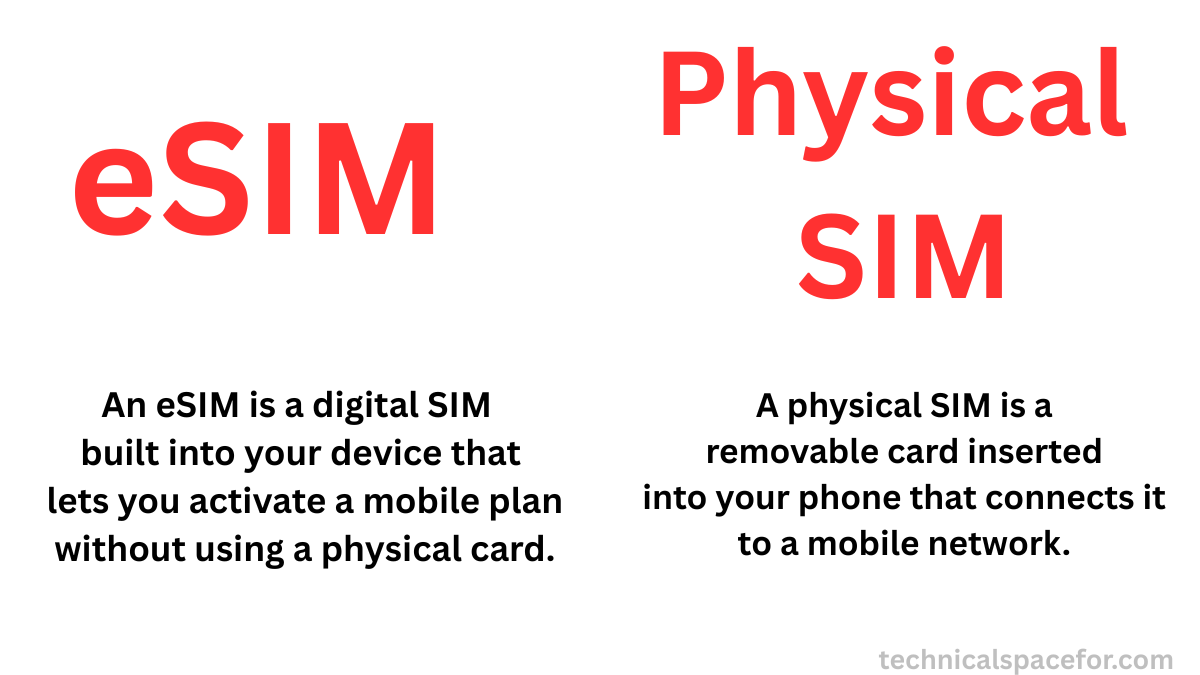
The main difference between an eSIM and a physical SIM is how they are used and managed. A physical SIM is a removable card that you insert into your phone, while an eSIM is built into your device and works digitally.
With a physical SIM, you need to remove and replace the card when switching devices or carriers. In contrast, an eSIM allows you to switch networks by downloading a plan, making the process faster and more convenient.
While both serve the same purpose of connecting your device to a mobile network, they differ in how they are installed, used, and managed.
The table below highlights the key differences to help you quickly compare and decide which one suits you best.
| eSIM | Physical SIM |
|---|---|
| Embedded in the device | Removable card |
| Activated digitally (QR code / app) | Inserted manually into SIM slot |
| No need to swap cards | Requires swapping SIM cards |
| Easy to switch carriers digitally | Must replace SIM to switch carriers |
| Can store multiple profiles | Usually one profile per SIM |
| Supported on newer devices only | Works on almost all devices |
| Great for travel (instant plans) | Need to buy local SIM when traveling |
| Cannot be lost or damaged physically | Can be lost or damaged |
| More secure (harder to remove) | Easier to remove |
| Requires setup to transfer devices | Easy to move between devices |
What Is a Physical SIM Card and How Does It Work?
A physical SIM card is a small, removable chip that stores your mobile phone’s subscriber information, allowing your device to connect to a carrier’s network. It contains important data like your phone number, network authorization, and sometimes contacts. When you insert a SIM card into your phone, it identifies you to the network, enabling you to make calls, send messages, and use mobile data.
Physical SIM cards are easy to swap between devices, which makes them convenient if you change phones frequently or travel internationally. However, unlike eSIMs, they require a physical card for each device and carrier.
A physical SIM card works by storing your mobile subscriber information, such as your phone number and carrier details. When you insert it into your phone, it connects your device to your carrier’s network, allowing you to make calls, send messages, and use mobile data. The SIM card acts like an ID card for your phone, letting the network recognize and authenticate your device.
It is removable, so you can easily switch it between compatible phones, making it convenient for device upgrades or international travel.
What is the cost of using an eSIM compared to a physical SIM?
The cost of using an eSIM is usually similar to a physical SIM, but eSIM plans can sometimes be slightly more expensive, especially for international or multi-country use, due to convenience and flexibility.
When comparing eSIMs and physical SIMs, cost is an important factor to consider. While the monthly plan fees are often similar, there are differences in activation, travel options, and extra charges that can affect your overall expense. Here are the main points to understand about the cost of using an eSIM versus a physical SIM.
- Plan Pricing Is Often Similar
For standard mobile plans with the same data, talk, and text, many carriers charge about the same price whether you use an eSIM or a physical SIM. There’s usually no difference in the monthly service cost itself.
- Activation and Card Fees
eSIM activation is often free or included when you sign up, while physical SIM cards can sometimes have a small fee for the card itself, delivery, or replacement.
- Travel eSIM Plans vs Local SIMs
For travel or short-term data, eSIM plans (especially from travel eSIM providers) are often competitive or cheaper than buying physical SIMs from local carriers, particularly for short trips. However, prices vary by destination, and local physical SIMs can be cheaper in some countries for longer stays.
- Hidden Cost Differences
Physical SIMs can incur shipping, replacement, or store purchase costs, whereas eSIMs eliminate these physical card expenses.
Are there any benefits of using an eSIM?
Using an eSIM offers several advantages over traditional SIM cards. From easy digital activation to better security and travel convenience, eSIMs make managing multiple carriers and plans simpler while reducing the risk of loss or damage.
Here are the main benefits of using an eSIM.
- Convenient Activation
eSIMs can be activated digitally via QR code or carrier app—no need to handle physical cards. - Multiple Carrier Profiles
Many eSIMs can store multiple network profiles on a single device, making it easy to switch carriers or plans without changing SIMs. - Ideal for Travel
You can download local data plans instantly when traveling, avoiding the need to buy and swap physical SIM cards. - Space-Saving Design
Because they are embedded in the device, eSIMs save space inside smartphones, allowing for slimmer designs or extra features like larger batteries. - Less Risk of Loss or Damage
Unlike physical SIMs, eSIMs cannot be lost, stolen, or physically damaged. - Enhanced Security
Being embedded makes eSIMs harder to remove or tamper with, offering better protection against theft or unauthorized use. - Supports Dual SIM Functionality
Many modern phones allow using both a physical SIM and an eSIM simultaneously, letting you manage work and personal numbers on one device. - Hardware Improvements:
Without a physical SIM tray, manufacturers have more internal space for larger batteries or improved water/dust resistance.
Which should I choose: local SIM or eSIM?
Choosing between a local SIM and an eSIM depends on your needs and how you use your phone. If you want the easiest setup with digital activation, the ability to store multiple plans, and great flexibility for switching carriers or getting travel data instantly, an eSIM is often the better choice — especially for short trips or frequent travelers.
You need to choose a physical SIM when your device doesn’t support eSIM, but Even if your phone supports eSIM, you can choose a physical SIM when staying long-term in one country, traveling to places where eSIM isn’t supported, needing to swap SIMs between multiple devices, or preferring instant activation without relying on Wi-Fi.
if you need wide compatibility, plan to stay in one place for a long time, or your phone doesn’t support eSIM, then a local physical SIM might be more practical and sometimes more affordable for long-term use.
In short:
- Choose eSIM for convenience, flexibility, and travel.
- Choose local SIM for simplicity, broad support, and long-term stays.
eSIM FAQs: Frequently Asked Questions
1. Are there any disadvantages of using esim on iphone ?
Yes, there are some disadvantages of an eSIM on iphone. Unlike physical SIM cards, eSIMs cannot be easily removed or quickly transferred between devices, making it less convenient in situations like phone loss or switching devices. The setup and activation process can also be more complex, often requiring QR codes, apps, and a stable internet connection.
Additionally, not all carriers fully support eSIM, which may limit your options, especially when traveling. Since eSIM is embedded in the device, it offers less flexibility and depends on software, meaning bugs or system issues can sometimes affect connectivity. In certain regions, limited eSIM support can also make physical SIM cards a more reliable choice.
2. Are there any disadvantages of using esim on Android ?
Yes, there are several disadvantages of eSIM on Android devices. Unlike physical SIM cards, eSIMs cannot be easily removed or swapped, making it less convenient to switch devices or handle emergencies. The setup process can be more complicated, often requiring QR codes, apps, and a stable internet connection for activation.
Additionally, not all Android phones and mobile carriers fully support eSIM, which can limit your options. Since eSIM depends on software, bugs or system issues may sometimes affect connectivity, and it offers less flexibility compared to a physical SIM. Furthermore, in some regions, especially when traveling, eSIM support may still be limited, making physical SIM cards a more reliable choice.
3. Is eSIM better than a physical SIM when traveling?
eSIM is generally better than a physical SIM when traveling because it allows instant activation, easy switching between countries, and no need to physically swap SIM cards, making it very convenient for short trips and multi-country travel. However, physical SIM cards can be a better option for long-term stays, as they are often cheaper, provide a local phone number for calls and SMS, and may offer better coverage in some regions.
Overall, eSIM is ideal for convenience and flexibility, while physical SIM is more suitable for extended travel and reliability.
4. How do you activate and manage an eSIM compared to a SIM card?
Activating and managing an eSIM is done entirely digitally, whereas a physical SIM card requires manual insertion into your device. With eSIM, you typically scan a QR code, download a carrier profile, or use a mobile app to activate your plan, and you can manage or switch plans directly from your phone settings. In contrast, a physical SIM must be physically inserted, removed, or replaced when changing carriers or devices.
Overall, eSIM offers more convenience and flexibility through software, while physical SIM cards provide a simpler, hands-on setup.
5. What should I know before changing from a SIM card to eSIM?
Before switching from a physical SIM card to an eSIM, you should make sure your device supports eSIM and that your mobile carrier offers compatible plans. It’s important to have a stable internet connection for activation, as the setup is done digitally using a QR code or carrier app. You should also back up your data and confirm whether your current SIM can be easily transferred or reactivated if needed.
Additionally, keep in mind that switching devices or troubleshooting issues may be less convenient with eSIM compared to simply swapping a physical SIM, so understanding the activation and transfer process in advance can help avoid problems.
Conclusion: Is eSIM Right for You?
While eSIM technology offers modern convenience and flexibility, it’s important to understand the disadvantages of an eSIM before making the switch. From limited device and carrier support to difficulties in switching devices and reliance on internet activation, eSIM may not be ideal for every user. However, for those who value digital convenience, travel flexibility, and the ability to manage multiple plans easily, eSIM can still be a great option.
Ultimately, the right choice depends on your needs—if you prioritize simplicity and compatibility, a physical SIM may be better, but if you prefer a more advanced and flexible experience, eSIM is worth considering.
Read more: