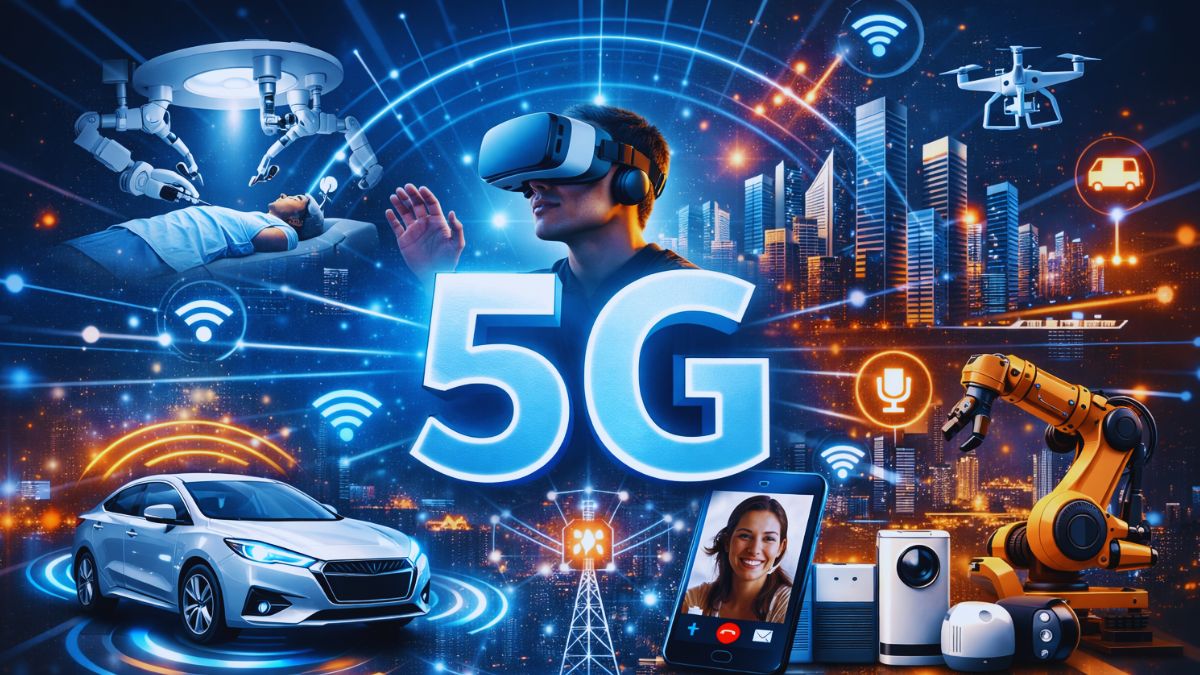
The world is moving faster than ever, and 5G technology is at the heart of this digital revolution. From streaming videos instantly to connecting smart cities, autonomous vehicles, and advanced IoT devices, 5G is transforming how we live, work, and play. In this blog post, we’ll explore what 5G is, how it works, its benefits, real-world applications, and why it’s shaping the future of technology.
What is 5G?
5G is the fifth generation of mobile network technology, coming after 1G, 2G, 3G, and 4G. It is a new global wireless standard designed to connect people, devices, machines, and everyday objects all at the same time.
Compared to older networks, 5G offers much faster internet speeds, very low delay (latency), and the ability to connect many more devices simultaneously. This makes online activities smoother, more reliable, and more consistent for users everywhere.
Because of its high speed and strong performance, 5G enables new technologies such as smart cities, self-driving cars, Internet of Things (IoT) devices, remote medical services, and immersive AR/VR experiences. Overall, 5G is built to support the future of mobile communication and new industries worldwide.
You can also watch this video to learn more about 5G:
How does 5G work?
5G works by using new and faster radio waves along with smart network technology to deliver high speed and low delay. It uses higher frequency bands that can carry more data, allowing faster downloads and smoother streaming.
To handle this data efficiently, 5G uses advanced antennas like Massive MIMO and beamforming, which send signals directly to your device instead of spreading them everywhere. This improves speed and connection quality.
5G networks are mostly software-based, making them flexible and easy to manage. They also use network slicing, which creates separate virtual networks for different needs, such as smartphones, IoT devices, or self-driving cars. To understand this better, see the diagram below.
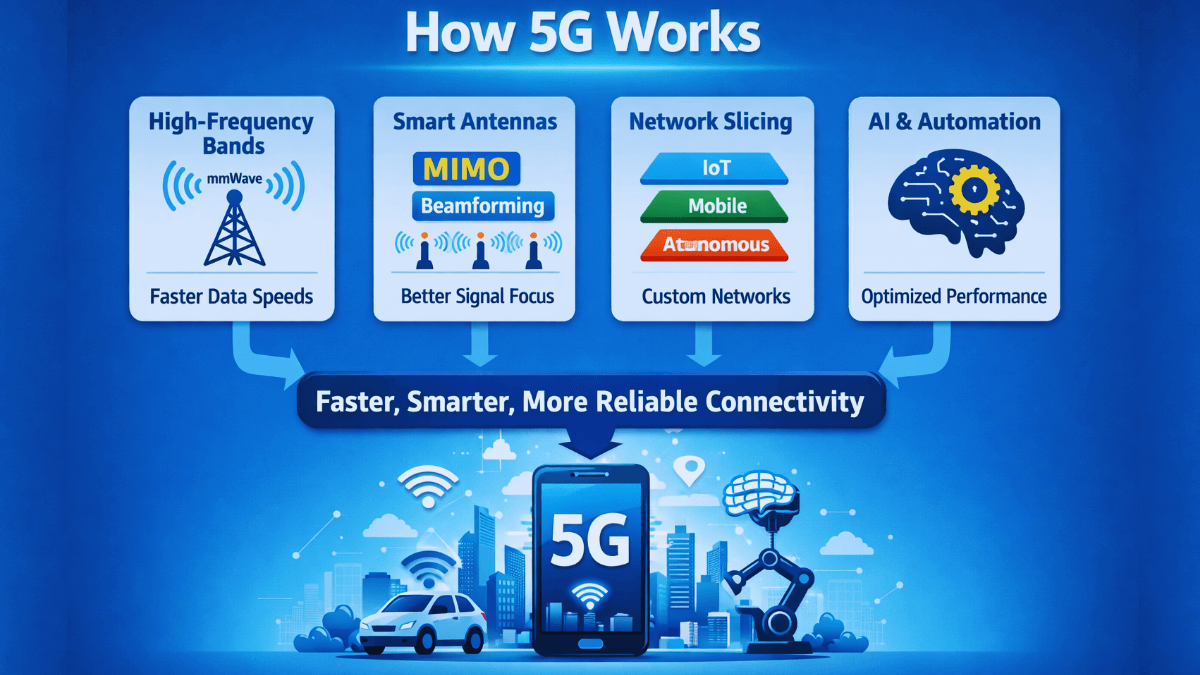
Finally, AI and machine learning help manage traffic automatically, reduce delays, and keep the network stable even when many devices are connected at the same time.
5G Speed and Performance: How Fast Is It Really?
5G speed is much faster than 4G, making it a major upgrade in mobile network performance. In theory, 5G can reach download speeds of up to 20 Gbps, while 4G is limited to around 1 Gbps. It also offers much lower latency, sometimes as low as 1 millisecond, compared to 10 milliseconds or more on 4G. This improvement in 5G speed allows instant downloads and smooth real-time experiences such as cloud gaming, video calls, and AR/VR applications. In real-world use, 5G speed depends on the network band and location—low- and mid-band 5G usually provide hundreds of Mbps, while high-band (mmWave) 5G can deliver gigabit-level speeds in ideal conditions. Even with these variations, 5G still offers faster and more responsive performance than 4G.
5G vs 4G : What’s the Real Difference?
The real difference between 5G vs 4G is speed, response time, and capacity. 5G is much faster than 4G and has very low latency, sometimes as low as 1 millisecond, while 4G usually has 50–100 milliseconds of delay. This means data moves almost instantly on 5G, making it suitable for advanced uses like AR/VR, autonomous vehicles, cloud gaming, and large-scale IoT devices. 5G achieves this by using new technologies such as higher-frequency spectrum (including mmWave) and smaller cell towers, which allow faster and more efficient data transfer. In comparison, 4G is still excellent for everyday tasks like browsing, social media, and HD video streaming, with wider coverage in many areas. While 5G has huge potential, its coverage is still growing compared to the well-established 4G network.
For a quick comparison, see the table below.
| Feature | 5G | 4G |
|---|---|---|
| Speed | Much faster (up to multi-Gbps) | Slower (up to ~1 Gbps) |
| Latency (Delay) | Very low (as low as 1 ms) | Higher (50–100 ms) |
| User Experience | Very smooth and responsive | Good for daily use |
| Device Capacity | Supports many devices at once | Limited compared to 5G |
| Technology Used | mmWave, small cells, Massive MIMO | Traditional cell towers |
| Best For | AR/VR, gaming, IoT, smart cities | Browsing, social media, HD video |
| Coverage | Still expanding | Widely available |
Benefits of 5G Technology in Daily Life
The benefits of 5G can be clearly seen in faster speeds, lower latency, and greater network capacity, which greatly improve daily digital life. 5G allows smooth video streaming and quick downloads without interruptions, while making smart home devices work more reliably together. With almost no delay, it enables lag-free gaming and immersive AR/VR experiences. Beyond everyday use, the benefits of 5G also include support for advanced applications such as remote healthcare services, autonomous vehicles, and smarter cities. It boosts productivity by improving remote work, video meetings, and cloud-based tasks, creating a more connected, efficient, and innovative digital experience for both consumers and industries.
Real-World Uses of 5G Technology
Real-world uses of 5G technology are driven by its high speed, low latency, and ability to connect many devices at the same time. These features enable autonomous vehicles, remote surgery, and smart cities, where traffic control and energy management work more efficiently. 5G also powers immersive AR/VR experiences for entertainment and training, as well as industrial automation such as smart factories and robotics. In addition, 5G supports large Internet of Things (IoT) systems, including smart agriculture, connected sensors, and livestock monitoring. From improving fan experiences in stadiums with AR to supporting critical public safety networks, 5G is transforming how industries operate and how people stay connected.
5G-Supported Devices and Network Compatibility
5G-supported devices include many recent smartphones such as iPhone 12 and newer models, Samsung Galaxy S20 series, Z Flip and Z Fold phones, and Google Pixel 6 and above. These devices come with built-in 5G modems from brands like Qualcomm, MediaTek, Exynos, or Apple’s A14 chip and later, allowing faster mobile internet speeds. However, network compatibility depends on your mobile carrier and the 5G bands available in your area (low-, mid-, or high-band). Even if your phone supports 5G, it must match your carrier’s supported bands and have an active 5G plan with good signal coverage. Older phones, such as iPhone 11 or Pixel 4 and 5, usually do not support 5G. You can check your phone settings or specifications to confirm whether your device and network are fully compatible with 5G.
5G Network Coverage and Availability
5G network coverage in the United States is now widespread, but the experience can differ depending on location and network type. T-Mobile currently leads in overall population coverage, reaching around 95% of Americans, followed by AT&T and Verizon. Most carriers use low-band 5G, which covers over 90% of the population and works well across cities and rural areas, though speeds are closer to 4G. Mid-band 5G is expanding quickly and offers a good balance of speed and coverage, especially in urban and suburban areas. The fastest option, mmWave 5G, delivers ultra-high speeds but is limited to dense locations like downtown areas, stadiums, and airports. Because of this, 5G coverage in the U.S. is strong overall but still uneven, with rural areas often lagging behind cities.
Advantages and Disadvantages of 5G
5G technology offers many powerful benefits, but it also comes with some challenges. While it delivers faster speeds, lower latency, and better connectivity than previous networks, issues like limited coverage, high costs, and device compatibility still exist. The table below highlights the key advantages and disadvantages of 5G in a clear and easy way.
| Advantages of 5G | Disadvantages of 5G |
|---|---|
| Blazing Fast Speeds – Much faster downloads, streaming, and browsing, with potential speeds reaching gigabits per second. | High Infrastructure Costs – Building 5G networks requires heavy investment and many new small cell towers. |
| Ultra-Low Latency – Near-instant response times (as low as 1ms), ideal for gaming, remote surgery, and self-driving cars. | Limited Coverage & Range – Fastest 5G signals travel short distances and can be blocked by buildings or obstacles. |
| Massive Connectivity – Supports many devices at once, enabling IoT, smart homes, and smart cities. | Device Compatibility Issues – Older phones and devices do not support 5G and need costly upgrades. |
| Better Efficiency & Capacity – Uses bandwidth more efficiently, reducing network congestion in busy areas. | Security Concerns – More connected devices increase security risks, requiring stronger protection systems. |
| New Technologies & Applications – Powers AR/VR, advanced robotics, 4K/8K streaming, and cloud gaming. | Deployment Challenges – Network rollout is slow due to complex planning and physical barriers. |
| Improved Battery Efficiency – Devices can use less power when idle, helping extend battery life. | Uneven Performance – Upload speeds may be slower, and true gigabit speeds are not available everywhere yet. |
Future of 5G Technology
The future of 5G technology goes far beyond faster smartphones. With ultra-low latency and massive connectivity, 5G will power immersive experiences like AR and VR, enable autonomous vehicles, and support remote surgery. It will connect billions of devices, helping build smart cities with better traffic control, energy management, and public safety. Edge computing and AI will allow real-time data processing for industries, boosting industrial automation, robotics, and smart factories. As 5G networks expand and improve, it is expected to become more dominant than 4G by the late 2020s, laying the foundation for even future technologies like 6G. Overall, 5G will transform how people live, work, and interact with technology.
Frequently Asked question
Why 5G important ?
5G technology is important because it provides much faster speeds, lower latency (less lag), and the ability to connect many devices at once. These improvements make everyday activities like streaming, gaming, and video calls smoother and more reliable. Beyond personal use, 5G technology enables transformative applications such as autonomous vehicles, remote surgery, immersive AR/VR experiences, smart cities with massive IoT connectivity, and efficient industrial automation. In other words, 5G technology is not just about faster phones—it powers innovation across industries and helps shape the future of technology and everyday life.
Is 4G or 5G better?
5G technology is significantly better than 4G because it offers much faster speeds—potentially 10 to 100 times faster—and much lower latency, which reduces lag for real-time applications. 5G technology also provides greater network capacity, allowing more devices to connect at the same time. This makes streaming, gaming, video calls, and IoT applications smoother, faster, and more reliable. However, 4G remains a solid option in areas where 5G coverage is still limited, so both networks are important for providing consistent connectivity.
Final Thoughts: Is 5G Worth It?
Yes, for most users, especially those who want faster speeds, lower latency, and more reliable connections, 5G technology is worth it. 5G technology makes streaming, gaming, video calls, and smart device connectivity smoother and more responsive. It also enables advanced applications like autonomous vehicles, remote healthcare, smart cities, and industrial automation, which 4G cannot support as effectively. While 5G coverage is still expanding and may require a compatible device and plan, the long-term benefits of 5G technology for both personal use and business applications make it a worthwhile investment for the future.