Posted on Leave a comment

Why 5G technology Is Trending Worldwide: Speed, Benefits, and Future

Illustration showing 5G technology powering autonomous vehicles, smart cities, VR/AR experiences, remote healthcare, IoT devices, and industrial automation with glowing 5G icons and connected signals.

The world is moving faster than ever, and 5G technology is at the heart of this digital revolution. From streaming videos instantly to connecting smart cities, autonomous vehicles, and advanced IoT devices, 5G is transforming how we live, work, and play. In this blog post, we’ll explore what 5G is, how it works, its benefits, real-world applications, and why it’s shaping the future of technology.

Futuristic digital illustration showing 5G technology connecting a smartphone, autonomous cars, smart city buildings, drones, IoT devices, and robotic automation with glowing 5G signals.
5G technology powers faster, smoother, and smarter connections for smartphones, smart cities, autonomous vehicles, IoT devices, and advanced industrial applications.


What is 5G?

5G is the fifth generation of mobile network technology, coming after 1G, 2G, 3G, and 4G. It is a new global wireless standard designed to connect people, devices, machines, and everyday objects all at the same time.

Compared to older networks, 5G offers much faster internet speeds, very low delay (latency), and the ability to connect many more devices simultaneously. This makes online activities smoother, more reliable, and more consistent for users everywhere.

Because of its high speed and strong performance, 5G enables new technologies such as smart cities, self-driving cars, Internet of Things (IoT) devices, remote medical services, and immersive AR/VR experiences. Overall, 5G is built to support the future of mobile communication and new industries worldwide.

You can also watch this video to learn more about 5G:

How does 5G work?

5G works by using new and faster radio waves along with smart network technology to deliver high speed and low delay. It uses higher frequency bands that can carry more data, allowing faster downloads and smoother streaming.

To handle this data efficiently, 5G uses advanced antennas like Massive MIMO and beamforming, which send signals directly to your device instead of spreading them everywhere. This improves speed and connection quality.

5G networks are mostly software-based, making them flexible and easy to manage. They also use network slicing, which creates separate virtual networks for different needs, such as smartphones, IoT devices, or self-driving cars. To understand this better, see the diagram below.
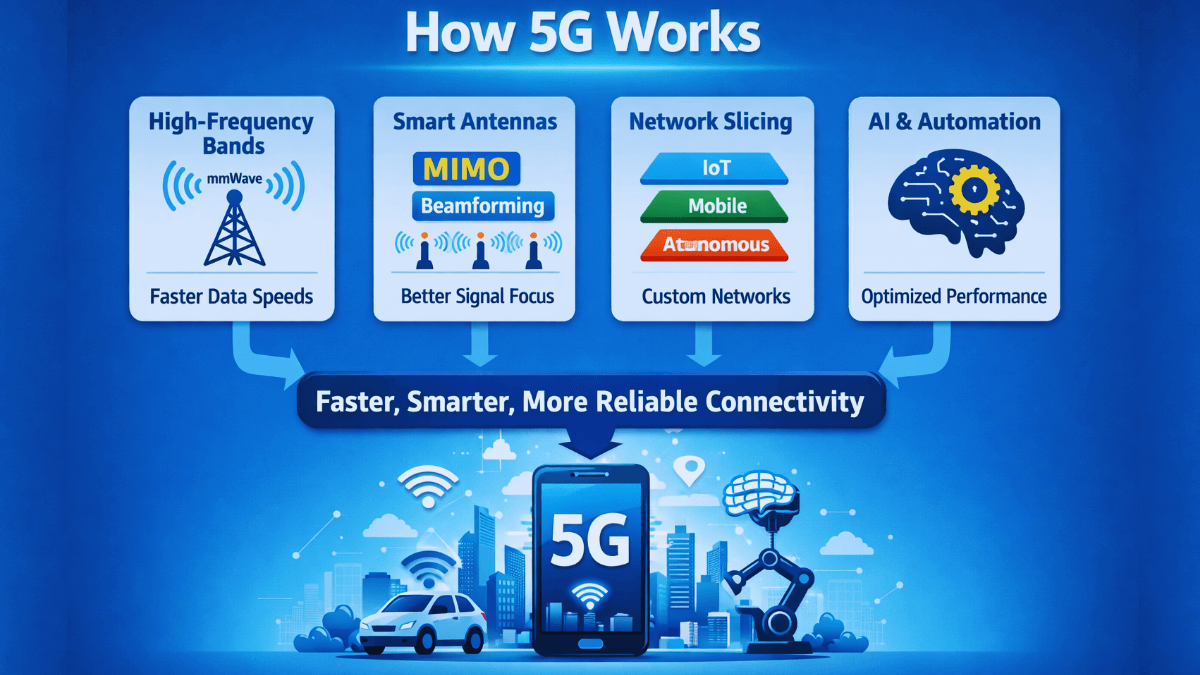
Diagram showing how 5G technology works using high-frequency bands, Massive MIMO antennas, network slicing, and AI automation
A simple diagram explaining how 5G works using advanced radio waves, smart antennas, software-based networks, and AI automation.

Finally, AI and machine learning help manage traffic automatically, reduce delays, and keep the network stable even when many devices are connected at the same time.

5G Speed and Performance: How Fast Is It Really?

5G speed is much faster than 4G, making it a major upgrade in mobile network performance. In theory, 5G can reach download speeds of up to 20 Gbps, while 4G is limited to around 1 Gbps. It also offers much lower latency, sometimes as low as 1 millisecond, compared to 10 milliseconds or more on 4G. This improvement in 5G speed allows instant downloads and smooth real-time experiences such as cloud gaming, video calls, and AR/VR applications. In real-world use, 5G speed depends on the network band and location—low- and mid-band 5G usually provide hundreds of Mbps, while high-band (mmWave) 5G can deliver gigabit-level speeds in ideal conditions. Even with these variations, 5G still offers faster and more responsive performance than 4G.

5G vs 4G : What’s the Real Difference?

The real difference between 5G vs 4G is speed, response time, and capacity. 5G is much faster than 4G and has very low latency, sometimes as low as 1 millisecond, while 4G usually has 50–100 milliseconds of delay. This means data moves almost instantly on 5G, making it suitable for advanced uses like AR/VR, autonomous vehicles, cloud gaming, and large-scale IoT devices. 5G achieves this by using new technologies such as higher-frequency spectrum (including mmWave) and smaller cell towers, which allow faster and more efficient data transfer. In comparison, 4G is still excellent for everyday tasks like browsing, social media, and HD video streaming, with wider coverage in many areas. While 5G has huge potential, its coverage is still growing compared to the well-established 4G network.
For a quick comparison, see the table below.

Feature 5G 4G
Speed Much faster (up to multi-Gbps) Slower (up to ~1 Gbps)
Latency (Delay) Very low (as low as 1 ms) Higher (50–100 ms)
User Experience Very smooth and responsive Good for daily use
Device Capacity Supports many devices at once Limited compared to 5G
Technology Used mmWave, small cells, Massive MIMO Traditional cell towers
Best For AR/VR, gaming, IoT, smart cities Browsing, social media, HD video
Coverage Still expanding Widely available

Benefits of 5G Technology in Daily Life

The benefits of 5G can be clearly seen in faster speeds, lower latency, and greater network capacity, which greatly improve daily digital life. 5G allows smooth video streaming and quick downloads without interruptions, while making smart home devices work more reliably together. With almost no delay, it enables lag-free gaming and immersive AR/VR experiences. Beyond everyday use, the benefits of 5G also include support for advanced applications such as remote healthcare services, autonomous vehicles, and smarter cities. It boosts productivity by improving remote work, video meetings, and cloud-based tasks, creating a more connected, efficient, and innovative digital experience for both consumers and industries.

Real-World Uses of 5G Technology

Real-world uses of 5G technology are driven by its high speed, low latency, and ability to connect many devices at the same time. These features enable autonomous vehicles, remote surgery, and smart cities, where traffic control and energy management work more efficiently. 5G also powers immersive AR/VR experiences for entertainment and training, as well as industrial automation such as smart factories and robotics. In addition, 5G supports large Internet of Things (IoT) systems, including smart agriculture, connected sensors, and livestock monitoring. From improving fan experiences in stadiums with AR to supporting critical public safety networks, 5G is transforming how industries operate and how people stay connected.

5G-Supported Devices and Network Compatibility

5G-supported devices include many recent smartphones such as iPhone 12 and newer models, Samsung Galaxy S20 series, Z Flip and Z Fold phones, and Google Pixel 6 and above. These devices come with built-in 5G modems from brands like Qualcomm, MediaTek, Exynos, or Apple’s A14 chip and later, allowing faster mobile internet speeds. However, network compatibility depends on your mobile carrier and the 5G bands available in your area (low-, mid-, or high-band). Even if your phone supports 5G, it must match your carrier’s supported bands and have an active 5G plan with good signal coverage. Older phones, such as iPhone 11 or Pixel 4 and 5, usually do not support 5G. You can check your phone settings or specifications to confirm whether your device and network are fully compatible with 5G.

5G Network Coverage and Availability

5G network coverage in the United States is now widespread, but the experience can differ depending on location and network type. T-Mobile currently leads in overall population coverage, reaching around 95% of Americans, followed by AT&T and Verizon. Most carriers use low-band 5G, which covers over 90% of the population and works well across cities and rural areas, though speeds are closer to 4G. Mid-band 5G is expanding quickly and offers a good balance of speed and coverage, especially in urban and suburban areas. The fastest option, mmWave 5G, delivers ultra-high speeds but is limited to dense locations like downtown areas, stadiums, and airports. Because of this, 5G coverage in the U.S. is strong overall but still uneven, with rural areas often lagging behind cities.

Advantages and Disadvantages of 5G

5G technology offers many powerful benefits, but it also comes with some challenges. While it delivers faster speeds, lower latency, and better connectivity than previous networks, issues like limited coverage, high costs, and device compatibility still exist. The table below highlights the key advantages and disadvantages of 5G in a clear and easy way.

Advantages of 5G Disadvantages of 5G
Blazing Fast Speeds – Much faster downloads, streaming, and browsing, with potential speeds reaching gigabits per second. High Infrastructure Costs – Building 5G networks requires heavy investment and many new small cell towers.
Ultra-Low Latency – Near-instant response times (as low as 1ms), ideal for gaming, remote surgery, and self-driving cars. Limited Coverage & Range – Fastest 5G signals travel short distances and can be blocked by buildings or obstacles.
Massive Connectivity – Supports many devices at once, enabling IoT, smart homes, and smart cities. Device Compatibility Issues – Older phones and devices do not support 5G and need costly upgrades.
Better Efficiency & Capacity – Uses bandwidth more efficiently, reducing network congestion in busy areas. Security Concerns – More connected devices increase security risks, requiring stronger protection systems.
New Technologies & Applications – Powers AR/VR, advanced robotics, 4K/8K streaming, and cloud gaming. Deployment Challenges – Network rollout is slow due to complex planning and physical barriers.
Improved Battery Efficiency – Devices can use less power when idle, helping extend battery life. Uneven Performance – Upload speeds may be slower, and true gigabit speeds are not available everywhere yet.

Future of 5G Technology

The future of 5G technology goes far beyond faster smartphones. With ultra-low latency and massive connectivity, 5G will power immersive experiences like AR and VR, enable autonomous vehicles, and support remote surgery. It will connect billions of devices, helping build smart cities with better traffic control, energy management, and public safety. Edge computing and AI will allow real-time data processing for industries, boosting industrial automation, robotics, and smart factories. As 5G networks expand and improve, it is expected to become more dominant than 4G by the late 2020s, laying the foundation for even future technologies like 6G. Overall, 5G will transform how people live, work, and interact with technology.

Frequently Asked question

Why 5G important ?

5G technology is important because it provides much faster speeds, lower latency (less lag), and the ability to connect many devices at once. These improvements make everyday activities like streaming, gaming, and video calls smoother and more reliable. Beyond personal use, 5G technology enables transformative applications such as autonomous vehicles, remote surgery, immersive AR/VR experiences, smart cities with massive IoT connectivity, and efficient industrial automation. In other words, 5G technology is not just about faster phones—it powers innovation across industries and helps shape the future of technology and everyday life.

Is 4G or 5G better?

5G technology is significantly better than 4G because it offers much faster speeds—potentially 10 to 100 times faster—and much lower latency, which reduces lag for real-time applications. 5G technology also provides greater network capacity, allowing more devices to connect at the same time. This makes streaming, gaming, video calls, and IoT applications smoother, faster, and more reliable. However, 4G remains a solid option in areas where 5G coverage is still limited, so both networks are important for providing consistent connectivity.

Final Thoughts: Is 5G Worth It?

Yes, for most users, especially those who want faster speeds, lower latency, and more reliable connections, 5G technology is worth it. 5G technology makes streaming, gaming, video calls, and smart device connectivity smoother and more responsive. It also enables advanced applications like autonomous vehicles, remote healthcare, smart cities, and industrial automation, which 4G cannot support as effectively. While 5G coverage is still expanding and may require a compatible device and plan, the long-term benefits of 5G technology for both personal use and business applications make it a worthwhile investment for the future.
Posted on Leave a comment

OPPO Find X9 Review: Stunning Camera, Smooth Performance, Long-Lasting Battery & Premium Design

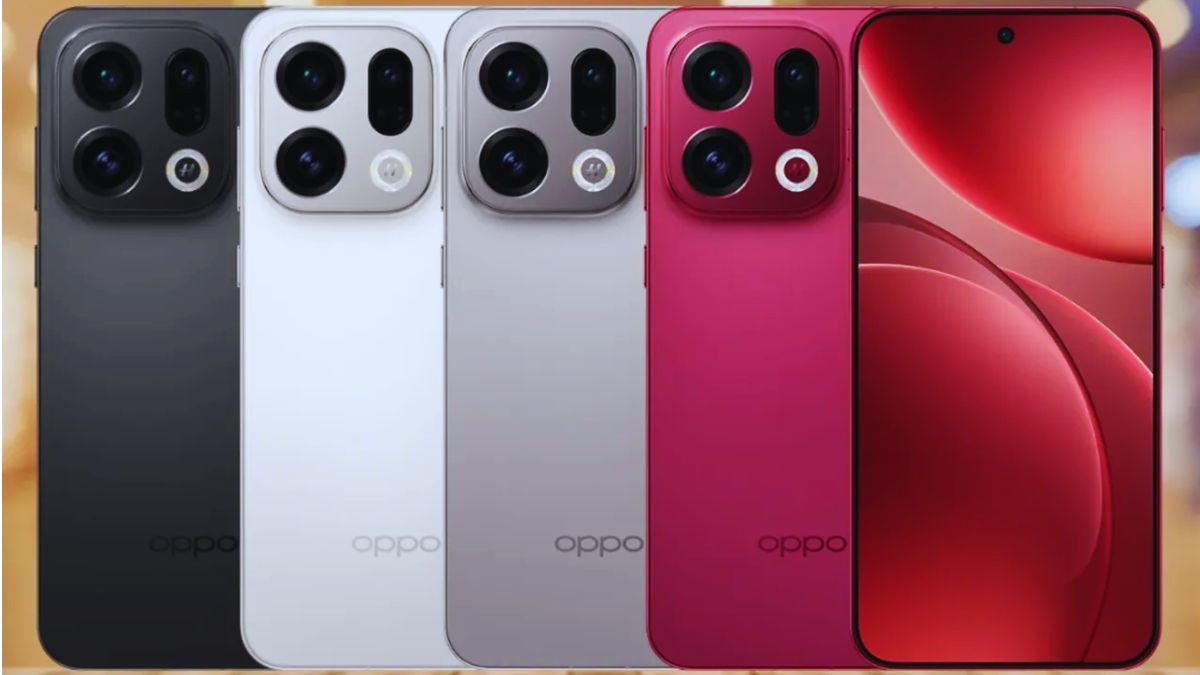
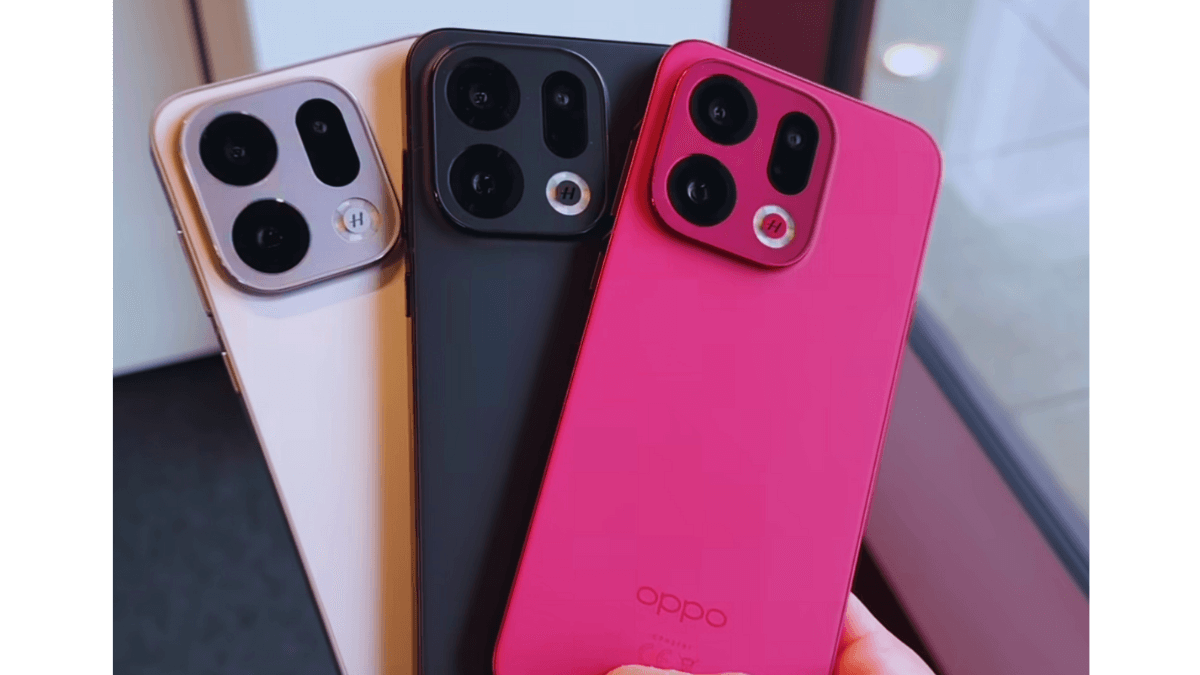
The OPPO Find X9, released on October 28, 2025, is a premium smartphone built for users who want a balance of power, style, and everyday reliability. In this OPPO Find X9 Review, the device stands out for its versatile and dependable camera system, featuring a 50MP Hasselblad telephoto lens with up to 120× zoom, capable of capturing sharp, vibrant photos and smooth 4K video at 120fps. Driven by the powerful MediaTek Dimensity 9500 processor, it delivers strong performance with good thermals, making gaming, multitasking, and AI tasks feel effortless. A bright, vibrant display and polished ColorOS 16 with long-term software support further enhance the overall experience. The OPPO Find X9 is available globally in three standard colors, with some regions also offering a fourth variant: Titanium Grey, Space Black, and Velvet Red.

OPPO Find X9 Review
Available in Titanium Grey, Space Black, and Velvet Red.

X9 Specifications at a Glance

  • Operating system –Android 16, up to 5 major upgrades
  • Chipset – Mediatek Dimensity 9500 (3 nm)
  • CPU – Octa-core (1×4.21 GHz C1-Ultra & 3×3.5 GHz C1-Premium & 4×2.7 GHz C1-Pro)
  • GPU -Arm G1-Ultra
  • Dimensions –157 x 73.9 x 8 mm (6.18 x 2.91 x 0.31 inch)
  • Camera – 50MP ( main ) +  50MP ( ultra-wide ) + 50MP ( telephoto ) + 32MP ( front )
  • RAM –  12GB /16GB
  • Storage- 256GB/512GB/1TB
  •  Screen Size: 6.59inches
  • Display Resolution: 1256 x 2760 pixels (~460 ppi density)
  • Refresh Rate: 120 Hz
  • Brightness: Up to3600 nits
  • Water and dust resistance – IP66 & IP68/IP69 dust tight and water resistant (high pressure water jets; immersible up to 1.5m for 30 min)
  • Weight – 203 gram
  • Thickness – 8mm
  • Connectivity –Wi-Fi 802.11 a/b/g/n/ac/6/7, dual-band, Wi-Fi Direct / Bluetooth 6.0, A2DP, LE, aptX HD, LHDC 5
  • Colors -Titanium Grey, Space Black, Velvet Red
  • SIM – Nano-SIM + eSIM
  • Memory card – No Card Slot
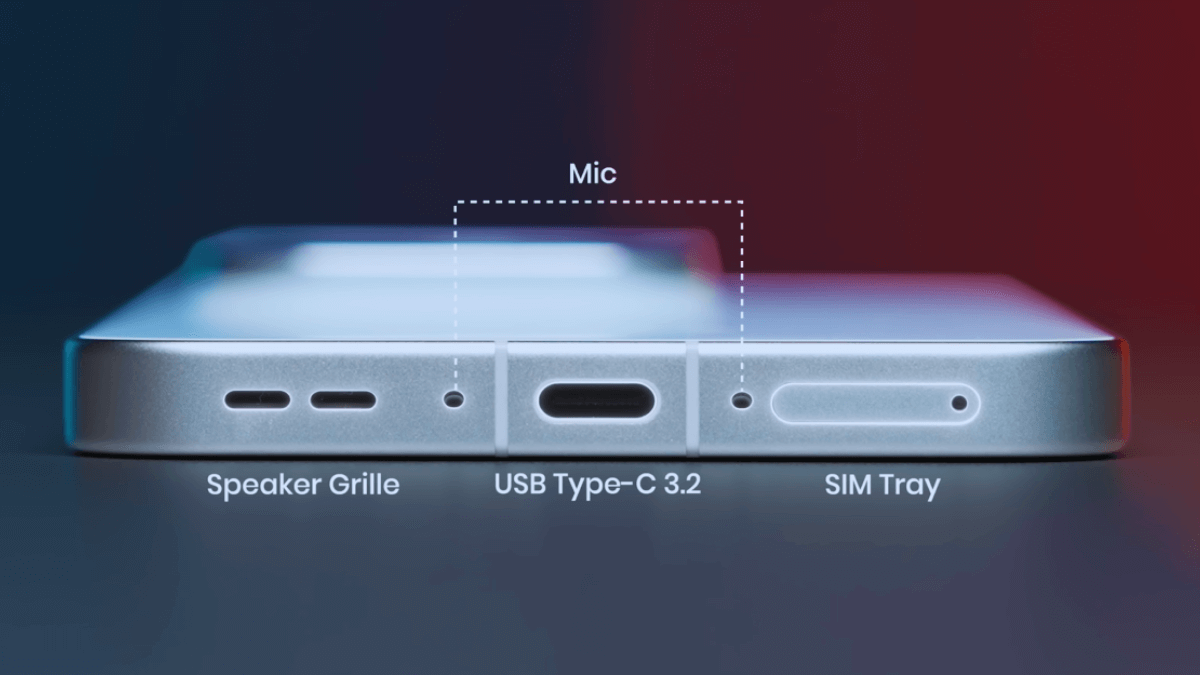
  • Charging – USB Type-C, OTG
  • Biometrics: 3D ultrasonic fingerprint scanner, face unlock


Display: Smooth, Bright, and Immersive

OPPO Find X9 Review
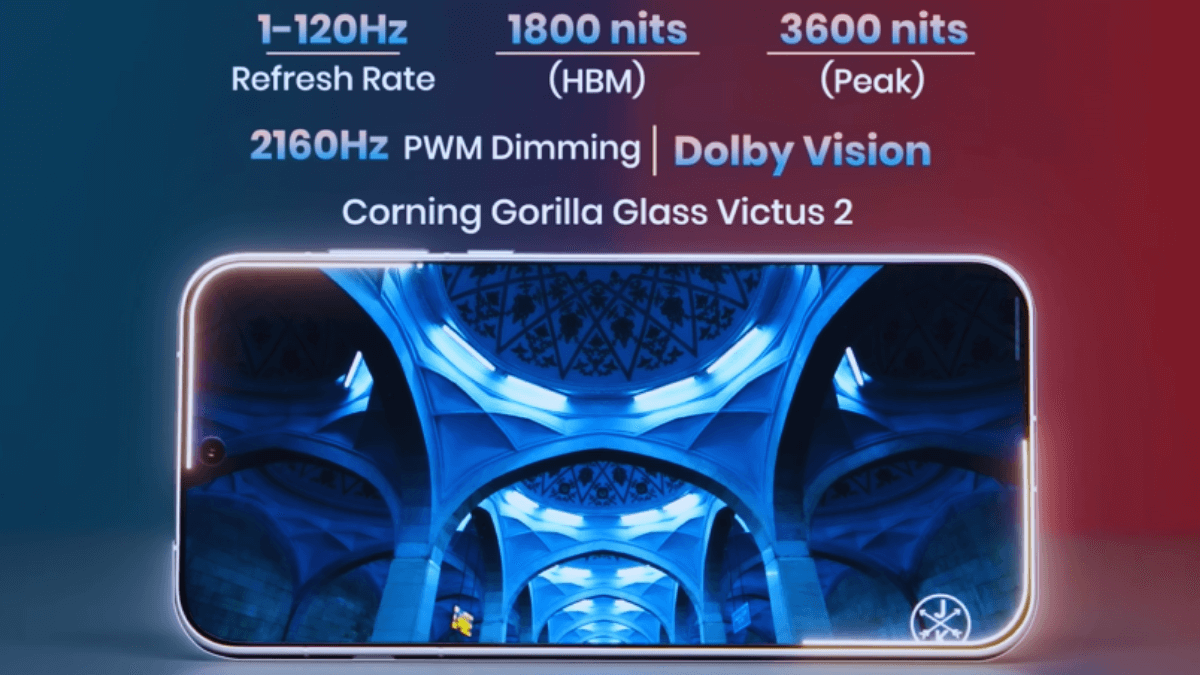
A stunning display that brings colors to life with clarity and vibrancy with upto 3600 nits brightness.

The OPPO Find X9 comes with an ultra-bright and ultra-smooth 6.59-inch display that delivers a great viewing experience for everyday use. It features a 120Hz ProXDR flexible AMOLED screen with a sharp 1.5K resolution (2760 × 1256) and a high 460ppi pixel density, making images and text look crisp and detailed. With peak brightness of up to 3600 nits, the screen stays clear even outdoors. Support for Dolby Vision, HDR10+, 10-bit color, and 100% DCI-P3 color gamut ensures rich colors and accurate contrast, making the display vibrant and enjoyable for streaming videos and gaming.

OPPO Find X9 Design: Premium Look and Comfortable

OPPO Find X9 Review
Sleek 8 mm slim design with a premium, luxury finish

The OPPO Find X9 design feels premium and durable, with a Gorilla Glass 7i front, a glass back, and an aerospace-grade aluminum frame for added strength. It features dual stereo speakers that deliver clear and immersive sound. With a slim 8mm thickness, the phone is comfortable to hold, though it does not support a memory card for storage expansion. It also comes with IP66, IP68, and IP69 water and dust resistance, making it well protected against splashes, dust, and tough everyday conditions.

Camera: Flagship-Level Photography Experience

OPPO Find X9 Review
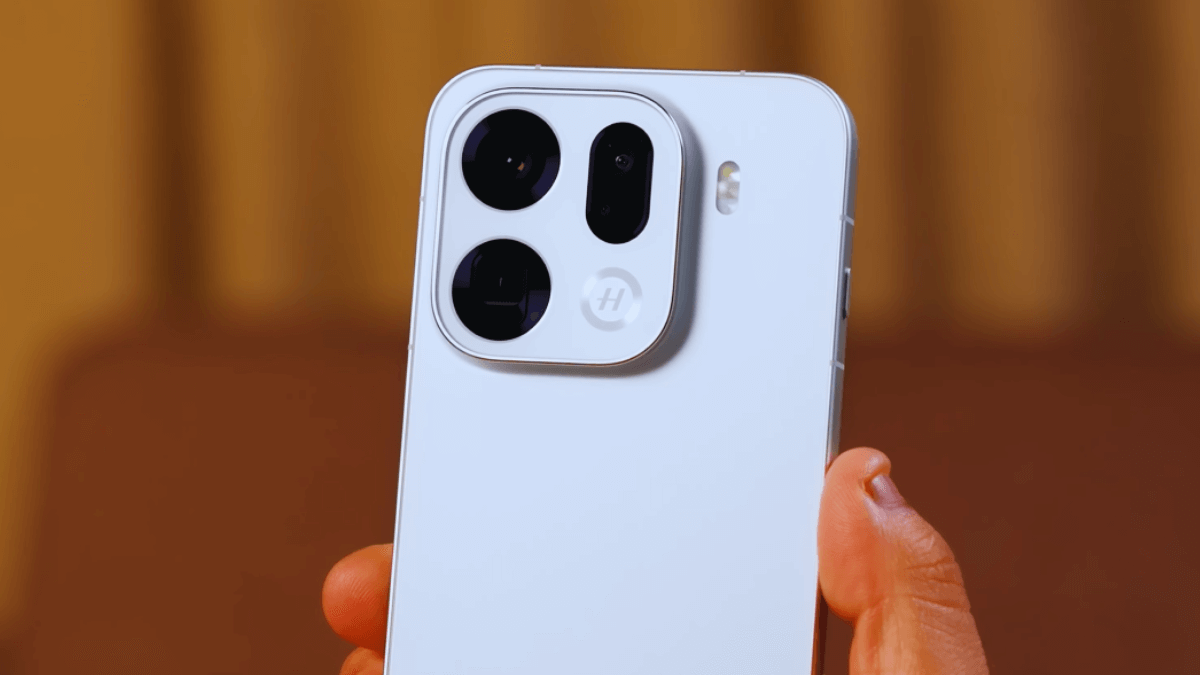
Triple 50MP cameras for stunning detail, wide shots, and powerful zoom.

The OPPO Find X9 camera system includes a powerful 50MP main camera with an f/1.6 wide aperture and a 23mm wide lens, allowing it to capture bright and natural-looking photos. Its large 1/1.4-inch sensor and 1.12µm pixels help take clearer images, especially in low light. Multi-directional PDAF ensures fast and accurate focusing, while OIS (Optical Image Stabilization) reduces blur and keeps photos and videos steady.

For daily photography, the OPPO Find X9’s features 50MP Hasselblad telephoto camera which  is great for capturing distant subjects clearly. With an f/2.6 aperture and 73mm lens, it offers 3× optical zoom, letting you take sharp photos without losing detail. The 1/1.95-inch sensor and 0.61µm pixels help maintain image quality, while multi-directional PDAF keeps focus fast and accurate. OIS helps reduce shake, making zoomed photos and videos more stable in everyday use.

Also this phone features 50MP ultra-wide camera which is perfect for daily wide shots like landscapes, group photos, and city scenes. With an f/2.0 aperture and 15mm lens, it captures a 120° field of view, fitting more into each photo. The 1/2.76-inch sensor and 0.64µm pixels help keep images clear, while multi-directional PDAF ensures fast and accurate focus for sharp, well-balanced wide-angle photos.

All three rear cameras on this phone work together to deliver reliable everyday photography. They feature Laser AF for faster and more precise focusing, while the color spectrum sensor and Hasselblad Color Calibration help produce natural and accurate colors. Support for an LED flash, HDR, and panorama mode ensures well-balanced photos in low light, high-contrast scenes, and wide landscapes.

All three rear cameras on the OPPO Find X9 support advanced video recording, making it easy to capture high-quality videos in any situation. They can record 4K video at 30, 60, or 120fps for smooth and detailed footage, and 1080p at up to 240fps for slow-motion scenes. Gyro-EIS helps keep videos stable, while HDR, 10-bit video, Dolby Vision, and LOG recording provide richer colors, better contrast, and a more professional cinematic look.

The OPPO Find X9 also features  32MP selfie camera which is designed for clear and natural-looking selfies and video calls. With an f/2.4 aperture and a 21mm wide lens, it captures more of the scene, making it great for group selfies. The 1/2.74-inch sensor and 0.8µm pixels help deliver sharp results, while Panorama mode lets you take wide selfies. For video, it supports 4K recording at 30/60fps and 1080p at 30/60fps, with gyro-EIS to keep your videos smooth and stable.

This phone makes video editing simple and fun with Master Cut. You can easily trim clips, split scenes, add music, and apply filters—all in just a few taps. It lets you fine-tune every frame and create smooth, cinematic videos without needing extra apps. Once you’re done, you can export your video in 4K at 120fps with HDR, making it look sharp, colorful, and ready to share on social media or watch on a big screen.

Battery Life: All-Day Power and Fast Charging

OPPO Find X9 Review
Long-lasting battery with fast, reliable charging for all-day use which supports 80W fast wired charging

The OPPO Find X9 is powered by a large 7025 mAh ultra large battery that delivers excellent OPPO Find X9 battery life, easily lasting a full two days with normal use. It supports 80W fast wired charging, allowing you to recharge quickly, along with 50W wireless charging for added convenience. The phone also includes 10W reverse wireless charging, making it easy to power accessories like wireless earbuds directly from your device.

OPPO Find X9 Performance: Fast, Smooth, and Reliable

The OPPO Find X9 is powered by the MediaTek Dimensity 9500 chipset, built on an advanced 3nm process for fast performance and better power efficiency. It uses a 64-bit octa-core CPU with a powerful mix of cores, reaching speeds of up to 4.21 GHz, so apps, gaming, and multitasking feel smooth and responsive. Graphics are handled by the Mali-G1 Ultra MC12 GPU, delivering strong performance for gaming and visuals. The phone also promises 6 years of security updates, adding long-term reliability. Paired with a large 7025 mAh battery, the phone can easily last up to two days, while 80W SUPERVOOC wired charging and 50W AirVOOC wireless charging provide quick top-ups, helped by efficient silicon-carbon battery technology for all-day power.

Price: Is It Worth the Cost?

The OPPO Find X9 price in the US market starts at approximately $629 USD for the 12GB RAM + 256GB storage variant. The 16GB RAM + 256GB model is priced at approximately $679 USD, while the 12GB RAM + 512GB version costs around $739 USD. For users who want more power and storage, the 16GB RAM + 512GB variant is available at about $799 USD. The top-end 16GB RAM + 1TB (1024GB) model is priced at approximately $869 USD, making it suitable for heavy users who need maximum storage.

Final Verdict: Should You Buy the OPPO Find X9?

In this OPPO Find X9 Review, it’s clear that the phone is a well-rounded choice with a strong focus on performance, photography, and battery life. It offers an impressive camera system, a vibrant 120Hz AMOLED display, and smooth day-to-day performance that suits both casual users and gamers. Features like fast charging, advanced video tools, and long-term security updates add extra value for the price. If you’re looking for a premium smartphone with modern features without paying an ultra-flagship price, the OPPO Find X9 is definitely worth buying.

You may like :

Posted on Leave a comment

Samsung Galaxy S25 Ultra Review: The Ultimate Breakdown

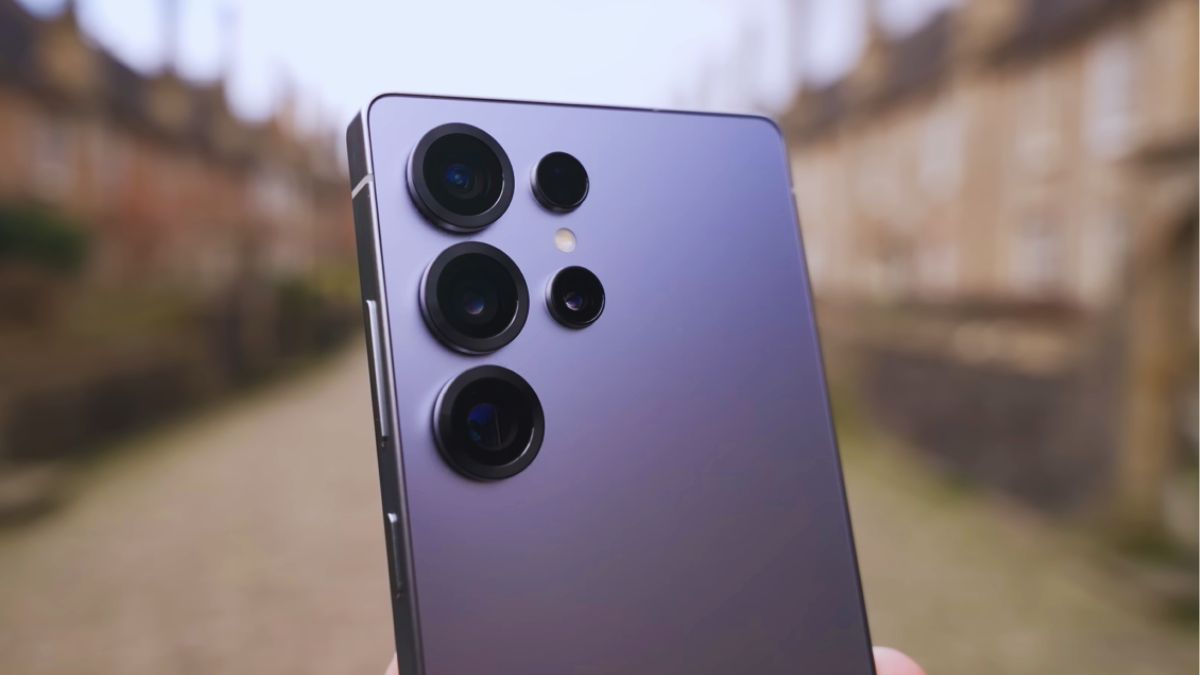
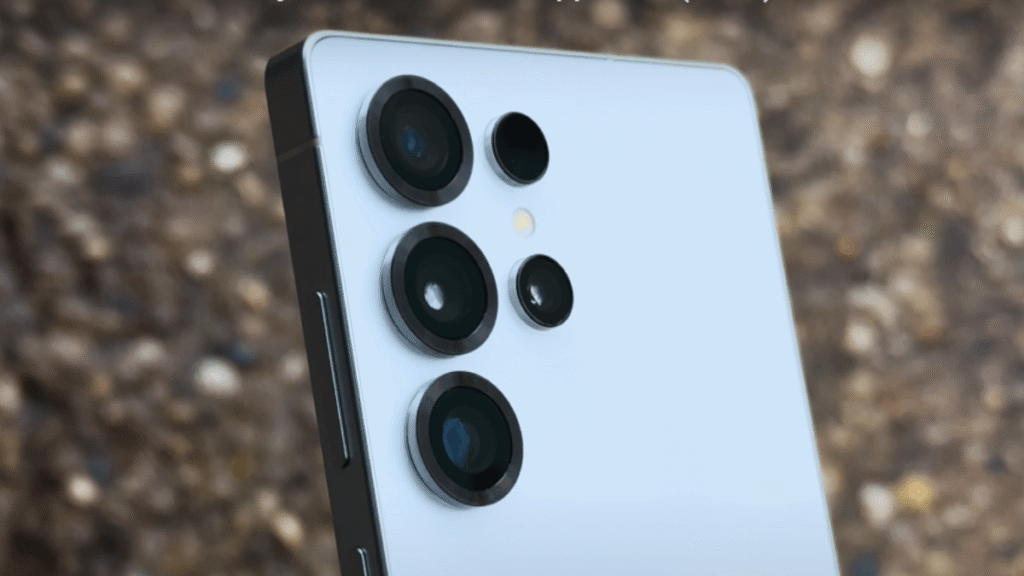
Samsung Galaxy S25 Ultra showing advanced camera setup and sleek design

Welcome to our Samsung Galaxy S25 Ultra review, where we break down everything you need to know about Samsung’s newest flagship.

In this section, we’ll quickly explore what’s new in the Galaxy S25 Ultra, from its upgraded design to the latest hardware and AI-powered features.

Samsung Galaxy S25 Ultra review
Galaxy S25 Ultra (2025)

Samsung Galaxy S25 Ultra review

Let’s break down the details of S25 ultra :

What’s New in the Galaxy S25 Ultra?

The Galaxy S25 Ultra brings some exciting updates! Here’s what’s new:

  • Sleeker DesignSlimmer body with titanium frame and thinner bezels

  • Better Battery LifeOptimized power usage, faster charging, and up to 31 hours of video playback

  • Upgraded Camera – New AI zoom and improved low-light photography

  • Faster Chipset – Snapdragon 8 Gen 4 (or Exynos 2500), built for speed and efficiency

  • AI-Powered Features – Smart replies, live translation, and AI photo editing

  •  Improved Speakers – Clearer, louder sound with Dolby tuning


 Galaxy S25 Ultra Features at a Glance

Design & Materials

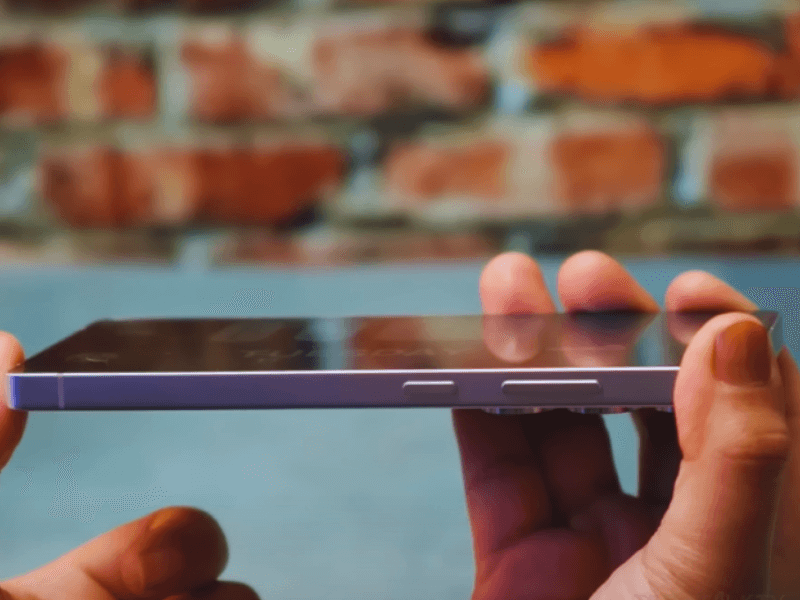
Side view of Samsung Galaxy S25 Ultra highlighting its slim profile and sleek metallic frame
Samsung Galaxy S25 Ultra Side View – Slim Design & Premium Build

Design

One of the most impressive Galaxy S25 Ultra features is its refined design. The phone sports a flat, matte titanium frame that not only looks premium but also provides an excellent grip and a luxurious feel.

It,s flat display with rounded corners gives it a modern look, complemented by slimmer bezels that maximize the screen-to-body ratio for an immersive viewing experience.

Built tough, the S25 Ultra boasts an IP68 rating for water and dust resistance, making it durable in everyday situations.

Plus, the built-in S Pen remains a signature Samsung feature, seamlessly integrated into the phone’s body for easy access and use.

Materials

A key part of the Galaxy S25 Ultra features is its use of premium materials for durability and style. The frame is built from high-grade, lightweight titanium, offering both strength and a comfortable feel in the hand.

The front display and rear panel are protected by Corning® Gorilla® Armor 2, Samsung’s latest glass technology that provides excellent scratch and impact resistance while reducing glare for clearer viewing.

Impressively, the rear panel is made from recycled glass, combining sustainability with a sleek, polished look.

Display Technology & Brightness

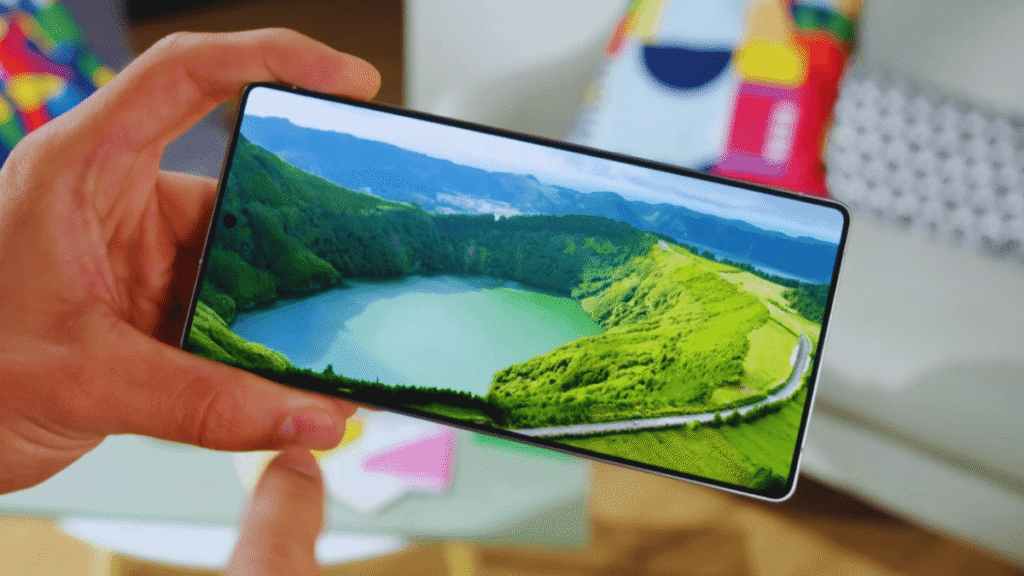
Samsung Galaxy S25 Ultra 6.9-inch AMOLED display with ultra-slim bezels and vivid colors
Samsung Galaxy S25 Ultra Display – Stunning 6.9-Inch AMOLED Screen

Display Technology

One of the standout Galaxy S25 Ultra features is its stunning Dynamic LTPO AMOLED 2X display, which offers vibrant colors and deep blacks.

The screen supports an adaptive refresh rate from 1 to 120 Hz, ensuring smooth scrolling and animations while helping to conserve battery life.

For an enhanced viewing experience, it supports HDR10+, delivering rich contrast and vivid visuals.

The display is protected by Corning Gorilla Armor 2 and features an anti-glare coating that significantly reduces reflections, making it easy to use even in bright sunlight.

Brightness

A key highlight among the Galaxy S25 Ultra features is its impressive peak brightness of 2,600 nits. This ensures that the screen stays clear and easily visible even outdoors under direct sunlight.

Combined with the advanced anti-glare coating, the display minimizes reflections, making it comfortable to use in bright environments.

The S25 Ultra’s display delivers outstanding brightness, smooth motion, and excellent anti-glare properties — perfect for everything from photography to gaming in any lighting condition.

 Software & UI Changes (User Interface )

Software

One of the standout Galaxy S25 Ultra features is its software. It runs on Android 15 with One UI 7, offering a smooth and smart experience. With built-in Galaxy AI and a promise of 7 years of updates, including security and new features, the S25 Ultra is built to stay fast, safe, and future-ready.

UI Changes

One of the key Galaxy S25 Ultra features is the updated user interface with One UI 7 and One UI 8.

It brings a cleaner Samsung DeX layout, smoother notifications and quick settings, and a refreshed media player.

You’ll notice larger lock screen widgets, customizable app icon sizes, and a more intuitive Quick Share experience.

It also improves multitasking with new split-screen controls, and even updates small details like the battery icon and charging animation for a more polished look.


S25 Ultra Camera Specs Explained

Rear Camera Setup & New Sensors

The Galaxy S25 Ultra builds on its predecessor with a refined quad-camera system, including a 200MP main sensor, a 50MP 5x periscope telephoto, a 10MP 3x telephoto, and a much-improved 50MP ultrawide sensor—a notable upgrade from the 12MP ultrawide on the S24 Ultra.

All lenses feature OIS, and laser autofocus ensures fast, accurate focusing. With 2x, 3x, 5x, and 10x optical-quality zoom and up to 100x digital zoom, you can capture every detail.

The phone supports 8K video recording at 30fps, and the 12MP front camera delivers sharp selfies.

Enhanced by Galaxy AI features like Circle to Search and Nightography, the S25 Ultra offers a smarter, more versatile photography experience.

Zoom, Night Mode & AI Enhancements

The Galaxy S25 Ultra supports up to 100x zoom, including 3x, 5x optical and AI-powered 10x zoom, for clear shots at any distance.

Night Mode and Nightography Zoom enhance low-light photos with better clarity.

Galaxy AI improves scene detection and features like Circle to Search, making the camera smarter and more intuitive.

 Front Camera & Video Recording Features

The Galaxy S25 Ultra comes with a 12MP front camera that captures sharp selfies and supports 4K video at 60fps.

On the back, it records 8K video at 30fps, along with slow-motion and super steady modes for smooth, cinematic shots.

AI enhancements boost facial details, lighting, and focus during video calls and recordings.


Samsung S25 Ultra Performance Overview

Processor & RAM

The Samsung S25 Ultra performance is faster and smoother than ever, thanks to the new Snapdragon 8 Elite for Galaxy processor.

Apps open quickly, games run without lag, and everything feels super responsive.

With up to 12GB of RAM, the phone can easily handle multitasking, video editing, and more — all while staying cool and efficient.

Gaming, Multitasking & Thermal Control

Gaming

The Samsung S25 Ultra performance delivers a smooth gaming experience, even with graphics-heavy titles.

You can play on high settings with no lag or frame drops, making it perfect for mobile gamers.

Multitasking

Thanks to the powerful processor and up to 12GB of RAM, multitasking is fast and seamless.

You can switch between apps, edit videos, and browse the web all at once — without slowing down.

Thermal Control

Even during long gaming or work sessions, the phone stays cool. Improved thermal control prevents overheating.

so the performance remains steady and the phone feels comfortable in your hands.

 Battery Life & Charging Speed

The Samsung S25 Ultra performance is backed by a powerful 5000mAh battery, giving you up to 31 hours of video playback on a single charge.

It supports Super Fast Charging 2.0 at 45W via USB-C, which takes you from 0 to 100% in about 55–60 minutes.

Need to go wireless? The S25 Ultra also supports 15W wireless charging, reaching full charge in roughly 90–110 minutes.

Whether you’re gaming, streaming, or multitasking, the battery and charging performance easily keep up with your day.


Should You Buy Galaxy S25 Ultra?

 Who It’s Best For

If you’re wondering should you buy Galaxy S25 Ultra, this phone is perfect for users who want top-tier performance, a versatile camera system, and long-term software support.

It’s ideal for gamers, photographers, and power users who need a device that handles multitasking and heavy apps smoothly.

If you value a premium build with a large, bright display and smart AI features, the S25 Ultra is a solid choice.

Key Strengths & Weak Points

Key Strengths

The Samsung Galaxy S25 Ultra offers powerful performance with its Snapdragon 8 Elite chip and a versatile 200MP camera enhanced by smart AI features.

It boasts a long-lasting 5000mAh battery that supports up to 31 hours of video playback.

The phone features a slim, durable titanium frame with tough Gorilla Armor 2 glass and IP68 water resistance. Its large 6.9-inch AMOLED display with 120Hz refresh rate delivers smooth visuals,

while the built-in S Pen enhances productivity. Plus, Galaxy AI helps make everyday tasks smarter and easier.

Weak Points

If you’re wondering should you buy Galaxy S25 Ultra, keep in mind a few drawbacks. The S-Pen lost its Bluetooth functions, limiting some smart features.

The phone sticks with a 5x optical zoom instead of the better 10x zoom found on earlier models. Battery life feels similar to past versions, and some users report overheating during heavy use.

The camera shutter can be slow, and the new AI features are sometimes seen as overhyped.

Plus, the design is quite minimal and similar to before, while the high price may not feel fully justified for some.

Final Recommendation

You should buy Galaxy S25 Ultra,

If you want a top-tier smartphone with cutting-edge performance, an incredible 200MP camera, a vibrant 120Hz AMOLED display, and long-term software support, this phone is a fantastic choice.

It’s perfect for power users, photographers, and anyone who values a premium design combined with smart AI features.

The built-in S Pen and strong battery life with up to 31 hours of video playback make it a versatile device for work and play.

You shouldn’t buy Galaxy S25 Ultra,

if you’re on a budget or don’t need the absolute latest specs. The design is quite similar to previous models, the S-Pen lost some handy Bluetooth features, and the 5x optical zoom might disappoint if you wanted more advanced camera zoom.

Also, some users experience overheating and slower camera response, so if those are deal-breakers, you may want to consider other options.

But, If you are a students and looking for affordable alternatives, Redmi smartphones remain a popular choice thanks to their competitive pricing and solid performance.

To know more details about Redmi, here’s a detailed post that explains whether Redmi is a smartphone or just another Android phone.


Pricing, Variants & Availability

Regional Price Comparison

United States

  • Price Range: $999 – $1,459

  • Retailers: Available through Samsung’s official U.S. website, Amazon, Best Buy, and other major retailers.

  • Offers: Discounts and trade-in deals are often available, with prices varying based on storage capacity and retailer.

Europe

  • Price Range: €991 – €1,469

  • Retailers: Available through Samsung’s official European stores and authorized retailers.

  • Offers: Prices vary by country and retailer, with occasional promotions and trade-in options.

Storage & Color Options

The Samsung Galaxy S24 Ultra offers a range of storage choices and stylish colors to match your performance and aesthetic preferences.

Whether you’re into photography, gaming, or multitasking, there’s a variant that fits.

Storage Variants:

  • 256GB with 12GB RAM

  • 512GB with 12GB RAM

  • 1TB with 12GB RAM

Color Options:

Standard Colors:
    • Titanium Gray

    • Titanium Black

    • Titanium Violet

    • Titanium Yellow

Exclusive Samsung.com Colors:

  • Titanium Blue

  • Titanium Green

  • Titanium Orange

These options make the Galaxy S24 Ultra not just powerful, but also customizable to your personal style — a true reflection of the Galaxy S24 Ultra features and premium design.


Galaxy S25 Ultra vs Previous Models

S25 Ultra vs S24 Ultra

The Samsung Galaxy S25 Ultra refines what made the Galaxy S24 Ultra great. It keeps the same 200MP camera but adds smarter AI zoom and better night shots. However, it replaces the 10x optical zoom with a 5x lens, which may disappoint some.

Performance gets a boost with the new Snapdragon 8 Gen 4, improving speed over the S24 Ultra’s Gen 3 chip. You also get longer software support and Galaxy AI tools like Note Assist and Live Translate, which weren’t as advanced on the S24.

Design-wise, the S25 Ultra is slimmer and uses tougher Gorilla Armor 2 glass. But if you already own the S24 Ultra, the upgrade is only worth it if you want better AI, newer software, and slightly better efficiency.
You might also be interested in the Galaxy Z Flip7 or Z Fold7, Samsung’s latest foldable phones offering a completely different experience in 2025.

What Has Actually Changed?

The S25 Ultra brings a faster Snapdragon 8 Gen 4 chip, smarter Galaxy AI, and 7 years of updates. It’s slimmer and tougher with Gorilla Armor 2.

However, it drops the 10x zoom for 5x and keeps a similar design. A solid upgrade, but not a huge leap from the S24 Ultra.

Frequently Asked Questions (FAQ)

1. Is the Samsung Galaxy S25 Ultra worth buying in 2025?

Yes, the Samsung Galaxy S25 Ultra is worth buying in 2025 for its top-tier performance, advanced AI, enhanced cameras, and strong 5,000 mAh battery with fast charging. It also features a slim, premium design. Best suited for users upgrading from older models—not ideal for recent S24 Ultra users.

If you have any doubts, you can also check out the official Samsung YouTube channel for more information and hands-on videos.

2. What are the key features of the Galaxy S25 Ultra?

The Galaxy S25 Ultra features include a 200MP main camera, Snapdragon 8 Gen 4 processor, brighter display with 2,600 nits peak brightness, AI editing tools, and a slimmer titanium design.

3. How good is the S25 Ultra’s camera?

The S25 Ultra camera specs include a 200MP wide lens, 50MP 5x telephoto, 10MP 3x telephoto, and 12MP ultrawide lens—plus a 12MP front camera with 4K video. AI tools improve zoom, night mode, and image quality.

4. How does the Samsung S25 Ultra perform in real use?

The Samsung Galaxy S25 Ultra offers smooth performance, long battery life with fast charging, and a powerful 200 MP camera enhanced by AI. Its precise S Pen, slim design, and bright 120Hz display make it great for everyday use.

5. Should you buy the Galaxy S25 Ultra?

If you want top performance, excellent cameras, long battery life, and a sleek design, the Galaxy S25 Ultra is a great choice—especially if you’re upgrading from an older model. However, if you already have the S24 Ultra, the upgrade may not be essential.


Conclusion

The Samsung Galaxy S24 Ultra is a strong and reliable phone with great performance and smart features. It has a beautiful screen, long battery life, and an advanced camera system, which makes it a great choice for many users.

If you like using the S Pen, taking high-quality photos, and want a phone that will last for years, the Galaxy S24 Ultra features are worth it. But if you already have the S23 Ultra or don’t need top-level specs, the changes might not feel big enough.

To sum up this Samsung Galaxy S24 Ultra review, it’s not a huge upgrade but still one of the best phones of 2025. The S24 Ultra camera specs and Samsung S24 Ultra performance are impressive. Before buying, think about your needs — and ask yourself: Should you buy the Galaxy S24 Ultra, or wait for something newer?